
TL;DR
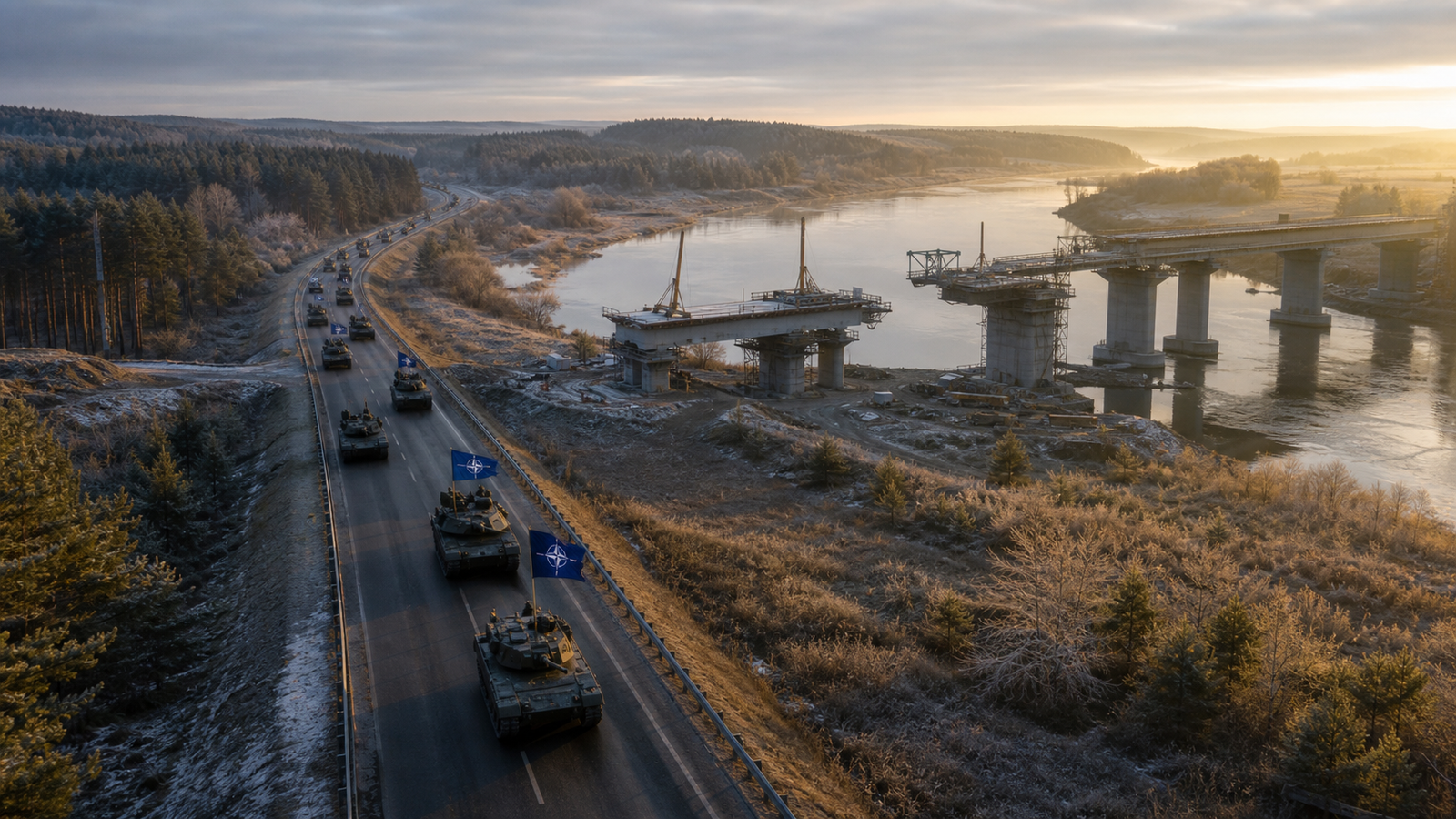
NATO’s Eastern Flank is undergoing its most significant strategic realignment since the Cold War. As the United States reduces its European commitment, frontline states stretching from the Baltics to Romania face an emboldened Russia that uses grey zone tactics, including drone incursions, infrastructure sabotage, and disinformation, to destabilise the alliance below the threshold of open conflict. Sweden and Finland’s accession has widened the flank’s defensive perimeter, but critical gaps in decision-making speed, sustainment, and infrastructure such as Rail Baltica remain unresolved. European defence spending is at a 70-year high, creating a major commercial opportunity for firms in aerospace, cybersecurity, and logistics, but also a fiscal crowding-out risk for broader public investment. For businesses and investors, the NATO Eastern Flank is no longer a geopolitical footnote. It is a live risk environment that demands active strategy, not passive observation.
Introduction
A structural shift is underway at the edge of Europe. NATO’s eastern flank, stretching from the Baltic states through Poland to Romania, is no longer simply a military theatre. It is becoming the defining axis of European political economy, trade architecture, and business risk for the decade ahead. This article critically analyses what that redrawing means for corporations, governments, and investors, drawing on strategic research and policy frameworks from leading institutions.
The Strategic Context
Russia’s core objective, as Rosenbach et al. (2026) at Harvard Kennedy School’s Belfer Center confirm, is to fracture the NATO alliance. This objective pursues not outright conquest, but grey zone coercion: drone incursions, infrastructure sabotage, disinformation, and exploitation of political divisions within member states. Within three years, the same report projects a likely escalation toward a limited military incursion on NATO’s northeastern flank, exploiting the window created by reduced U.S. strategic certainty under the Trump administration (Rosenbach et al., 2026).
Niec and Jensen (2024) at the Centre for Strategic and International Studies argue that NATO’s fundamental deterrence logic has shifted from ‘defend by trading space for time’ to forward deterrence, a forward deployment designed to deny any opportunity for Russian aggression from the outset. This is not an incremental adjustment. It constitutes a generational reset of European security architecture.
The Globsec 2026 Annual Battle Readiness Report identifies a ‘clear divide’ between pre-delegated decision systems (Finland, Estonia, and Poland) and sequential frameworks that require cross-national coordination before troops can mobilise (Nagy, cited in Breaking Defense, 2026). This gap in political agility, the report warns, is itself a strategic liability.
The Political Realignment
Three political realities now converge on Europe’s eastern frontier.
First, American strategic withdrawal is structural, not cyclical. The Trump administration’s 2025 National Security Strategy deprioritises Europe and frames migration, not Russia, as the primary security concern (Rosenbach et al., 2026). European capitals can no longer anchor their defence plans to automatic U.S. intervention. As Ras-NSA (2025) notes, small states on the eastern flank face acute vulnerability precisely because they built deterrence models around a Washington guarantee that is now conditional.
Second, Sweden and Finland’s integration into NATO has extended the alliance’s defensive perimeter into the Arctic and the Baltic Sea, a shift that qualitatively changes the strategic calculus for Russia. The International Institute for Strategic Studies confirms that frontline states now face growing grey zone threats including UAV incursions and state-sponsored sabotage (IISS, 2026). These fall below the Article 5 threshold by design, forcing governments to respond outside the collective defence framework.
Third, the EU’s Readiness 2030 initiative signals that Brussels now treats defence as an economic policy instrument. The European Commission’s accompanying white paper explicitly calls for pairing higher spending with faster, coordinated procurement, a structural departure from the post-Cold War consensus that separated civilian EU institutions from military affairs (Rosenbach et al., 2026).
The Business Imperative
The strategic shift carries direct and traceable consequences for the private sector across multiple dimensions.
Supply Chains and Infrastructure
Rail Baltica, an 870-kilometre rail network connecting Estonia, Latvia, and Lithuania with Poland, carries a price tag exceeding 15 billion euros and is critical for wartime logistics (Globsec, cited in Breaking Defense, 2026). Latvia’s portion will not meet its 2030 deadline, with completion now projected closer to 2035. For logistics firms, manufacturers, and energy companies operating across Eastern Europe, infrastructure delays compound geopolitical risk. Supply chain resilience strategies must now account for degraded transit corridors in worst-case scenarios.
Defence Industrial Opportunity
Military spending by European NATO members rose faster in 2024 to 2025 than at any time since 1953 (Euronews, 2026). The OECD (2026) confirms that defence expenditure generates short-run demand multipliers, though it also warns that crowding out of productive private investment becomes a risk when defence draws heavily on the same labour and capital pools as civilian sectors. KPMG’s Central and Eastern Europe analysis (2026) identifies the region as the ‘new centre of gravity’ for European defence manufacturing, driven by sustained procurement increases and a strategic shift from one-off purchases to continuous production cycles.
The IMF’s April 2026 World Economic Outlook finds that defence spending allocated toward investment components, rather than personnel, generates the strongest positive spillovers for broader economic growth (IMF, 2026). For firms in aerospace, cybersecurity, drone technology, and advanced materials, the eastern flank’s rearmament cycle represents a generation-defining commercial opportunity.
Financial and Investment Risk
Investors must price a new category of geopolitical premium into Eastern European assets. Rosenbach et al. (2026) outline a plausible scenario in which Russia seizes a symbolically significant border city, such as Narva, Estonia, using unmarked forces before NATO reaches political consensus on an Article 5 response. Such an event would not merely create humanitarian consequences; it would restructure sovereign risk premiums, insurance markets, and foreign direct investment flows across the entire region overnight. The OECD (2026) further notes that governments financing defence through debt rather than taxation reduce fiscal space for growth-oriented public investment, compressing the longer-run outlook for markets that depend on public infrastructure spending.
The Operational Gaps That Matter
Decision-Making Speed
The Globsec DMTI index (2026) reveals that several NATO flank states operate sequential decision chains, including legal triggers, cross-ministerial authority, and parliamentary approvals, that require days, not hours (Nagy, cited in Breaking Defense, 2026). In a grey zone or hybrid attack, this latency is exploitable. For multinationals with assets in the region, business continuity frameworks must now incorporate scenarios where host-state governments are operationally paralysed in the first 48 to 72 hours of an incident.
Sustainment and Logistics
Niec and Jensen (2024) at CSIS identify sustainment, covering maintenance capacity, logistical depth, and transportation infrastructure, as the most critical and most neglected capability gap on the eastern flank. Firms that position themselves as dual-use infrastructure providers or industrial sustainment partners align directly with the alliance’s stated procurement priorities and gain preferential market access in a multi-billion-euro spending cycle.
Strategy Is the New Risk Management
NATO’s eastern flank is no longer a peripheral concern for boardrooms. Rosenbach et al. (2026) argue that Europe’s collective ability to deter aggression will hinge on fielding indigenous capabilities and streamlining political decision-making, both processes that require sustained private-sector partnership. The OECD (2026) and IMF (2026) confirm that how governments fund and structure this spending will determine whether the rearmament cycle creates growth or crowds it out.
For businesses, the immediate priority is not predicting the outcome of NATO-Russia strategic competition. It is building organisations agile enough to operate across multiple scenarios. Firms that treat geopolitical fluency as a core strategic competency, not a compliance function, will define Europe’s next decade of business leadership.
References
Globsec (2026). 2026 Annual Battle Readiness on the Eastern Flank. Bratislava: Globsec Policy Institute. Cited in Breaking Defense, 23 April 2026.
IMF (2026). World Economic Outlook, April 2026: Chapter 2 — Defence Spending: Macroeconomic Implications. Washington DC: International Monetary Fund.
IMF (2026). World Economic Outlook, April 2026: Chapter 2 — Defence Spending: Macroeconomic Implications. Washington DC: International Monetary Fund.
IISS (2026). NATO’s Eastern Flank Faces Growing Russian ‘Grey Zone’ Threats. London: International Institute for Strategic Studies, 8 March 2026.
KPMG (2026). Central and Eastern Europe — The New Centre of Gravity of Europe’s Defence Industry. Bucharest: KPMG Romania, April 2026.
Niec, P. and Jensen, B. (2024). ‘The Future of NATO’s Eastern Flank’, CSIS Analysis. Washington DC: Centre for Strategic and International Studies, October 2024.
OECD (2026). Fiscal and Macroeconomic Impacts of Defence Spending. Paris: Organisation for Economic Co-operation and Development, March 2026.
Ras-NSA (2025). ‘The Perils of Attractiveness: Small States on NATO’s Eastern Flank Facing American Uncertainty’. Ottawa: Royal Alberta Society for National Security Affairs, July 2025.
Rosenbach, E., Giannone, C., Ancheva, S., Hillion, L., Lee, E. and Kolodziej, L. (2026). Russian Threats to NATO’s Eastern Flank: Scenarios, Strategy, and Policy for European Security. Cambridge, MA: Belfer Center for Science and International Affairs, Harvard Kennedy School, February 2026.



Well researched and engaging. Looking forward to reading more articles on global affairs and strategic trends.