
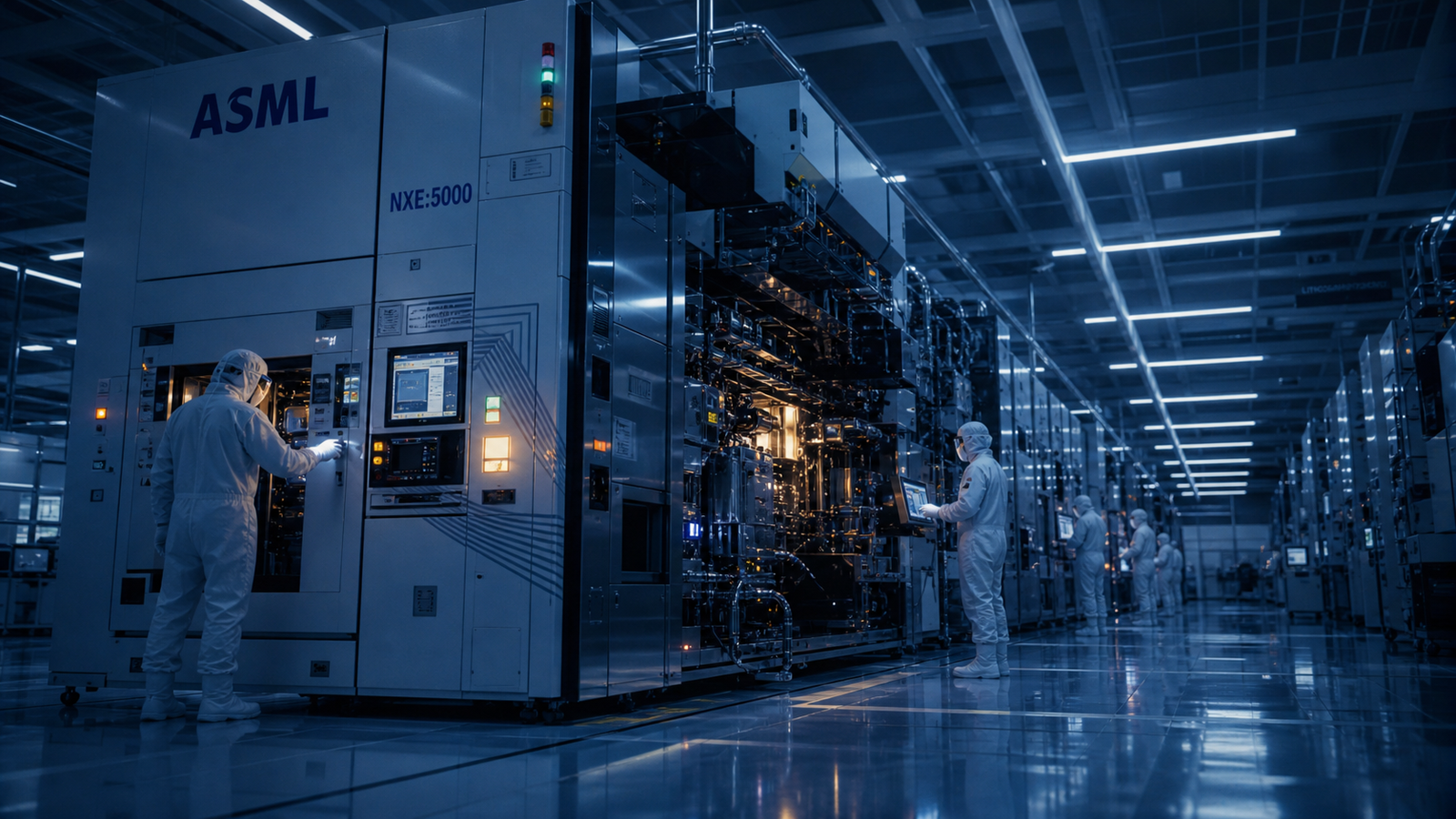
TL;DR By late May 2026, Bloomberg and CNBC had both confirmed that SK Hynix and Micron crossed $1 trillion in market value, following Samsung earlier in the month. That is a market signal, not a headline. It tells us that investors have stopped pricing AI memory chips as commodity hardware and started pricing them as strategic infrastructure. Whether that re-rating holds depends on forces that most business commentary is not yet tracking carefully enough.
From Commodity to Infrastructure: What the Re-Rating Really Signals
Markets do not move the way they did in late May 2026 without a structural reason. Bloomberg reported that SK Hynix surged 9.3 percent in a single session and crossed $1 trillion in market cap on 27 May, while Micron jumped 19 percent in its biggest single-day gain since 2011, triggered partly by a UBS note forecasting the stock could double within a year (Bloomberg, 2026a; CNBC, 2026b). Reuters had already flagged the shift on 13 May, reporting SK Hynix was approaching $1 trillion as AI demand consumed its output (Reuters, 2026).
The most important word in that UBS note is not “double.” It is the framing behind it. Analysts who once modeled memory companies as cyclical commodity producers are now applying infrastructure multiples to them. That is a fundamental change in how capital markets read AI memory chips. Infrastructure assets command higher multiples because their revenue is seen as structurally embedded rather than subject to pure price cycles. When markets start pricing AI memory chips that way, every downstream consequence follows: higher investment, more aggressive supply contracts, and stronger geopolitical attention.
The right question is not whether the valuation is justified. The right question is what it reveals about where AI memory chips now sit in the global value chain. The answer is: at the bottleneck.
Why AI Memory Chips Control the Bottleneck
High-bandwidth memory, or HBM, is the specific class of AI memory chips that makes modern AI compute possible. HBM stacks directly onto AI processors made by Nvidia and others, allowing models to move massive amounts of data at speeds that ordinary DRAM cannot match. Without sufficient HBM supply, even the most advanced AI chips cannot run at full capacity.
CNBC reported in January 2026 that Synopsys CEO Sassine Ghazi said the AI data-center boom had pushed the memory crunch into 2027, because new fabrication facilities need a minimum of two years from construction to first production wafer (CNBC, 2026a). That timeline mismatch between surging AI demand and slow supply response is the core economic fact driving everything else in this story.
Porter’s Five Forces framework clarifies why this matters for business strategy. Supplier power in AI memory chips is exceptionally high: only Samsung, SK Hynix, and Micron can produce advanced HBM at scale. Entry barriers are severe because the capital requirement for a leading-edge fab exceeds $20 billion and the process know-how takes decades to build. Buyer power is weak in this environment because firms that need AI memory chips to run their AI roadmap cannot easily walk away or substitute the input. That is a structurally powerful position for the three incumbents.
The Spillover That Most Analysts Are Missing
AI memory chips do not just affect AI companies. When wafer capacity moves toward high-margin HBM production, it leaves less capacity for the conventional memory used in smartphones, PCs, automobiles, and industrial equipment. Oxford Economics confirmed in January 2026 that the diversion of capacity toward AI applications was actively weighing on supply chains in those adjacent sectors (Oxford Economics, 2026).
Tech Wire Asia reported in February that the global memory shortage was expected to push smartphone average selling prices up 6.9 percent in 2026, with DRAM contract prices forecast to jump 90 to 95 percent quarter on quarter in the first quarter of the year and NAND prices rising 55 to 60 percent over the same period (Tech Wire Asia, 2026). Bill-of-materials costs for low-end phones had already risen 25 percent since early 2025 (Tech Wire Asia, 2026). For budget smartphone manufacturers in South and Southeast Asia, that is not a rounding error. That is an existential margin pressure.
The automotive sector faces a similar dynamic. AI-driven infotainment, driver assistance, and vehicle computing all require memory components. When AI memory chips absorb supply, automotive procurement teams find themselves competing against data-center buyers with far deeper pockets and more urgent timelines. This is exactly the supply-chain logic that Resource Dependence Theory describes: when a critical input becomes scarce, firms that depend on it must either secure supply directly or accept strategic vulnerability.
The Geopolitical Dimension That Governments Are Acting On
AI memory chips are no longer just an industry story. They are a national security issue. The manufacturing capability for HBM sits almost entirely in South Korea, with Samsung and SK Hynix controlling the bulk of global output. Taiwan plays a critical role in advanced packaging. The United States controls chip design ecosystems and has used export control rules to restrict HBM shipments to China, extending those rules to cover South Korean producers as well (Reuters, 2026).
That means Washington now influences whether South Korean companies can sell AI memory chips to Chinese buyers. This is a profound shift from the normal logic of international trade. John Dunning’s OLI framework helps explain the original structure: ownership advantages sit with firms that hold the technical know-how, location advantages sit with East Asian manufacturing clusters, and internalization decisions shape how firms protect their position. But the OLI model was built for a world where market forces drove location decisions. In AI memory chips, state power now intervenes directly in all three dimensions.
The EU Chips Act, the US CHIPS and Science Act, and India’s semiconductor incentive program all reflect the same strategic anxiety: dependence on a handful of factories in one region for the world’s most critical technology input is a geopolitical risk that governments can no longer ignore. The race to build domestic capacity is expensive and slow, but the political will behind it is real.
What the Bears Get Right: Counter-Pressure That Matters
Any serious analysis of AI memory chips must also confront the counter-case, because the semiconductor industry has a well-documented history of turning shortage into glut.
TechInsights noted in November 2025 that the memory market had just recovered from a severe 2023 downturn, when first-quarter memory inventory reached 31 weeks of forward supply and both DRAM and NAND prices collapsed. Industry data confirmed that DRAM revenue fell 33.2 percent from 2022 to 2023 while flash revenue dropped 39 percent in one of the sharpest memory downturns on record (TechInsights, 2025; StorageNewsletter, 2024). The AI memory chip boom of 2026 follows directly from that bust. History says the cycle does not stop at the peak.
A second counter-pressure is AI efficiency. The more that model developers optimize training and inference workloads, the less memory each task requires per unit of output. If efficiency gains outpace new AI application demand, the scarcity premium on AI memory chips narrows. This is not a theoretical risk. It is the normal trajectory of any technology as it matures.
China presents a third counterforce. Reports on CXMT, the Chinese state-backed memory producer, indicate it is targeting HBM3 capability, but its progress has hit technical walls because it lacks access to the foreign equipment needed for the most advanced process steps (Fudzilla, 2026; LinkedIn, 2025). That delay protects incumbents for now. It does not protect them permanently.
Three Scenarios and What They Mean for Strategy
Based on current evidence, three scenarios deserve structured attention.
The first scenario, assigned a probability of around 55 percent, is continued tightness through 2027. CNBC reported that Synopsys leadership expected the shortage to persist at least that long given the pace of AI infrastructure investment and the lead times on new capacity (CNBC, 2026a). Under this scenario, AI memory chips remain bottleneck assets, hyperscalers accelerate long-term supply agreements, procurement strategies shift from just-in-time to forward-committed, and the strategic leverage held by Samsung, SK Hynix, and Micron grows further.
The second scenario, assigned a probability of around 30 percent, is managed normalization by late 2027 or early 2028. TechInsights observed that pricing dynamics in the memory market were already bifurcating, with HBM commanding a sustained premium while standard DRAM pricing softened (TechInsights, 2025). In this scenario, the market segments cleanly between AI memory chips and commodity memory, supply gradually catches up with demand, and the extraordinary pricing power of incumbents moderates without collapsing.
The third scenario, assigned a probability of around 15 percent, is a faster unwind driven by some combination of AI demand normalization, accelerated efficiency gains, and faster-than-expected Chinese catch-up. The current evidence does not support this as a near-term base case. Bloomberg, Reuters, and CNBC all describe a market where scarcity and leverage remain the dominant forces (Bloomberg, 2026a; Reuters, 2026; CNBC, 2026a). But the 2023 downturn is a useful reminder that markets can move faster than forecasts.
What Business Leaders Should Do With This
AI memory chips are now a board-level risk category, not a procurement detail. The implication of everything above is that firms building serious AI strategies need to treat memory access the way energy-intensive businesses treat fuel security: as a governed dependency with pricing risk, concentration risk, and geopolitical risk attached.
Three moves are already visible among companies taking this seriously. First, forward procurement: hyperscalers like Microsoft, Google, and Amazon are locking in supply years ahead, tying up working capital but securing their AI development timelines. Second, supply-chain diversification: firms are co-investing in new fab capacity in exchange for guaranteed allocations, a direct application of Resource Dependence Theory in practice. Third, architecture review: engineering teams are auditing how much AI memory each workload actually consumes, looking for efficiency gains that reduce exposure to the supply constraint.
None of these moves eliminate the risk. But firms that make them deliberately will navigate the AI memory chip environment better than firms that treat it as someone else’s problem. The $1 trillion valuations of Samsung, SK Hynix, and Micron are not just a financial story (Bloomberg, 2026a; CNBC, 2026b; Reuters, 2026). They are a signal about where leverage now sits in the global AI economy. The firms and governments that read that signal early will be better positioned than those that read it late.
References
Bloomberg (2026a) Memory Chip Frenzy Pushes SK Hynix, Micron Into $1 Trillion Club, 27 May. Available at: https://www.bloomberg.com/news/newsletters/2026-05-27/memory-chip-frenzy-pushes-sk-hynix-micron-into-1-trillion-club (Accessed: 27 May 2026).
CNBC (2026a) Memory chip shortage to last through 2027, semiconductor boss says, 26 January. Available at: https://www.cnbc.com/2026/01/26/memory-chip-shortage-synopsys-lenovo-ai-data-centers.html (Accessed: 27 May 2026).
CNBC (2026b) CNBC Daily Open: The $1 trillion club just got bigger, 27 May. Available at: https://www.cnbc.com/2026/05/27/sk-hynix-micron-join-1-trillion-club-cnbc-daily-open.html (Accessed: 27 May 2026).
Fudzilla (2026) CXMT hits a wall on HBM3, 20 April. Available at: https://fudzilla.com/cxmt-hits-a-wall-on-hbm3/ (Accessed: 27 May 2026).
LinkedIn (2025) CXMT targets HBM3 by 2026 amid US chip trade tensions, 20 August. Available at: https://www.linkedin.com/posts/marcomezger_ai-hbm-aitraining-activity-7364196758815473665-TRwy (Accessed: 27 May 2026).
Oxford Economics (2026) Global memory chip shortages continue to weigh on supply chains, 18 January. Available at: https://www.oxfordeconomics.com/resource/global-memory-chip-shortages-continue-to-weigh-on-supply-chains/ (Accessed: 27 May 2026).
Reuters (2026) AI boom puts SK Hynix on cusp of $1 trillion market value, 13 May. Available at: https://www.reuters.com/world/asia-pacific/ai-boom-puts-sk-hynix-cusp-1-trillion-market-value-2026-05-14/ (Accessed: 27 May 2026).
StorageNewsletter (2024) 2023 NAND Flash Market Declining Y/Y at 40% on $36.7 Billion, 4 April. Available at: https://www.storagenewsletter.com/2024/04/05/2023-nand-flash-market-declining-y-y-at-40-on-36-7-billion/ (Accessed: 27 May 2026).
Tech Wire Asia (2026) Memory chip shortage to push smartphone prices up 7% in 2026, 10 February. Available at: https://techwireasia.com/2026/02/memory-chip-shortage-smartphone-prices-asia-2026/ (Accessed: 27 May 2026).
TechInsights (2025) The Chip Insider: DRAM Super-Cycle?, 20 November. Available at: https://www.techinsights.com/blog/chip-insiderr-dram-super-cycle (Accessed: 27 May 2026).



👍👍