
Competitive advantage is the set of conditions that lets one business earn more, or earn more consistently, than its rivals in the same market. A firm holds a competitive advantage when it delivers value to customers that competitors cannot match at the same cost, or matches that value at a lower cost than competitors can achieve. The advantage shows up in the figures that matter most to any business: higher margins, steadier sales, or both together.
Consider Solheim Cycles, a bicycle manufacturer based in Bergen, Norway. Solheim builds touring and commuter bicycles from hand-welded steel frames, sells them through independent bicycle shops across Northern Europe, and competes directly against large importers that sell bicycles which overseas factories mass-produce. Solheim charges more than these importers for a bicycle that, on paper, performs a similar function: it moves a rider from one place to another. Yet Solheim has grown for eleven consecutive years, its retailers report waiting lists during peak season, and its profit margin per bicycle sits well above the industry norm. Something about how Solheim operates gives it a competitive advantage over larger and better-funded rivals, and the rest of this article uses Solheim to show where that advantage comes from, how the company builds it, how it defends it, and how it eventually erodes.
Table of Contents
The Two Sources of Competitive Advantage
Strategy researchers, most notably Michael Porter, trace competitive advantage to exactly two directions: cost and differentiation (Porter, 1985). A firm builds a cost advantage when it produces a comparable product at a lower cost than its rivals, a position that lets it either undercut them on price or hold price steady and keep a wider margin. A firm builds a differentiation advantage when it offers something rivals cannot easily copy, such as superior quality, a stronger brand, or a design that fits customer needs more precisely, a position that lets it charge a premium customers willingly pay.
A single company can pursue both paths, though Porter (1985) warns that a firm chasing both at once, without a clear priority between them, risks satisfying neither strategy fully. Solheim Cycles illustrates the point well. Its central competitive advantage rests on differentiation: a patented frame-welding process that produces a stiffer, longer-lasting frame than mass-produced alternatives, and it carries a lifetime warranty that few importers can afford to offer. At the same time, Solheim spent the past three years lowering its production costs, not to become the cheapest bicycle on the market, but to widen the margin that its differentiation already earns. The next two sections work through each source of advantage using Solheim’s own figures.
Building a Cost Advantage Through Economies of Scale
Solheim’s manufacturing costs split into two parts: fixed costs, such as factory lease, equipment depreciation, and salaried staff, which do not change with the number of bicycles produced, and variable costs, such as steel tubing, components, and hourly labor, which rise with each additional bicycle built. Assume Solheim’s fixed manufacturing costs total $2,000,000 per year when the factory runs a single shift with capacity for up to 30,000 bicycles, and assume each bicycle costs $120 in variable inputs at that shift’s purchasing volume.
At an annual production volume of 20,000 bicycles, the fixed cost per bicycle equals $2,000,000 divided by 20,000, or $100. Adding the $120 variable cost gives a total cost of $220 per bicycle.
In 2025, Solheim added a second production shift, which raised annual capacity to 40,000 bicycles. The extra shift required additional supervisors and maintenance staff, which raised fixed costs to $2,400,000 per year, while the larger purchasing volume qualified Solheim for a bulk discount on steel tubing that lowered the variable cost per bicycle from $120 to $110.
At the new volume of 40,000 bicycles, the fixed cost per bicycle equals $2,400,000 divided by 40,000, or $60. Adding the $110 variable cost gives a total cost of $170 per bicycle, a full $50 lower than before the expansion, even though Solheim kept its selling price unchanged at $400 per bicycle.
Table 1: Solheim Cycles cost per bicycle, before and after the second shift
| Metric | Before expansion (20,000/yr) | After expansion (40,000/yr) |
| Fixed cost per bicycle | $100 | $60 |
| Variable cost per bicycle | $120 | $110 |
| Total cost per bicycle | $220 | $170 |
| Selling price per bicycle | $400 | $400 |
| Profit per bicycle | $180 | $230 |
| Profit margin | 45.0% | 57.5% |
Figure 1 extends this arithmetic across a wider range of production volumes, holding the same assumptions about fixed cost, variable cost, and the two step changes that occur once volume passes 30,000 bicycles a year.
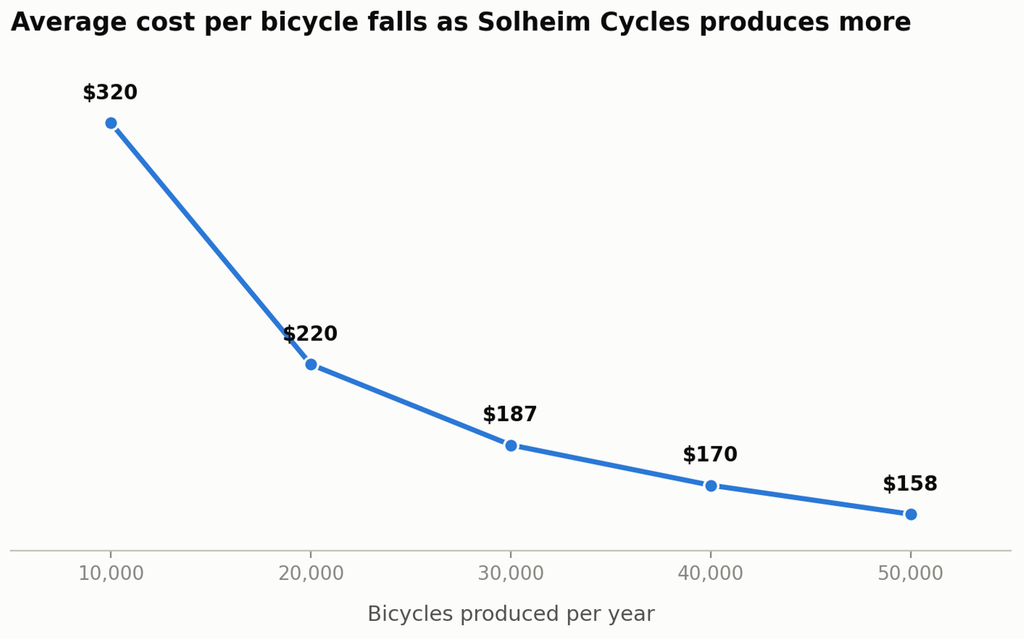
The curve drops sharply between 10,000 and 20,000 bicycles, keeps falling more gradually after that, and steps down again once the second shift and the bulk discount take effect at 30,000 units. Beyond that point, extra volume still lowers average cost, but at a slower rate, because the fixed costs are already spread thin across a large number of units. Economists call this pattern, in which average cost falls as output rises, an economy of scale (Loo, 2019), and it forms one of the two basic routes to competitive advantage introduced above.
Building a Differentiation Advantage Through Product Quality
Solheim’s more consequential competitive advantage, however, is not its cost position but its differentiation. Assume a generic mass-market importer sells a comparable-looking bicycle for $180 and pays $150 to produce and import each unit. That importer earns a profit of $180 minus $150, or $30 per bicycle, for a profit margin of $30 divided by $180, or 16.7%. Solheim, using the pre-expansion figures set out above, sells its bicycle for $400 and spends $220 to produce it, for a profit of $400 minus $220, or $180 per bicycle, and a profit margin of $180 divided by $400, or 45.0%.
Table 2: Profit comparison between Solheim Cycles and a generic importer
| Metric | Solheim Cycles (differentiation) | Generic importer (cost-focused) |
| Selling price | $400 | $180 |
| Cost per unit | $220 | $150 |
| Profit per unit | $180 | $30 |
| Profit margin | 45.0% | 16.7% |
Solheim earns six times the profit per bicycle that the importer earns, and it earns that profit despite a cost base roughly 47% higher, because customers buying a Solheim bicycle rarely compare it to the importer’s bicycle on price alone. They are paying for a frame that carries a lifetime warranty, a welding process that few competitors hold a license to replicate, and a brand that three decades of dependable products have built. This is what a differentiation advantage looks like in practice: it does not require the lowest cost in the market, only a gap between what customers will pay and what the product costs to make, a gap that rivals cannot easily close.
Why a Competitive Advantage Must Be Difficult to Copy
A competitive advantage that a rival can copy within a season is not much of an advantage at all. Barney (1991) identifies four conditions that a resource must satisfy for the competitive advantage it creates to last: the resource must be valuable, rare among competitors, costly for competitors to imitate, and without an equally effective substitute available to those competitors.
Solheim’s frame-welding process meets all four conditions for now. The process is valuable, since it produces a stiffer frame that customers notice and warranty records confirm. It is rare, since Solheim holds the only license to use it in Northern Europe. It is costly to imitate, since a patent blocks direct copying and the underlying welding skill takes years to train into a workforce. It also lacks a close substitute, since no alternative frame material at a comparable price point matches its blend of weight and stiffness. Solheim’s brand supplies a second, independent layer of protection: three decades of dependable products have earned a level of customer trust that a new entrant cannot buy or accelerate, regardless of how much it spends on advertising in a single year.
What Erodes a Competitive Advantage
None of these barriers lasts forever, and this is the part of competitive advantage that strategy discussions often skip. Solheim’s frame-welding patent has eleven years of protection remaining; once it lapses, any competitor may legally use the same process, and the exclusivity behind Solheim’s differentiation advantage disappears on that date. Skilled welders who trained under the patent can also leave for a competitor and carry tacit knowledge with them well before the patent expires, which is why Barney (1991) treats “costly to imitate” as a matter of degree rather than a permanent guarantee.
Substitute products pose a second threat that patents cannot block. Electric bicycles have grown from a niche product into a significant share of the commuter bicycle market over the past decade, and an electric bicycle meets the same underlying need, daily transport, in a way that makes frame material a secondary concern for many buyers. If commuters shift their spending toward electric bicycles faster than Solheim adapts its product line, the specific competitive advantage that Solheim built around steel-frame quality becomes less relevant to a shrinking share of the market, no matter how well the company defends it against direct imitation.
McGrath (2013) argues that this pattern, a company defending one advantage until a shift in technology or customer preference makes that advantage irrelevant, has become the norm rather than the exception across most industries. She recommends that firms plan to build and retire several advantages in sequence rather than defend a single one indefinitely. Solheim’s own response illustrates the point: instead of choosing between its steel-frame differentiation and the shift toward electric models, it has begun applying the same patented welding process to a new electric-assisted frame, carrying its hardest-to-copy skill into a second product line before the original advantage fully erodes.
Competitive Advantage Is a Moving Target, Not a Fixed Position
Solheim Cycles shows competitive advantage as a combination rather than a single choice. Its second production shift lowered cost and widened margin; its patented welding process and its brand created a differentiation advantage that customers pay a premium to own; and its patent, its trained workforce, and its reputation slow competitors down long enough to protect that margin, even though none of these barriers holds without limit. A competitive advantage, in short, is not something a company earns once and then keeps by default. It is something a company must keep rebuilding, one product cycle at a time, faster than its competitors imitate it and faster than its customers change what they want.
References
Barney, J. (1991) ‘Firm resources and sustained competitive advantage’, Journal of Management, 17(1), pp. 99–120. Available at: https://doi.org/10.1177/014920639101700108 (Accessed: 31 August 2026).
Loo, A. (2019) Economies of Scale. Corporate Finance Institute. Available at: https://corporatefinanceinstitute.com/resources/economics/economies-of-scale/ (Accessed: 31 August 2026).
McGrath, R.G. (2013) ‘Transient advantage’, Harvard Business Review, June. Available at: https://hbr.org/2013/06/transient-advantage (Accessed: 31 August 2026).
Porter, M.E. (1985) Competitive Advantage: Creating and Sustaining Superior Performance. New York: Free Press.
To read more Click Here