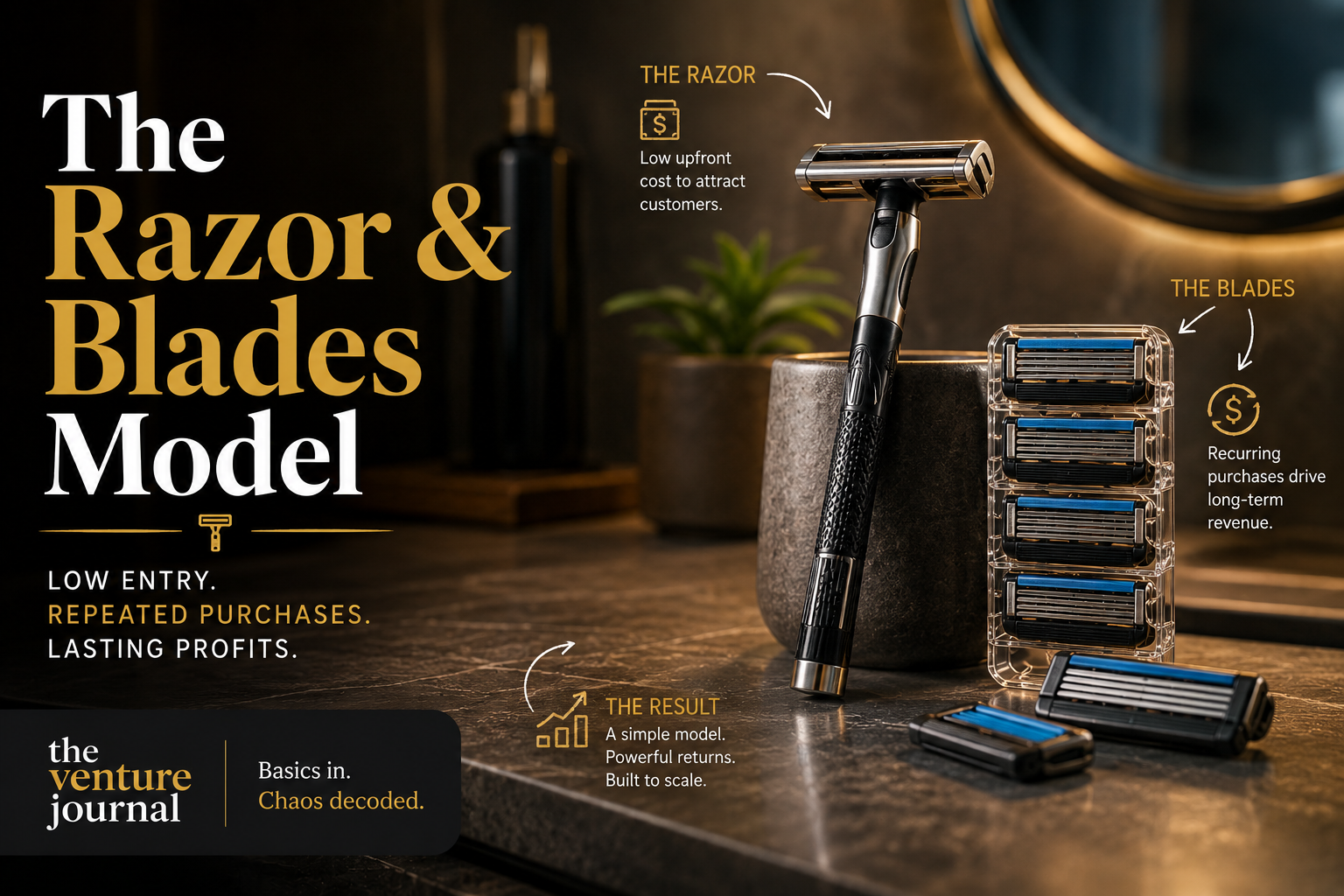
Why would a company want to sell its main product at a loss? The answer is a well known business strategy called the razor-and-blades model. It looks like bad business at first glance, and the numbers make it easy to see why, and why it still works.
The razor-and-blades model is a pricing strategy in which a company sells a durable product at a very low price, sometimes even below its own cost, and earns its real profit from an ongoing consumable product that the durable product requires. To show exactly how and why this works, this article follows a single example, a company named Northline Razors, through one full year of a customer relationship.
Table of Contents
How the Razor-and-Blades Model Works
Northline Razors sells two products: a razor handle, bought once, and blade cartridges, bought again and again. Assume the following prices and costs for each.
| Price charged for the handle | $5 |
| Cost to make the handle | $8 |
| Profit or loss per handle | -$3 |
| Price charged for a blade pack | $12 |
| Cost to make a blade pack | $3 |
| Profit per blade pack | $9 |
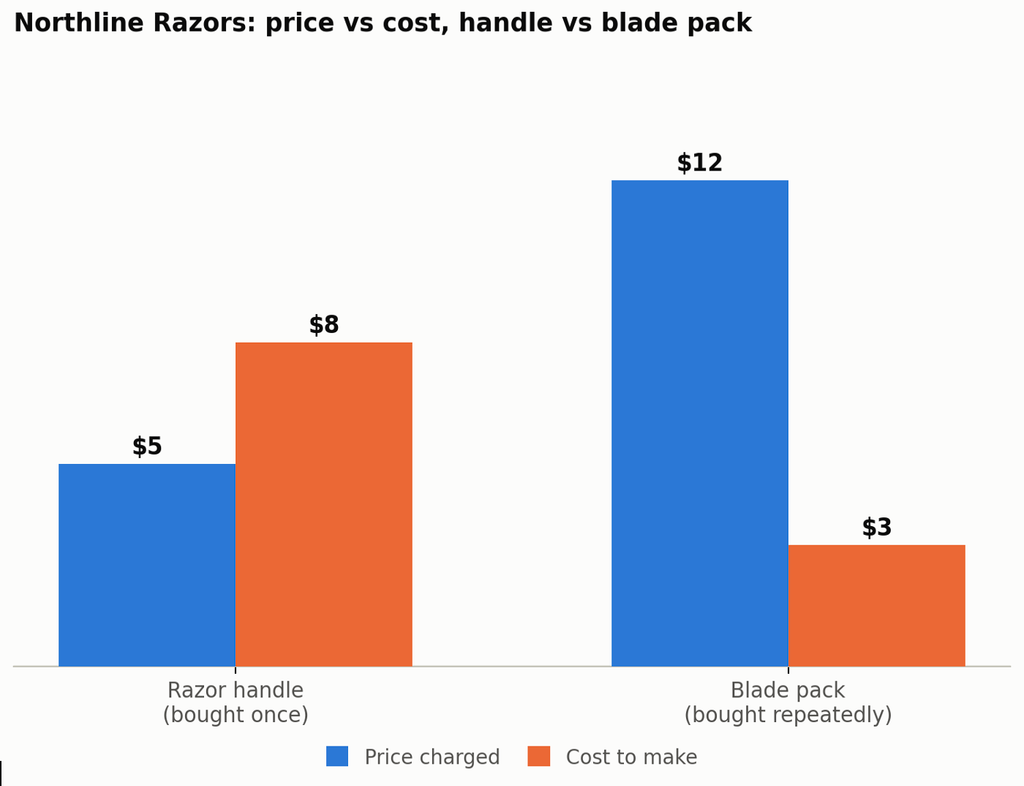
On the handle alone, Northline loses $3 every time it sells one, since it costs $8 to make but sells for only $5. Looked at by itself, this looks like a losing decision. Once a customer starts buying blade cartridges, the picture changes completely. Each blade pack costs Northline $3 to make and sells for $12, a profit of $9 per pack.
Assume a typical customer buys a new blade pack every two months. In month zero, Northline is $3 down from the handle. By month two, the first blade pack brings in $9, putting Northline $6 ahead overall, already past breakeven. Every two months after that adds another $9. By month twelve, after six blade packs, Northline has earned $51 in total profit from that one customer, as the chart below shows.
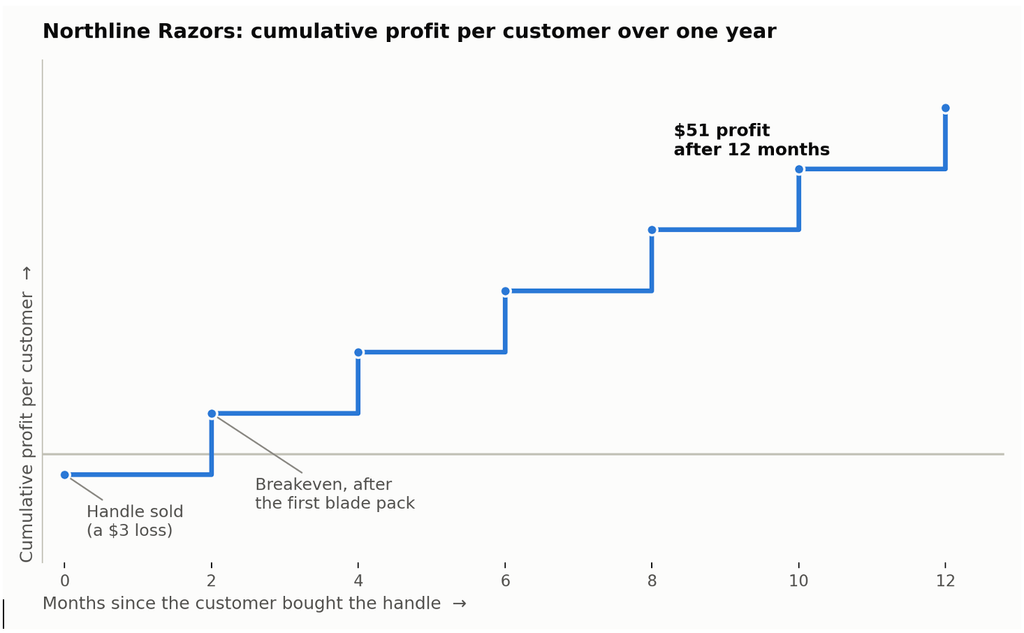
Northline never meant the handle to make money on its own. It exists to get a blade cartridge into a customer’s bathroom, since everything after that first sale is where the real profit of the razor-and-blades model comes from.
Why the Razor-and-Blades Model Works
The razor-and-blades model only works if the customer keeps buying blades from Northline rather than switching to someone else, and two things make that likely. First, Northline designs its blade cartridges to fit only Northline handles, so a customer who wants a compatible refill has nowhere else to go without buying a new handle from a competitor as well. Second, buying a blade pack is a small, routine purchase, not a big decision the customer researches every time, so most customers simply repurchase the same brand out of habit rather than comparing every option.
Both of these depend on the same thing: Northline controls the only convenient supply of the one product the customer actually needs. As long as that control holds, the loss on the handle is really an investment that pays for itself within a couple of months and then keeps paying for the rest of the year.
The Risk: What Can Undo the Razor-and-Blades Model
That control does not always hold. Suppose a competitor starts selling blade cartridges compatible with Northline handles, priced at $6 instead of $12, and a customer switches to the cheaper, compatible option after buying a Northline handle. Northline never earns the $9 per pack it depended on, and the numbers change sharply.
| Annual profit, customer stays with Northline blades | $51 |
| Annual profit, customer switches to a $6 generic blade | -$3 |
Northline still lost $3 on the handle, and now earns nothing from that customer afterward to make up for it. A model built on the assumption of repeated, exclusive blade purchases turns into a straightforward loss the moment that exclusivity disappears. This is why companies using this model spend heavily on patents, proprietary designs, and legal action against compatible refill makers: the model’s profit depends entirely on keeping that one point of control.
Why This Concept Matters
The same logic appears well beyond razors. Printer manufacturers sell printers cheaply and earn their profit from ink cartridges. Gaming console makers often sell hardware near cost and make their profit from game and subscription sales. Coffee machine makers sell machines at a modest margin and profit from the pods that only fit their machine. In every case, the underlying arithmetic is the same as Northline’s: a loss or thin margin on the durable product, recovered and then some through a consumable product the customer keeps needing.
Investors and business students study the razor-and-blades model because it explains why a product’s sticker price often tells you very little about how profitable it actually is. Entrepreneurs consider it when they design new products, since a product that seems to lose money on paper can still be the right choice if it reliably leads to years of profitable repeat purchases.
Final Thoughts
The razor-and-blades model is not a complicated idea once you break it down into its parts. As Northline Razors’ example shows, a company can sell its main product at a real loss and still come out well ahead, as long as it also controls a consumable product the customer needs again and again. The whole model depends on that control holding, and the moment a competitor breaks it, the same arithmetic that made the model profitable can just as easily make it a loss. Understanding both sides of the razor-and-blades model, the payoff and the risk, gives a much clearer view of why some companies price their products the way they do.
References
Picker, R.C. (2011) ‘The Razors-and-Blades Myth(s)’, University of Chicago Law Review, 78(1), pp. 225–255.
Kotler, P. and Armstrong, G. (2023) Principles of Marketing. 19th edn. Harlow: Pearson.
Pahwa, A. (2022) Razor and Blades Business Model Explained. Feedough. Available at: https://www.feedough.com/razor-and-blades-business-model-explained/ (Accessed: 30 August 2026).
For more such reading explore: The Venture Journal