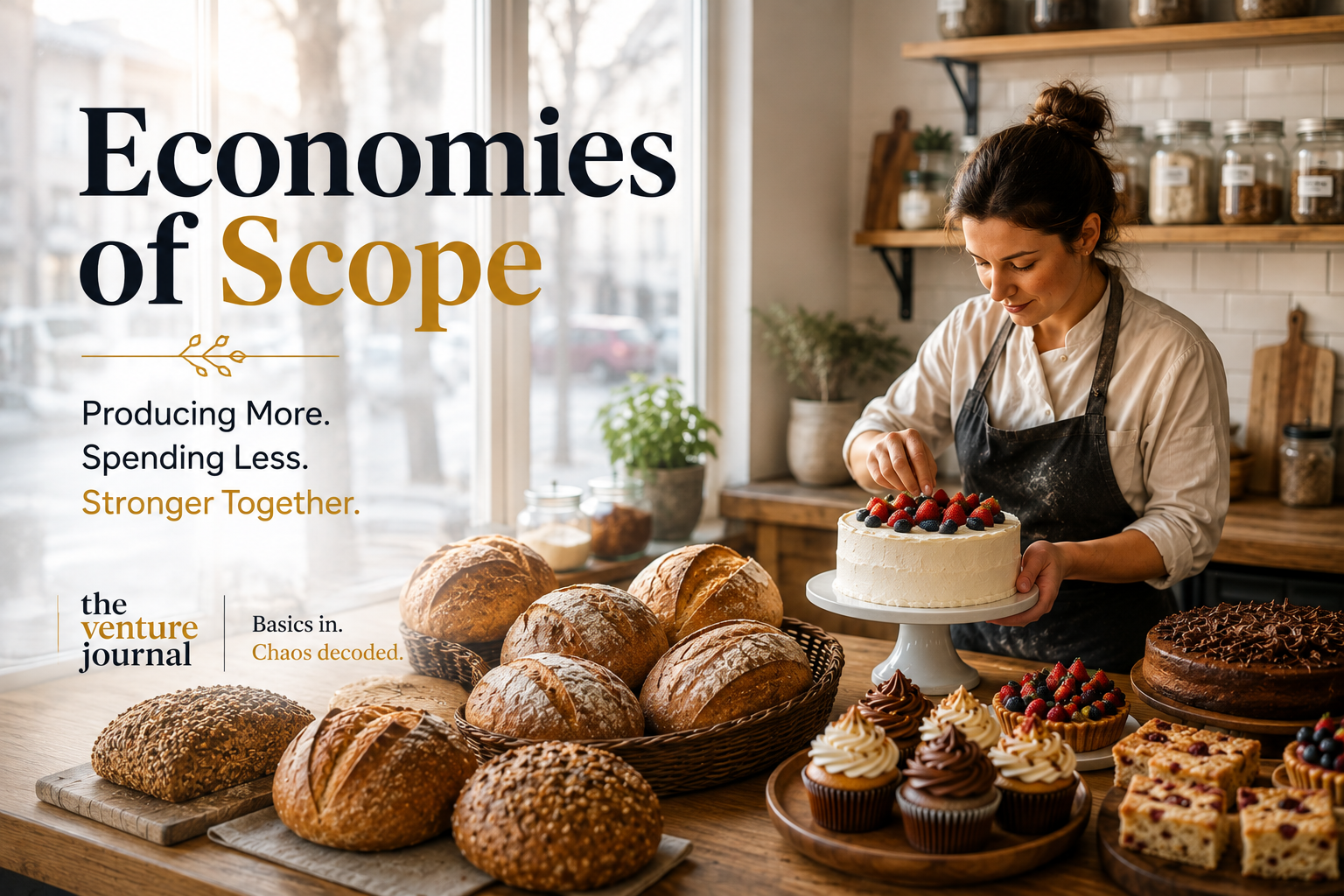
Aoife owns Hearth & Crumb Bakery, a single shopfront in Dublin that has sold bread for the past six years. Her ovens run every morning, her two bakers arrive before dawn, and her lease covers a modest kitchen and a small retail counter. Bread alone keeps the business steady, but it does not fill the ovens or occupy the staff for the full working day. Aoife is now deciding whether to add a second product line, cakes, using the same kitchen, the same bakers, and the same shopfront. This decision sits at the centre of economies of scope, a concept that explains why producing several different goods together, inside one firm, can cost less than producing each good alone in a separate operation.
Economies of scope describe a cost advantage that comes from variety rather than from volume. A firm achieves this advantage when the combined cost of producing two or more goods together, sharing the same equipment, staff, premises, or inputs, is lower than the sum of the costs each good would carry if produced separately. The word “scope” points to the range of what a firm makes, not the quantity of any single item. This distinguishes the idea sharply from economies of scale, which concerns cost per unit as the volume of one product rises. The sections below use Aoife’s bakery to show how economies of scope arises, how a firm can measure it, how it differs from economies of scale, where the savings actually come from, and where the advantage runs out.
Table of Contents
How Economies of Scope Arises
Aoife’s oven, mixer, and shopfront sit largely idle for part of each day once she has baked and displayed the bread. A baker who has spent the morning shaping loaves already has the skill, and often the spare hours, to shape cakes as well. The lease on the shopfront costs the same whether one product sits in the window or two. These facts describe the central mechanism behind economies of scope: many of the assets and skills a firm already owns are indivisible, meaning a firm cannot buy or hire them in small enough pieces to match the needs of a single product line exactly. Once Aoife has paid for an oven large enough to bake bread at the volume her customers demand, that oven carries spare capacity that a second product can use at little extra cost. The same logic applies to her bakers’ skills, her shop lease, and her relationships with flour and dairy suppliers. Producing cakes inside the existing bakery draws on capacity that bread production has already paid for, rather than requiring Aoife to buy a second oven, hire a second baker, or lease a second shop. This sharing of already-committed resources, not any change in how much bread she bakes, creates that advantage.
Measuring Economies of Scope: A Worked Example
To decide whether adding cakes makes sense, Aoife needs to compare two situations for one calendar month: producing bread and cakes in two separate operations, against producing both inside her existing bakery. Assume the following monthly costs, drawn from her landlord’s quote, her staff wages, and her suppliers’ price lists.
| Monthly cost item | Bread alone | Cakes alone (separate) | Combined (Hearth & Crumb) |
| Oven and equipment lease | $2,000 | $1,800 | $2,400 |
| Baker wages | $3,000 | $2,500 | $4,200 |
| Ingredients | $1,500 | $1,300 | $2,660 |
| Storefront rent | $1,200 | $1,200 | $1,200 |
| Waste and rework | $150 | $150 | $500 |
| Total | $7,850 | $6,950 | $10,960 |
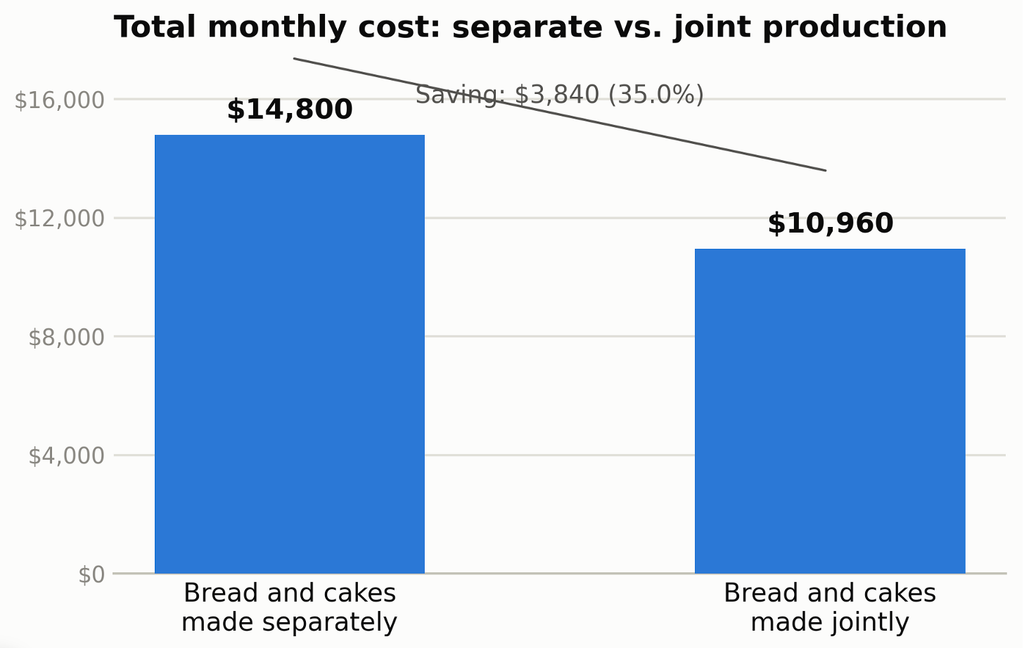
Producing bread alone costs Aoife $7,850 a month: $2,000 for oven and equipment lease, $3,000 for baker wages, $1,500 for ingredients, $1,200 for shopfront rent, and $150 for waste and rework, which sum to $2,000 + $3,000 + $1,500 + $1,200 + $150 = $7,850. A stand-alone cake shop, run separately with its own oven, staff, and premises, would cost $6,950 a month: $1,800 for equipment, $2,500 for wages, $1,300 for ingredients, $1,200 for rent, and $150 for waste, which sum to $1,800 + $2,500 + $1,300 + $1,200 + $150 = $6,950. Running bread and cakes as two separate businesses would therefore cost $7,850 + $6,950 = $14,800 a month in total.
Inside the existing bakery, adding cakes changes these figures differently. The oven lease rises only to $2,400 a month, because Aoife upgrades the existing oven rather than installing a second one. Wages rise to $4,200, because the same two bakers take on cake production with modest overtime rather than Aoife hiring a separate team. Ingredients cost $2,660: bread and cake ingredients together would cost $1,500 + $1,300 = $2,800 at list price, but ordering flour, sugar, butter, and eggs from one supplier in bulk earns a 5 percent discount, so $2,800 × 0.95 = $2,660. Shopfront rent stays at $1,200, since one shop now serves both product lines instead of two. Waste and rework rises to $500 a month, higher than either product carried alone, because sharing one oven schedule between two recipes causes occasional scheduling conflicts and spoiled batches. Adding these five figures gives a combined monthly cost of $2,400 + $4,200 + $2,660 + $1,200 + $500 = $10,960.
Comparing the two totals shows the size of the advantage: $14,800 in separate costs minus $10,960 in combined costs equals $3,840 in monthly savings from producing both goods inside one firm. Economists express this advantage as a ratio, commonly called the degree of economies of scope, calculated as the saving divided by the combined cost: $3,840 ÷ $10,960 = 0.350, or 35.0 percent. A positive result of this kind confirms that Hearth & Crumb Bakery gains a real cost advantage from combining production: cakes cost less to add to an existing bread operation than they would cost to produce on their own.
Economies of Scope versus Economies of Scale
The result above is easy to confuse with a related but different idea, economies of scale, so the distinction deserves a plain statement using the same bakery. Suppose that, instead of adding cakes, Aoife had kept selling bread only, but doubled the number of loaves she baked each day by installing a second, larger oven and hiring two more bakers. If her average cost per loaf falls as her bread volume rises, because fixed costs such as the shopfront lease now spread across twice as many loaves, that fall in unit cost counts as an economy of scale. It concerns one product, bread, produced in a larger quantity, you can read about it in detail here.
Economies of scope asks a different question entirely: not how many loaves Aoife bakes, but how many different products she bakes using the resources she already holds. When Aoife adds cakes rather than more bread, her bread volume does not change, yet her combined cost still falls below what two separate businesses would spend, as the $3,840 monthly saving above demonstrates. A firm can show strong economies of scale and no economies of scope at all, for example a large factory bakery that produces nothing but bread at enormous volume. A firm can equally show strong scope advantages with modest scale, as a small bakery that sells bread, cakes, and coffee from one counter does. The two ideas answer separate questions: economies of scale asks whether producing more of the same good lowers the cost per unit; economies of scope asks whether producing a different good alongside an existing one lowers the combined cost. Aoife’s bakery happens to have room to pursue both, but the decision she weighs now, whether to add cakes, raises a question of scope, not scale.
Where the Savings Actually Come From
The $3,840 saving in Aoife’s case is not one effect but several, layered together. A close look at her bakery reveals four distinct sources of economies of scope, each of which recurs in businesses far larger than hers.
Shared physical assets stand as the first source. Aoife’s oven, mixing equipment, and shopfront count as indivisible investments that neither bread nor cakes could justify buying alone in the same proportion; splitting their fixed cost across two product lines lowers the share that each line carries.
Shared labour and skill form the second source. The same bakers who shape loaves already understand dough, temperature, and timing, so training them to make cakes costs far less than hiring and training a separate team from nothing.
Shared purchasing and supplier relationships form the third source. Ordering flour, sugar, butter, and eggs together, in larger combined quantities, earned Aoife a 5 percent discount that neither product line would have reached on its own.
Shared customer access forms the fourth source. Every customer who walks into Hearth & Crumb Bakery for bread becomes a customer who can also buy a cake, without Aoife spending anything further to reach that customer a second time.
Each source traces back to the same underlying fact: Aoife had already paid for an oven, a shop, a set of skilled hands, and a stream of customers before she considered cakes at all. This advantage, in this sense, is a way of putting resources the firm already owns to fuller use.
The Limits of Scope: When Adding Product Lines Stops Paying Off
Aoife’s early success with cakes raises an obvious follow-up question: if two product lines save $3,840 a month, would a third product line, simple sandwiches for the lunchtime trade, save even more? The arithmetic answers yes, but with an important qualification that any firm weighing further diversification needs to notice.
Assume a stand-alone sandwich shop would cost Aoife $6,450 a month to run, and that adding sandwiches to the existing two-line bakery raises the combined monthly cost to $15,360, on the following figures.
| Monthly cost item | Sandwiches alone | Three-line combined (bread, cakes, sandwiches) |
| Oven and equipment lease | $1,200 | $2,900 |
| Wages | $2,200 | $6,000 |
| Ingredients | $1,700 | $3,560 |
| Rent | $1,200 | $1,300 |
| Waste and rework | $150 | $1,600 |
| Total | $6,450 | $15,360 |
The stand-alone sandwich figures sum to $1,200 + $2,200 + $1,700 + $1,200 + $150 = $6,450. The three-line combined figures sum to $2,900 + $6,000 + $3,560 + $1,300 + $1,600 = $15,360: equipment rises by $500 for a sandwich press, wages rise by $1,800 for part-time prep staff, ingredients rise by $900 for deli items bought in volumes too small to earn a further bulk discount, rent rises by $100 for a small chilled display case, and waste and rework rises sharply, because three product lines competing for one oven schedule create far more scheduling conflicts and spoiled batches than two did.
Running all three product lines separately would cost $7,850 + $6,950 + $6,450 = $21,250 a month, against $15,360 combined, a total saving of $21,250 − $15,360 = $5,890, or $5,890 ÷ $15,360 = 0.383, that is 38.3 percent of the combined cost. Read only at this aggregate level, adding sandwiches appears to strengthen Aoife’s scope advantage rather than weaken it.
The more revealing figure is the saving that sandwiches contribute at the margin, on their own, rather than the saving attributed to the whole three-line operation. Adding cakes to a bread-only bakery raised the combined cost from $7,850 to $10,960, an increase of $10,960 − $7,850 = $3,110, against a stand-alone cake cost of $6,950; cakes therefore saved $6,950 − $3,110 = $3,840 at the margin, the same figure calculated earlier. Adding sandwiches to the two-line bakery raised the combined cost from $10,960 to $15,360, an increase of $15,360 − $10,960 = $4,400, against a stand-alone sandwich cost of $6,450; sandwiches therefore saved only $6,450 − $4,400 = $2,050 at the margin. That gap matters: ($3,840 − $2,050) ÷ $3,840 = 0.466, so sandwiches added roughly 47 percent less marginal saving than cakes did.
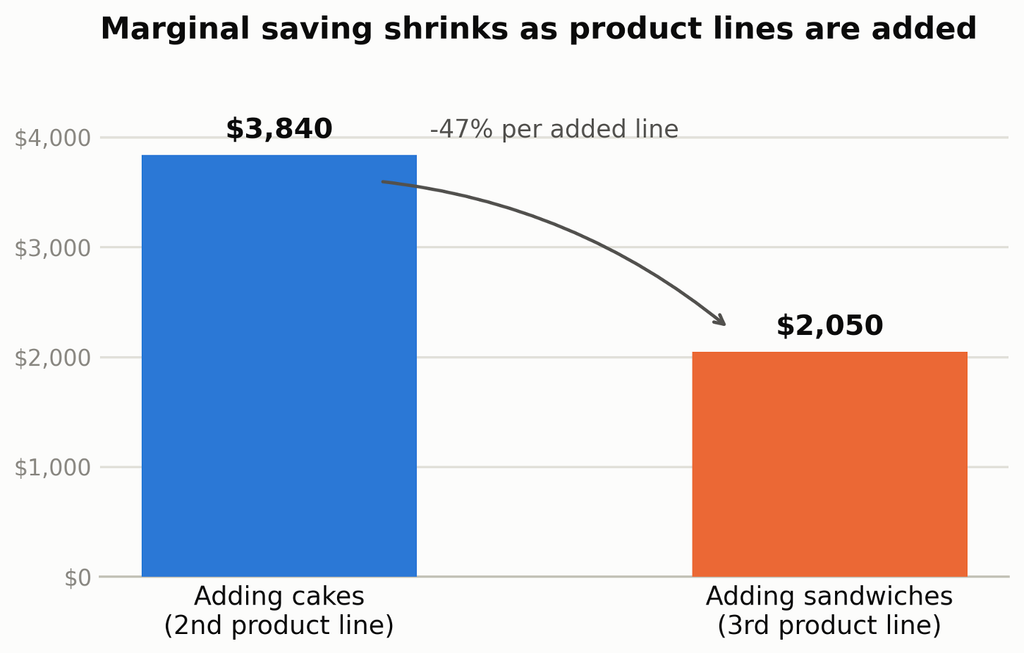
The marginal saving from each new product line is shrinking, even while the aggregate saving across the whole business still looks healthy. The same oven, the same two-and-a-half staff, and the same shop that made the first addition so cheap now serve three demands instead of two, and the waste and rework line captures the cost of that strain directly: $150 with one product, $500 with two, $1,600 with three. This pattern, if it continues, points toward diseconomies of scope, the point at which an additional product line costs more, through congestion, quality slips, and coordination effort, than it saves through shared resources. Aoife has not reached that point with sandwiches, since $2,050 remains a real saving, but a fourth product line added onto the same single oven and the same small staff could plausibly push the marginal saving to zero or below. At that point, the sound choice would be to stop, or to invest in the second oven and additional staff that scope economies had, until then, let her avoid.
Deciding When to Diversify
Aoife’s numbers point to a general rule for any firm weighing whether to add another product line to a shared operation. The relevant test is not whether the aggregate degree of economies of scope stays positive, since that figure can remain positive well past the point where the newest addition is actually worthwhile. The relevant test is the marginal saving that the specific product line under consideration contributes, measured against the strain that line places on shared, indivisible resources such as oven time, staff attention, and shop space. As long as the marginal saving stays comfortably above zero, and above the return Aoife could earn by spending the same money elsewhere, adding the product line remains sound. Once the marginal saving approaches zero, as the drop from $3,840 to $2,050 already warns, the sound response is not necessarily to halt diversification altogether, but to examine whether the shared resource behind the strain, the single oven in this case, has itself become the binding constraint, and whether investing in a second oven or additional staff would let the firm keep capturing that cost advantage on further products without the congestion cost. Economies of scope, in other words, names an advantage available to a firm that shares resources across products, but it does not grant a licence to add products without limit; it names a saving that a firm must measure, product by product, against the cost of the friction that variety itself creates.
Conclusion
Aoife’s decision, in the end, rests on arithmetic she can repeat for any future product she considers: state the assumed costs, compare the combined total against the sum of the separate totals, and track how the marginal saving moves as each new line joins the mix. Economies of scope explained why cakes were worth adding to Hearth & Crumb Bakery, and the same measurement, applied honestly to sandwiches and to whatever she considers next, will tell her when to keep sharing her oven, her staff, and her shop, and when a new product line needs resources of its own.
References
Corporate Finance Institute (2024) Economies of Scope – Definition, Formula, Example. Available at: https://corporatefinanceinstitute.com/resources/economics/economies-of-scope/ (Accessed: 31 August 2026).
Panzar, J.C. and Willig, R.D. (1981) ‘Economies of Scope’, American Economic Review, 71(2), pp. 268-272. Available at: https://ideas.repec.org/a/aea/aecrev/v71y1981i2p268-72.html (Accessed: 31 August 2026).
Teece, D.J. (1980) ‘Economies of Scope and the Scope of the Enterprise’, Journal of Economic Behavior & Organization, 1(3), pp. 223-247. Available at: https://ideas.repec.org/a/eee/jeborg/v1y1980i3p223-247.html (Accessed: 31 August 2026).
Wikipedia (2026) Economies of scope. Available at: https://en.wikipedia.org/wiki/Economies_of_scope (Accessed: 31 August 2026).