
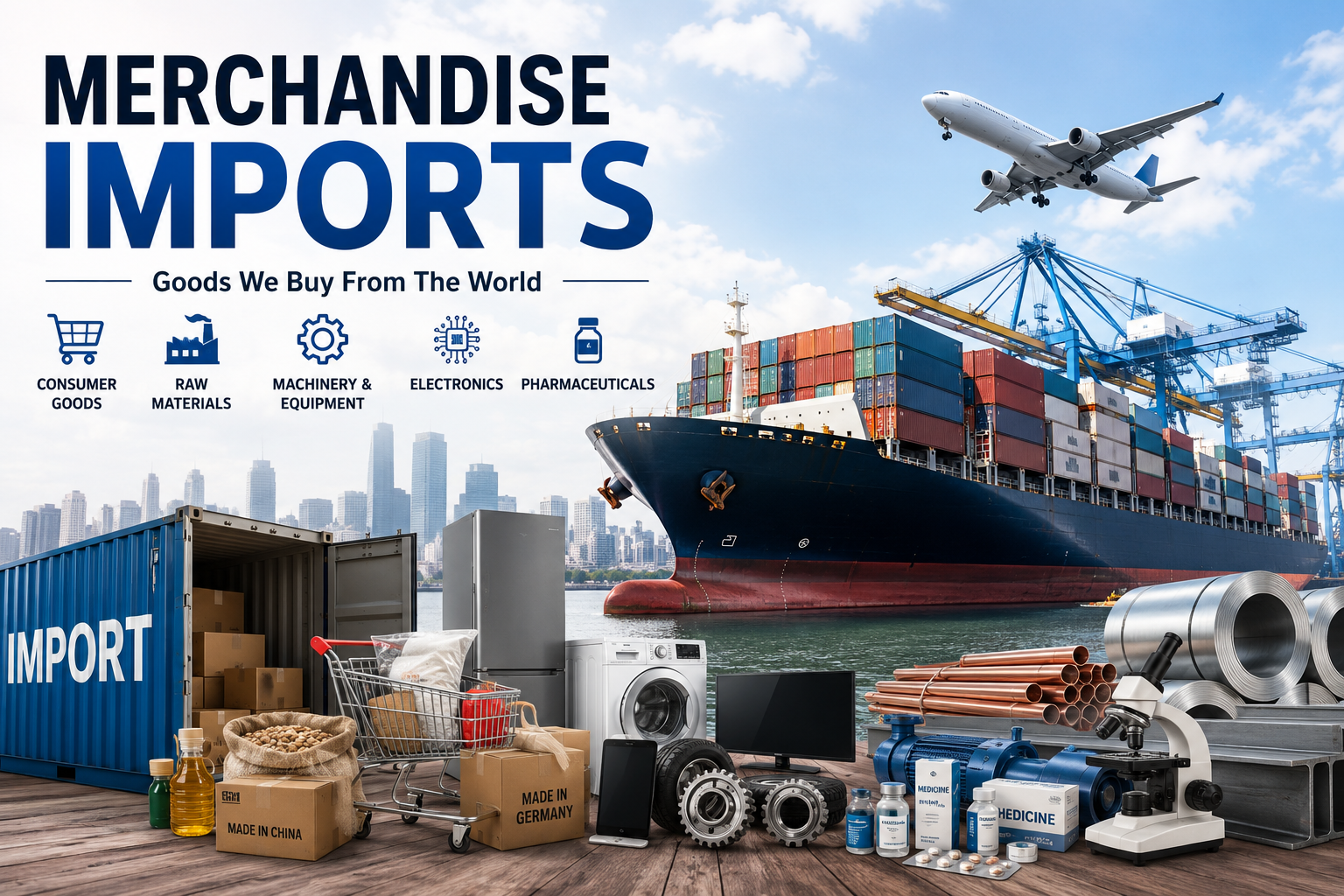
Countries cannot produce every product, raw material, or technology they need. Climate, natural resources, production costs, technical capabilities, and consumer preferences differ from one country to another. As a result, countries purchase goods from overseas suppliers.
These purchases are known as merchandise imports.
For example, India imports crude oil to meet its energy needs, Japan imports food and natural gas, and the United States imports automobiles, electronics, medicines, and industrial machinery.
Merchandise imports support consumers, manufacturers, retailers, hospitals, construction companies, energy producers, and many other parts of an economy. However, a large dependence on imports can also create economic risks.
This guide explains merchandise imports, how the import process works, why imports matter, and how economists measure their effect on an economy.
What Are Merchandise Imports?
Merchandise imports are physical goods that individuals, businesses, or governments purchase from another country.
The goods must cross an international border and enter the domestic economy. Ships, aircraft, trains, and trucks commonly transport these products.
Merchandise imports include:
- Consumer products
- Raw materials
- Industrial components
- Machinery and equipment
- Agricultural products
- Energy products
- Medical supplies
For example, when an Irish retailer purchases televisions from South Korea and brings them into Ireland, Ireland records those televisions as merchandise imports.
Similarly, when an Indian oil company purchases crude oil from Saudi Arabia, India records the shipment as a merchandise import.
Imports Are Not Limited to Finished Products
People often associate imports with finished products such as smartphones, cars, clothes, or furniture. However, a large part of international trade involves products that businesses use to manufacture other goods.
Economists generally divide imported merchandise into four broad groups.
Consumer Goods
Consumer goods are finished products that people purchase for personal use.
Examples include:
- Smartphones
- Clothing
- Cosmetics
- Furniture
- Televisions
- Packaged foods
A retailer may import these products and sell them directly to consumers.
Raw Materials
Raw materials are natural or basic resources that businesses use in production.
Examples include:
- Crude oil
- Iron ore
- Timber
- Cotton
- Natural rubber
- Copper
A country may import a raw material because it does not have enough domestic reserves or because overseas suppliers can provide it at a lower cost.
Intermediate Goods
Intermediate goods are components that businesses use to manufacture finished products.
Examples include:
- Semiconductor chips
- Automobile parts
- Chemicals
- Batteries
- Electronic circuits
- Fabric used by clothing manufacturers
For instance, a car manufacturer may import engines, sensors, batteries, and computer chips before assembling the final vehicle domestically.
Capital Goods
Capital goods help businesses produce other goods or services.
Examples include:
- Industrial machinery
- Factory equipment
- Construction equipment
- Medical machines
- Commercial vehicles
- Manufacturing robots
Capital goods can improve productivity because they allow businesses to produce more efficiently or adopt advanced technology.
How Merchandise Imports Work
The import process involves more than simply purchasing a product from another country. Several organisations participate in moving the goods from the foreign supplier to the domestic buyer.
Step 1: The Importer Identifies a Supplier
A domestic business first identifies a foreign company that can supply the required product.
The importer compares factors such as:
- Product quality
- Price
- Production capacity
- Delivery time
- Payment terms
- Supplier reliability
- Legal and technical standards
For example, an Indian electronics company may choose a semiconductor supplier in Taiwan because the supplier produces the required chip at the correct quality level.
Step 2: The Buyer and Supplier Agree on Terms
The buyer and supplier agree on the quantity, price, delivery date, payment method, and transport responsibilities.
International contracts often use recognised shipping terms to clarify who will pay for transport, insurance, customs documentation, and other costs.
The importer may pay the supplier in advance, after delivery, or through a bank-supported payment arrangement.
Step 3: The Supplier Prepares the Goods
The foreign supplier manufactures, packages, labels, and documents the products.
Some goods must meet specific safety, environmental, health, or quality regulations before the importing country allows them to enter.
For example, imported food products may need ingredient labels, health certificates, and evidence that they meet national food safety standards.
Step 4: The Goods Travel Internationally
A shipping company, airline, railway operator, or road transport company moves the goods.
Businesses commonly use ships for large and heavy shipments because sea transport usually costs less than air freight. Businesses use air transport when they need fast delivery or when the goods have a high value relative to their weight.
Freight companies may also combine several transport methods. A container may travel by truck to a port, by ship to another country, and then by train or truck to its final destination.
Step 5: Customs Authorities Check the Shipment
When the goods reach the importing country, customs authorities review the documentation.
Customs officials may examine:
- The type of product
- The country of origin
- The declared value
- The quantity
- Safety certificates
- Import licences
- Applicable tariffs and taxes
Customs checks help governments collect revenue, maintain trade records, stop illegal products, and ensure that imported goods meet national regulations.
Step 6: The Importer Pays Duties and Taxes
The importer may need to pay a tariff, customs duty, value-added tax, or another import-related charge.
A tariff is a tax that the government applies to imported goods. The rate can depend on the product and the country of origin.
For example, a government may apply a tariff to imported steel to protect domestic steel manufacturers from low-priced foreign competition.
Tariffs increase the final cost of imported products. Importers may absorb this cost or pass part of it to customers through higher prices.
Step 7: The Goods Enter the Domestic Market
After customs clearance, the importer can transport the products to a warehouse, factory, shop, or distribution centre.
A retailer may sell the products directly to consumers. A manufacturer may use the imported components in its production process. A wholesaler may distribute the goods to several businesses.
Merchandise Imports vs Service Imports
Both merchandise imports and service imports involve purchasing from another country. However, they represent different types of economic activity.
| Feature | Merchandise imports | Service imports |
|---|---|---|
| Nature | Physical and tangible goods | Intangible activities |
| Examples | Machinery, oil, cars and electronics | Consulting, insurance, tourism and software services |
| Physical transport | Usually required | Usually not required |
| Customs clearance | Generally required | Usually not required |
| Storage | Goods can often be stored | Services are generally consumed when provided |
| Border records | Customs authorities record them | Financial and statistical authorities record them |
For example, importing a computer from another country counts as a merchandise import.
Paying a foreign company to provide cloud computing, legal advice, or management consulting counts as a service import.
International tourism also creates service imports. When a resident travels overseas and spends money on accommodation, transport, and food, the home country records that spending as an import of travel services.
Why Do Countries Import Merchandise?
Countries import goods for several economic and practical reasons.
Access to Products That Are Unavailable Domestically
Geography and climate prevent some countries from producing certain goods.
For example, cold countries may import tropical fruits, coffee, cocoa, and natural rubber. Countries with limited oil reserves may import crude oil and natural gas.
Imports allow people and businesses to access goods that domestic producers cannot supply.
Lower Production Costs
A foreign producer may manufacture a product more cheaply because it has lower labour costs, better technology, larger factories, or easier access to raw materials.
Importing the product can therefore cost less than producing it domestically.
Consumers may benefit through lower prices. Businesses may also reduce their production costs by purchasing affordable components from overseas suppliers.
However, extremely cheap imports can place pressure on domestic manufacturers that cannot compete with foreign prices.
Greater Choice for Consumers
Imports increase the range of products available in the domestic market.
Consumers can choose between local and foreign brands, compare prices, and access products from different parts of the world.
For example, automobile imports allow buyers to choose from Japanese, German, Korean, American, and domestic manufacturers.
Greater competition can encourage companies to improve product quality, customer service, technology, and pricing.
Support for Domestic Manufacturing
Imports do not always compete with domestic production. In many cases, they support it.
Modern manufacturers often operate through global supply chains. They import raw materials and components before assembling or processing the final product domestically.
For example, an automobile manufacturer may import:
- Semiconductor chips
- Sensors
- Batteries
- Specialised steel
- Navigation systems
- Engine components
The manufacturer then combines these inputs with domestic labour and locally produced materials.
Without imported components, the factory may struggle to maintain production.
Access to Advanced Technology
Developing economies often import specialised machinery and equipment that domestic companies cannot yet produce.
Advanced machines can help businesses:
- Increase production
- Improve product quality
- Reduce waste
- Lower operating costs
- Introduce new products
- Improve worker safety
For example, a pharmaceutical company may import laboratory equipment from Germany or Switzerland to improve its research and manufacturing capabilities.
Therefore, imports can support long-term economic development when they increase productive capacity.
Managing Domestic Shortages
Countries may use imports when domestic production cannot meet demand.
A poor harvest may cause a shortage of wheat, rice, sugar, or other food products. The government or private companies may import additional supplies to stabilise the market.
Imports can prevent severe shortages and reduce sudden price increases.
However, depending too heavily on foreign suppliers can create risks when wars, shipping disruptions, natural disasters, or trade restrictions affect international supply.
Real-World Examples of Merchandise Imports
Import patterns reveal a great deal about a country’s economy, industries, resources, and consumer demand.
Merchandise Imports of the United States
The United States imports large quantities of:
- Electronics
- Motor vehicles
- Industrial machinery
- Pharmaceuticals
- Consumer goods
- Vehicle components
The country has a large consumer market, and American businesses operate through complex global supply chains.
Many imported products come from Mexico, China, Canada, Germany, Japan, South Korea, and European Union countries.
Some imports reach consumers as finished products. Others enter American factories as parts, raw materials, or capital equipment.
The United States imported approximately USD 3.4 trillion in goods during 2024, making it the world’s largest merchandise importer.
Merchandise Imports of China
China is a major manufacturing economy, but it also imports a large quantity of goods.
Its major imports include:
- Crude oil
- Iron ore
- Semiconductors
- Natural gas
- Agricultural products
- Industrial components
China imports raw materials to support its factories, infrastructure, energy system, and large population.
For example, Chinese steel manufacturers require large amounts of imported iron ore. Electronics manufacturers also import advanced semiconductor chips and production equipment.
China imported approximately USD 2.6 trillion in merchandise during 2024.
Merchandise Imports of Germany
Germany has one of the world’s largest manufacturing sectors.
Its major imports include:
- Energy products
- Electronic components
- Machinery parts
- Vehicles
- Chemicals
- Industrial materials
German companies use many imported products in automobile manufacturing, engineering, chemical production, and other industries.
Germany also imports consumer products for its domestic market and for distribution across Europe.
Official German statistics show that Germany recorded a large merchandise trade surplus in 2024, meaning the country exported more goods than it imported.
Merchandise Imports of India
India imports products such as:
- Crude oil
- Gold
- Electronic goods
- Machinery
- Chemicals
- Coal
- Semiconductor components
Crude oil forms a major part of India’s import bill because domestic oil production cannot fully meet the country’s energy demand.
India also imports machinery and electronic components to support manufacturing, infrastructure, telecommunications, and technology industries.
Gold imports reflect both jewellery demand and the cultural and investment importance of gold in India.
India imported merchandise worth approximately USD 720 billion during 2024.
Merchandise Import Performance Around the World
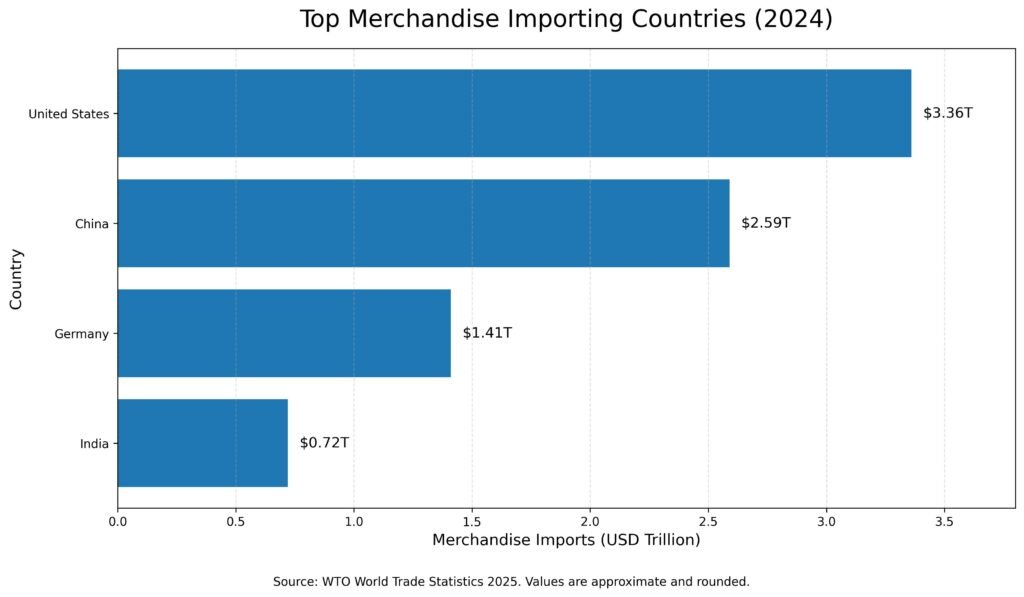
The following graph compares the approximate merchandise import values of four major economies during calendar year 2024.
The graph shows the large size of the United States consumer and business market. The United States imported more merchandise than the other countries included in the comparison.
China ranked second. Although China exports a large quantity of manufactured goods, it also imports energy, minerals, food, components, and advanced technology.
Germany’s import value reflects its position as a major European industrial and trading economy.
India’s merchandise imports remain lower than those of the United States, China, and Germany, but they support its growing energy needs, infrastructure, manufacturing sector, and consumer market.
The WTO provides merchandise trade statistics by country, product category, and trading partner.
Are Higher Merchandise Imports Always Bad?
Higher imports are not automatically harmful.
The economic effect depends on what a country imports, why it imports those goods, and how it uses them.
Productive Imports
Productive imports can help an economy expand.
Examples include:
- Factory machinery
- Construction equipment
- Semiconductor manufacturing tools
- Medical equipment
- Raw materials
- Industrial components
These imports can increase production, create employment, improve infrastructure, and strengthen future export capacity.
For example, a company may import an advanced machine and use it to manufacture products domestically for many years.
Consumer Imports
Consumer imports give buyers more choice and may reduce prices.
However, a rapid increase in imported consumer products can weaken domestic producers when local companies cannot compete.
The country may also become dependent on foreign suppliers for products that it previously produced domestically.
Essential Imports
Some imports are necessary even when they increase the trade deficit.
A country may have no practical alternative to importing crude oil, medicines, food, or essential industrial materials.
Reducing these imports immediately could harm consumers and businesses.
Therefore, policymakers must examine the composition of imports rather than judging the total value alone.
What Is a Trade Deficit?
A country records a merchandise trade deficit when the value of its merchandise imports exceeds the value of its merchandise exports.
The basic relationship is:
Merchandise trade balance = Merchandise exports − Merchandise imports
Suppose a country exports goods worth USD 400 billion and imports goods worth USD 500 billion.
Its merchandise trade balance would be:
USD 400 billion − USD 500 billion = −USD 100 billion
The negative result represents a merchandise trade deficit of USD 100 billion.
A trade deficit means the country purchases more goods from overseas than it sells abroad.
However, a trade deficit does not automatically prove that the economy is weak. Strong consumer spending, business investment, and demand for foreign machinery can increase imports.
Economists therefore examine trade deficits alongside:
- Economic growth
- Investment
- Employment
- Productivity
- Government borrowing
- Exchange rates
- Foreign investment
- Export competitiveness
The United States recorded a higher goods and services trade deficit in 2024 as imports grew faster than exports.
How Imports Affect Currency Demand
Imports require payment to overseas suppliers.
An importer may need to exchange the domestic currency for the supplier’s currency or for an internationally accepted currency such as the US dollar.
For example, an Indian importer purchasing crude oil may need US dollars to pay the foreign supplier.
A high demand for imports can therefore increase demand for foreign currency. When other factors remain unchanged, this can place downward pressure on the importing country’s currency.
A weaker domestic currency also makes imports more expensive.
For instance, if the Indian rupee falls against the US dollar, an Indian company may need more rupees to purchase the same dollar-priced machinery or crude oil shipment.
This can increase costs for businesses and consumers.
How Tariffs Affect Merchandise Imports
Governments use tariffs to increase the price of imported goods.
They may introduce tariffs to:
- Protect domestic industries
- Respond to unfair trade practices
- Reduce dependence on foreign suppliers
- Raise government revenue
- Support national security goals
- Influence another country’s trade policies
For example, a tariff on imported steel may help domestic steel producers compete with foreign suppliers.
However, tariffs can also increase costs for local businesses that use imported steel. These companies may raise the prices of cars, machinery, buildings, and other products.
Therefore, tariffs can protect one industry while increasing costs for another.
The Relationship Between Imports and Exports
Imports and exports often depend on each other.
A country may import raw materials or components, transform them into finished products, and then export those products.
For example, a smartphone manufacturer may:
- Import semiconductor chips.
- Import display panels.
- Import batteries.
- Assemble the smartphone domestically.
- Export the finished smartphone to other countries.
The imported components support the final export.
This relationship shows why governments cannot always reduce imports without affecting domestic production and exports.
Global supply chains connect businesses across several countries. A single finished product may contain materials and components from many different economies.
Benefits and Risks of Merchandise Imports
Merchandise imports create both opportunities and challenges.
Main Benefits
Imports can:
- Give consumers more product choices
- Reduce prices
- Support domestic manufacturing
- Provide essential resources
- Introduce advanced technology
- Increase competition
- Address shortages
- Improve productivity
Main Risks
Imports can:
- Increase dependence on foreign suppliers
- Weaken certain domestic industries
- Contribute to trade deficits
- Expose businesses to exchange-rate changes
- Create supply-chain vulnerabilities
- Increase unemployment in industries that cannot compete
- Transmit international price increases into the domestic economy
A balanced import strategy should protect economic resilience without preventing businesses and consumers from benefiting from international trade.
Key Takeaways
Merchandise imports are physical goods purchased from another country.
They include finished consumer products, raw materials, intermediate components, and capital equipment.
Countries import goods because they may lack natural resources, production capacity, advanced technology, or cost-efficient domestic suppliers.
Imports can support consumers and domestic businesses. They can improve competition, address shortages, and strengthen manufacturing.
However, excessive dependence on overseas suppliers can create economic and supply-chain risks.
Higher imports are not necessarily harmful. Policymakers must consider the type of imported goods and how the economy uses them.
Imports and exports are closely connected because many businesses use imported materials and components to produce goods for domestic consumption or export.
References
Federal Statistical Office of Germany (Destatis) (2025) ‘In 2024, United States became Germany’s most important trading partner once again after nine years’, Destatis, 19 February. Available at: https://www.destatis.de/EN/Press/2025/02/PE25_063_51.html (Accessed: 22 July 2026).
United Nations Conference on Trade and Development (UNCTAD) (2024) Global Trade Update: December 2024. Geneva: United Nations Conference on Trade and Development. Available at: https://unctad.org/publication/global-trade-update-december-2024 (Accessed: 22 July 2026).
U.S. Bureau of Economic Analysis and U.S. Census Bureau (2025) ‘U.S. International Trade in Goods and Services, December and Annual 2024’, Bureau of Economic Analysis, 5 February. Available at: https://www.bea.gov/news/2025/us-international-trade-goods-and-services-december-and-annual-2024 (Accessed: 22 July 2026).
World Trade Organization (WTO) (n.d.-a) Statistics on merchandise trade. Available at: https://www.wto.org/english/res_e/statis_e/merch_trade_stat_e.htm (Accessed: 22 July 2026).
World Trade Organization (WTO) (n.d.-b) Trade profiles. Available at: https://www.wto.org/english/res_e/statis_e/trade_profiles_list_e.htm (Accessed: 22 July 2026).
World Trade Organization (WTO) (n.d.-c) Tariff and trade data. Available at: https://www.wto.org/english/tratop_e/tariffs_e/tariff_data_e.htm (Accessed: 22 July 2026).
Additional Read: Explore Topics