
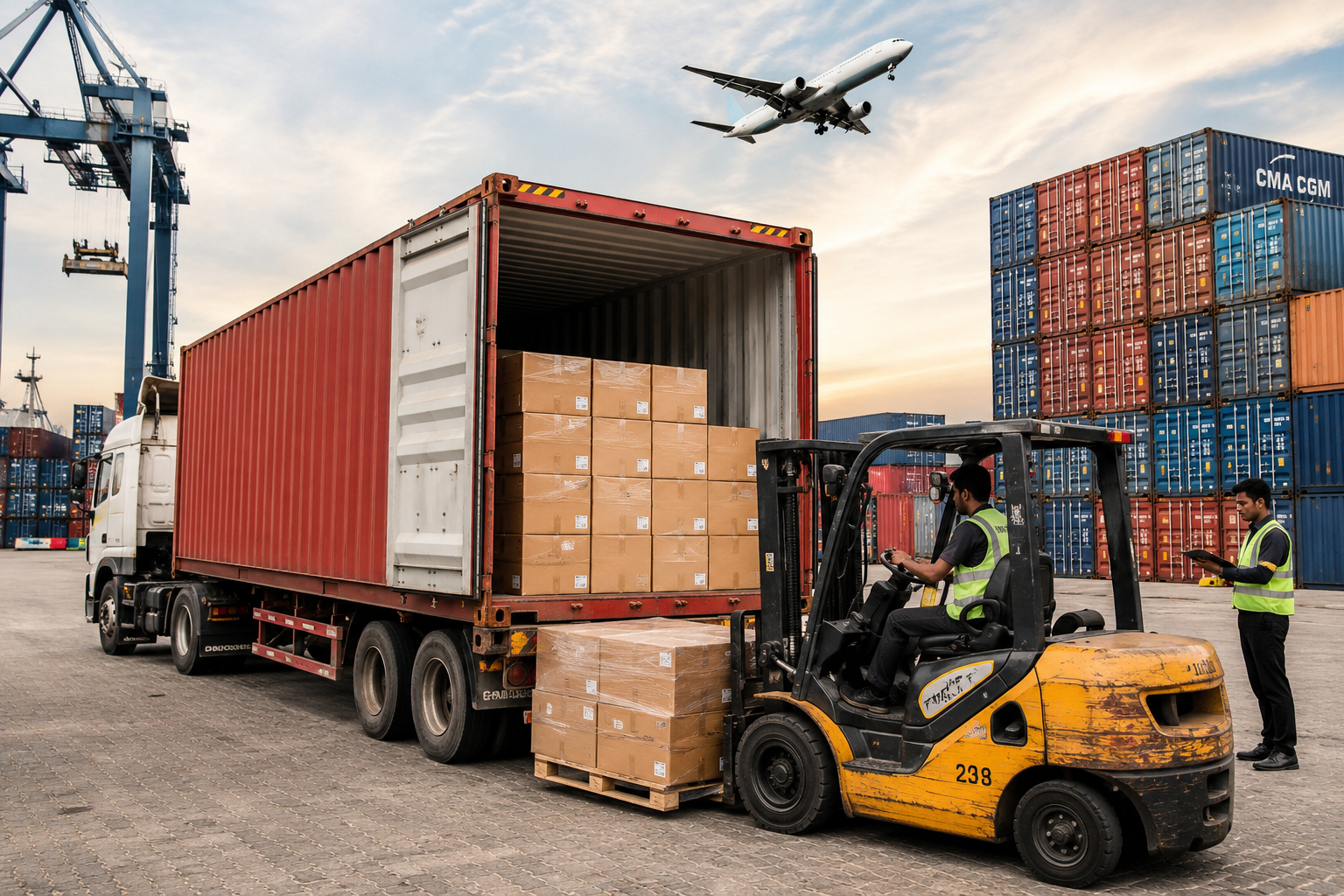
International trade allows countries to exchange goods and services across borders. Some countries produce goods more efficiently than others, while some have access to natural resources or advanced technology that gives them a competitive advantage. When businesses sell physical products to customers in another country, economists classify those sales as merchandise exports.
Understanding this concept is important because it helps explain how countries earn foreign income, create jobs, expand industries, and strengthen their economies. Whether it is an aircraft manufactured in the United States, a car assembled in Germany, or pharmaceutical products produced in India, every exported product contributes to international trade.
What Are Merchandise Exports?
Merchandise exports refer to physical goods that a country sells to buyers in another country. These goods cross international borders and include products such as automobiles, machinery, electronics, clothing, medicines, agricultural products, steel, and petroleum products.
For example, imagine an Indian pharmaceutical company manufactures medicines in Hyderabad and ships them to hospitals in South Africa. Since the medicines are physical products sold to another country, they become part of India’s merchandise exports.
Now consider another example. A furniture manufacturer in Vietnam produces wooden tables. If the company sells those tables to customers within Vietnam, the sales remain part of the domestic economy. However, if the company ships the same tables to Canada, those products become merchandise exports because they leave one country and enter another.
In simple terms, whenever a physical product moves from one country to another for sale, it becomes part of the exporting country’s merchandise exports.
How Do Merchandise Exports Work?
The export process involves several steps before a product reaches a foreign customer.
- A manufacturer produces the goods.
- A foreign buyer places an order.
- The goods undergo customs clearance and quality checks.
- The products travel by ship, aircraft, rail, or road.
- The buyer receives the goods and completes the payment.
This process connects producers with international markets and allows businesses to reach customers far beyond their home country.
Merchandise Exports and Services Exports
Many people confuse merchandise exports with services exports. The difference is straightforward.
| Feature | Merchandise Exports | Services Exports |
|---|---|---|
| What is exported? | Physical goods | Intangible services |
| Examples | Cars, medicines, machinery, rice | Software development, consulting, tourism, banking |
| Can you touch it? | Yes | No |
| Crosses a border physically? | Yes | Usually delivered digitally or through people |
For instance, when Tesla exports electric vehicles from the United States to Europe, those vehicles count as merchandise exports. When an Indian software company develops cloud-based applications for a client in Australia, the transaction becomes a services export because no physical product changes hands.
Why Are Merchandise Exports Important?
Merchandise exports contribute to economic development in several ways.
They Generate Foreign Exchange
When a country sells products overseas, it earns foreign currencies such as the US dollar, euro, or Japanese yen. These currencies help pay for imports like crude oil, machinery, and advanced technology.
They Create Employment
Growing export industries often require more workers. Manufacturing plants, logistics companies, shipping firms, ports, and warehouses all benefit when export demand increases.
They Encourage Industrial Growth
International competition encourages businesses to improve product quality, adopt better technology, and increase efficiency. As firms become more competitive, they often expand production and invest in innovation.
They Strengthen Global Business Relationships
Exports help businesses build long-term relationships with international buyers. These relationships can open new markets and create opportunities for future investment.
Real-World Examples
Countries export products that reflect their natural resources, industrial strengths, and technological capabilities.
The table below highlights a few examples.
Table 1. Examples of Major Merchandise Exports
| Country | Major Export Products |
|---|---|
| United States | Aircraft, machinery, medical equipment, semiconductors, petroleum products |
| China | Electronics, computers, machinery, textiles, electrical equipment |
| Germany | Automobiles, industrial machinery, chemicals, medical equipment |
| India | Petroleum products, pharmaceuticals, engineering goods, textiles, rice |
| Japan | Automobiles, electronic equipment, industrial machinery |
These examples show that countries do not export the same products. Instead, they specialise in industries where they have strong manufacturing capabilities or abundant resources.
Merchandise Export Performance Around the World
The value of exported goods differs significantly across countries.
The following figures refer to calendar year 2024.
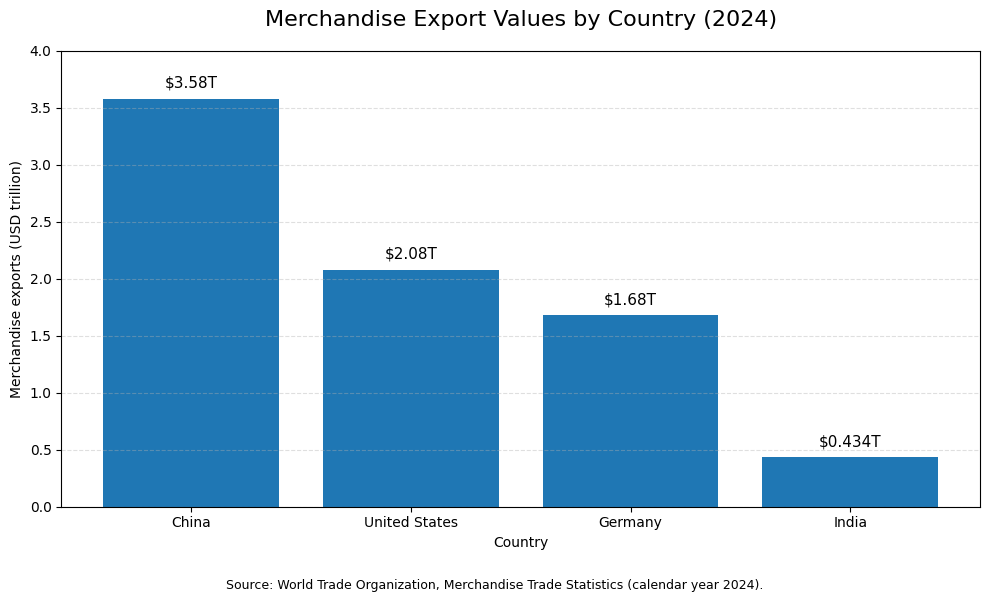
China remains the world’s largest exporter of goods because of its extensive manufacturing base. The United States follows with strong exports in high-value industries such as aerospace, machinery, energy products, and advanced technology. Germany continues to lead Europe with exports of automobiles and industrial equipment, while India’s exports have expanded through engineering goods, pharmaceuticals, electronics, and petroleum products.
A Closer Look at the United States
The United States provides a useful example because it exports a diverse range of high-value products.
According to the U.S. Bureau of Economic Analysis, the country exported USD 2.08 trillion worth of goods during 2024. Capital goods, including computers, semiconductors, and aircraft engines, represented one of the fastest-growing export categories. Energy products, industrial machinery, and medical equipment also contributed significantly.
This example shows that strong export performance does not depend only on low-cost manufacturing. Innovation, technology, research, and specialised production also play an important role.
Does Higher Export Growth Always Mean a Strong Economy?
Not necessarily.
Suppose a country’s exports increase by 20 percent because global oil prices double. The higher export value may reflect rising prices rather than increased production.
Similarly, if one product accounts for most export growth, the country could become vulnerable if demand for that product falls.
For this reason, economists examine not only the total value of exports but also what products drive the growth. A diversified export portfolio usually provides greater stability because the economy does not rely on a single industry.
Merchandise Exports and Imports
- Exports and imports always work together.
- Exports represent goods sold to other countries, while imports represent goods purchased from abroad.
- If a country exports goods worth USD 400 billion but imports goods worth USD 500 billion during the same period, it records a merchandise trade deficit of USD 100 billion.
- A trade deficit does not always indicate economic weakness. Many growing economies import machinery, technology, and raw materials to support future production. Economists therefore analyse trade balances alongside factors such as investment, productivity, and economic growth.
Key Takeaways
Merchandise exports represent the physical goods that businesses sell to customers in foreign markets. They help countries earn foreign exchange, create employment, support industrial development, and strengthen international trade relationships.
However, headline export figures tell only part of the story. Economists also examine the products being exported, the industries driving growth, and whether exports remain diversified across multiple sectors. A country that exports a broad range of competitive products is generally better positioned to adapt to changes in the global economy.
References
Reserve Bank of India (2024) Handbook of Statistics on the Indian Economy. Mumbai: Reserve Bank of India. Available at: https://www.rbi.org.in/Scripts/AnnualPublications.aspx?head=Handbook%20of%20Statistics%20on%20Indian%20Economy (Accessed: 22 July 2026).
U.S. Bureau of Economic Analysis (2025) U.S. International Trade in Goods and Services, Annual 2024. Washington, DC: U.S. Department of Commerce. Available at: https://www.bea.gov/news/2025/us-international-trade-goods-and-services-december-and-annual-2024 (Accessed: 22 July 2026).
World Trade Organization (2025) Statistics on Merchandise Trade. Geneva: World Trade Organization. Available at: WTO Statistics on Merchandise Trade (Accessed: 22 July 2026).
World Trade Organization (2025) WTO Stats Portal: Merchandise Trade Data. Geneva: World Trade Organization. Available at: WTO Stats Portal (Accessed: 22 July 2026).
World Trade Organization (2025) World Trade Statistics 2024: Key Insights and Trends. Geneva: World Trade Organization. Available at: WTO Global Trade Statistics (Accessed: 22 July 2026).
Additional Read : Explore topics