
Why does a large factory often produce each unit of a product more cheaply than a small workshop making the very same product? The answer lies in a simple economic idea called economies of scale.
Economies of scale means that as a business increases how much it produces, the cost of producing each unit tends to fall. To show exactly how and why this happens, this article follows a single example, a bakery named Sunrise Bakery, through every stage of its growth.
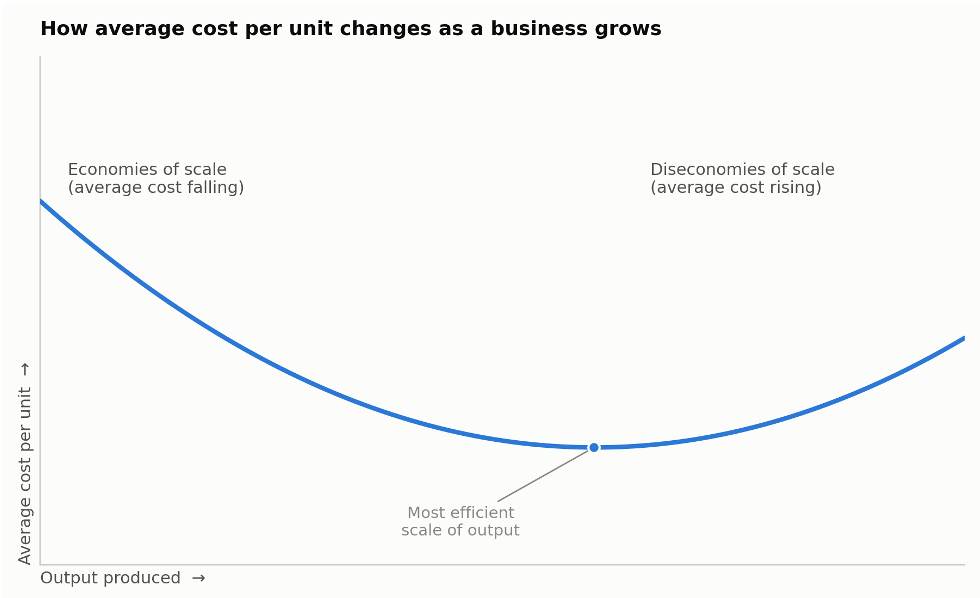
The chart above shows this pattern in general terms. As a business grows toward its most efficient size, its average cost per unit falls. If growth continues past that point, the average cost per unit begins to rise again. The sections below explain both halves of this pattern using Sunrise Bakery as the example.
Table of Contents
What Economies of Scale Really Mean
In its early days, Sunrise Bakery was a single small shop that made fifty loaves of bread a day. Several years later, after steady growth, Sunrise Bakery made five thousand loaves a day from a much larger facility. To see exactly why the cost of each loaf fell, it helps to assume real numbers for both stages and add them up, rather than simply saying that costs went down.
The table below lists Sunrise Bakery’s assumed daily costs when it produced fifty loaves a day.
| Rent for the shop | $20 |
| Electricity | $8 |
| Labour (one paid helper) | $72 |
| Flour and other ingredients (50 loaves × $0.90) | $45 |
| Total daily cost | $145 |
| Loaves produced | 50 |
| Cost per loaf | $2.90 |
Now compare this with Sunrise Bakery’s assumed daily costs after it grew to five thousand loaves a day.
| Rent for the larger facility | $500 |
| Electricity | $300 |
| Labour (twenty workers) | $1,400 |
| Flour and other ingredients (5,000 loaves × $0.60) | $3,000 |
| Total daily cost | $5,200 |
| Loaves produced | 5,000 |
| Cost per loaf | $1.04 |
Every one of these costs rose in total once the bakery grew. Rent rose from $20 to $500 a day, because the larger facility is a much bigger space, and a bigger space costs more to rent. Electricity rose from $8 to $300 a day, because more ovens now run for longer hours. The labour bill rose the most, from $72 to $1,400 a day, because the bakery grew from one paid helper to twenty workers. Even the ingredient bill rose in total, from $45 to $3,000 a day, since far more flour is now needed.
What changed is not the direction of these costs, but how many loaves each cost is divided among. Rent rose twenty-five times, from $20 to $500, but the number of loaves rose one hundred times, from fifty to five thousand. Because loaves grew faster than rent, rent’s share of each loaf fell from $0.40 to $0.10. The same reasoning explains why labour cost per loaf fell from $1.44 to $0.28: the wage bill rose nineteen times, but each of the twenty workers, helped by automated ovens and better organisation, now bakes far more bread in a day than the single helper once did alone. Electricity per loaf fell from $0.16 to $0.06 for the same reason, since total electricity use rose but is now spread across many more loaves.
The cost of ingredients fell for a different reason. It is not divided among more loaves in the way the other costs are, since each loaf still needs roughly the same amount of flour. Instead, buying flour by the truckload earned Sunrise Bakery a bulk discount from the mill, which brought the ingredient cost down from $0.90 to $0.60 per loaf.
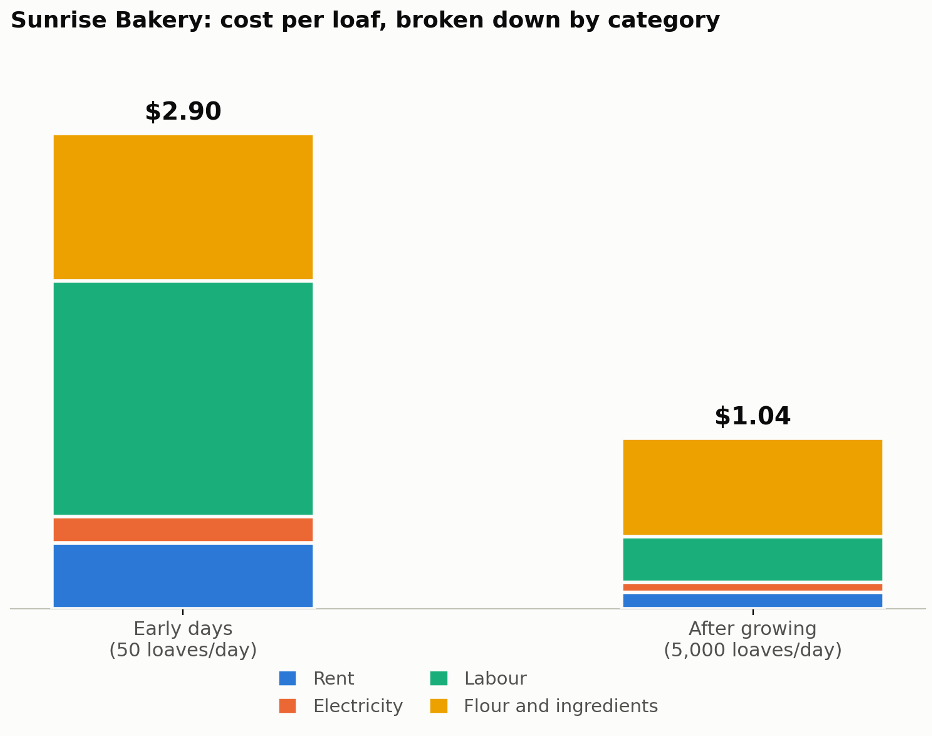
Add the four costs per loaf together, and the total falls from $2.90 in the early days to $1.04 after the bakery grows, as the chart below shows. The bread itself did not change. Only the scale of production changed, and that, combined with the bulk discount on flour, was enough to bring the cost down.
The Two Main Types of Economies of Scale
Economists usually divide economies of scale into two groups: internal and external. Internal economies of scale come from decisions the business makes on its own. External economies of scale come from the wider industry and location in which the business operates. The following sections explain both, using Sunrise Bakery as the example throughout.
Internal Economies of Scale
Purchasing. In its early days, Sunrise Bakery bought flour in small bags from a local shop and paid a high price for every kilogram. After the bakery grew larger, it began placing large orders directly with a flour mill. Because the order size was now large, the mill offered a much lower price per kilogram, which reduced the flour cost of every loaf.
Technical. The small version of Sunrise Bakery used one manual oven that could bake only a small batch of loaves at a time. After the bakery grew, it invested in large automated ovens that could bake hundreds of loaves at once for roughly the same amount of electricity per loaf. This equipment produced far more bread for every hour of a worker’s time, which lowered the labour and energy cost of each loaf.
Managerial. When Sunrise Bakery was small, the owner alone handled baking, accounts, and staff scheduling, often imperfectly. As the bakery grew, it could afford to hire a finance manager, a production manager, and a marketing manager, each trained in one area of the business. These specialists worked faster and made fewer costly mistakes than one person trying to manage every task alone.
Financial. When Sunrise Bakery was small and unproven, banks were reluctant to lend it money, and any loan offered carried a high interest rate. After years of steady sales and a much larger scale of operation, banks viewed the bakery as a safer borrower and offered loans at a lower interest rate. This cheaper borrowing reduced the cost of opening new locations.
Marketing. Advertising the single small shop was expensive relative to its sales, because one advertisement reached only a small number of customers. Once Sunrise Bakery expanded to many outlets across the city, a single advertising campaign promoted every outlet at the same time. The same advertising cost was now divided across a much larger number of loaves sold, so the marketing cost carried by each loaf became very small.
External Economies of Scale
A reasonable question arises at this point. If many bakeries operate in the same town, would competition for flour, ovens, and trained bakers not push local costs up rather than down? This is a fair point, and it is partly true.
When Sunrise Bakery opened a branch in a town already known for its baking industry, with dozens of other bakeries already operating there, competition for skilled bakers and for premises did push local wages and rent slightly higher than in a town with no baking industry at all. However, the branch still saved money overall, for reasons unrelated to local demand. It did not need to train a baker from the beginning, because trained bakers were already available in the area. It did not need to build its own flour supply line, because flour mills had already set up nearby to serve the many bakeries already there. It did not need to search far for oven repair technicians, because specialist repair services already operated nearby for the same reason.
When the savings on training, supply, and repairs are added together, they usually outweigh the extra cost of higher local wages and rent. This net saving is what economists call external economies of scale. It does not change the price at which Sunrise Bakery sells its bread, since that price is set by the wider market of customers, not by the local cost of running a bakery in that particular town. Local competition can raise the price of one specific resource, such as rent, exactly as ordinary demand and supply predicts. External economies of scale describe something broader than that single resource: once every cost is added together, running a bakery in that town still costs less overall than running one in a town with no baking industry at all.
Diseconomies of Scale: The Other Side of the Coin
The advantage of economies of scale does not continue forever. As Sunrise Bakery grew into a large chain with many branches, new problems appeared. Instructions from the head office had to pass through several layers of managers before reaching the bakers on the floor, so simple decisions took much longer than before. Communication between departments broke down at times, since more people were now involved in every task. Workers in the large organisation sometimes felt less noticed than they had in the small, single-shop bakery, and this reduced their motivation. If a company like Sunrise Bakery ignores such problems, its cost per loaf can rise again, even while it produces more bread than ever. Economists call this reversal diseconomies of scale.
Why This Concept Matters
Economies of scale shape decisions far beyond a single bakery. Governments consider it when they debate whether to protect small local businesses from large competitors. Investors consider it when they judge whether a fast-growing company can still turn a profit at a much larger size. Everyday shoppers benefit from it every time they choose a cheaper product from a large retailer over a small one. Large real-world companies such as Amazon and Walmart apply this same principle at a global scale, using enormous production and sales volumes to lower their cost per unit.
Students of business and economics encounter this idea often, because it explains a great deal about how markets behave. It explains why small industries often consolidate into a handful of large players over time. It also explains why some new companies pursue rapid growth before they turn a profit, on the expectation that economies of scale will eventually make their business model work.
Final Thoughts
Economies of scale is not a complicated idea once it is broken down into its parts. As Sunrise Bakery’s example shows, a larger scale of production usually brings a lower cost per unit, and that lower cost gives large firms a real advantage over smaller rivals. Growth carries its own risks too, since a company that expands carelessly can slide into diseconomies of scale and lose that advantage just as quickly. Understanding both sides, the benefits of scale and its limits, gives a much clearer view of how real businesses actually work.
References
Sloman, J., Garratt, D. and Guest, J. (2024) Economics. 11th edn. Harlow: Pearson.
Loo, A. (2019) Economies of Scale. Corporate Finance Institute. Available at: https://corporatefinanceinstitute.com/resources/economics/economies-of-scale/ (Accessed: 30 August 2026).
For more such readings around Business concepts & terms explore : Business Concepts & Terms



[…] The result above is easy to confuse with a related but different idea, economies of scale, so the distinction deserves a plain statement using the same bakery. Suppose that, instead of adding cakes, Aoife had kept selling bread only, but doubled the number of loaves she baked each day by installing a second, larger oven and hiring two more bakers. If her average cost per loaf falls as her bread volume rises, because fixed costs such as the shopfront lease now spread across twice as many loaves, that fall in unit cost counts as an economy of scale. It concerns one product, bread, produced in a larger quantity, you can read about it in detail here. […]