
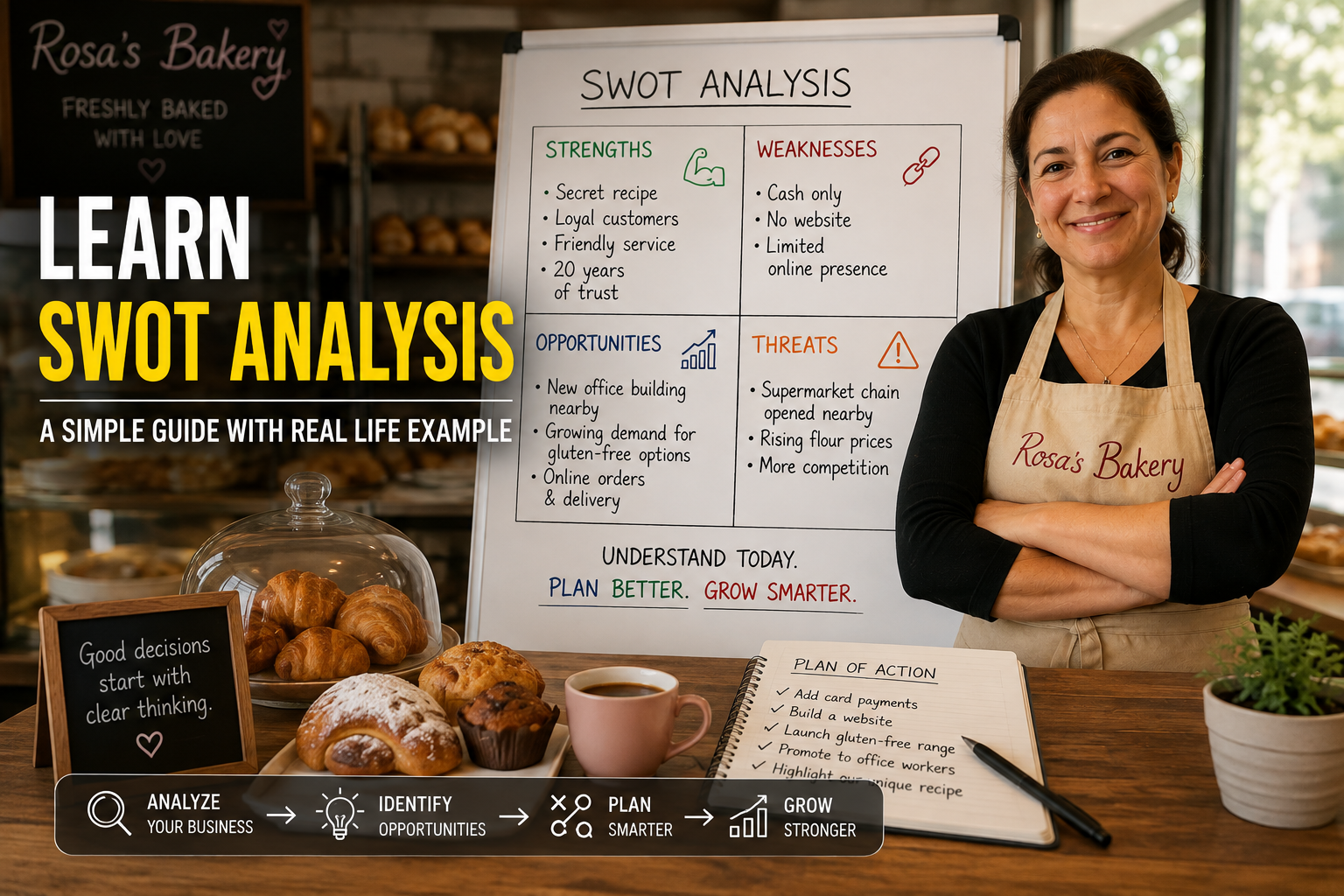
Have you ever wondered why some small businesses thrive for decades while others close within a year, even when they sell almost the same thing? The answer often comes down to one simple habit: successful owners understand themselves. They know what they do well, where they struggle, what opportunities sit right in front of them, and what dangers lurk around the corner.
This habit has a name, and it’s called SWOT analysis.
Don’t let the term scare you. You don’t need an MBA to understand it, and you don’t need years of business experience to use it. To make things easy to follow, we will walk through this entire guide using one story: Rosa, who runs a small family bakery called Rosa’s Bakery in a busy neighbourhood. By the time you finish reading, you’ll understand exactly what a SWOT analysis is, where it came from, and how you can build one for your own business, side hustle, or career, using nothing more than a pen, paper, and a little honest thinking.
Table of Contents
Where Did SWOT Analysis Come From?
SWOT analysis was not invented overnight by one person in a flash of genius, and it did not even start out under the name we use today. Its roots trace back to a research project carried out at the Stanford Research Institute (SRI) in California between 1960 and 1970, funded by a number of Fortune 500 companies who wanted to understand why corporate long-term planning kept failing (Puyt, Lie and Wilderom, 2023).
The project was led by Robert F. Stewart, working alongside colleagues Marion Dosher, Dr Otis Benepe, Birger Lie and Albert Humphrey (Puyt, Lie and Wilderom, 2023). For decades, popular business folklore credited Albert Humphrey alone as the sole inventor of the technique, and many textbooks claimed it was created by four Harvard Business School professors in their 1965 book Business Policy: Text and Cases. A detailed archival study published in the journal Long Range Planning found that neither claim holds up under scrutiny. The researchers concluded that the Harvard connection is best described as an “academic urban legend”, and that the story crediting Humphrey as sole inventor traces back to a memoir he circulated decades after the fact, rather than to the original 1960s project records (Puyt, Lie and Wilderom, 2023).
The tool did not start life as SWOT at all. It was first known as SOFT analysis, standing for Satisfactory, Opportunities, Faults and Threats, and it was presented at a management seminar in Zurich in 1964 (Morrison, no date). Soon after, colleagues Urick and Orr suggested changing the F for Faults to a W for Weaknesses, giving us the acronym SWOT that we still use today (Morrison, no date). The neat two-by-two grid most of us picture when we hear the term, with Strengths and Weaknesses on top and Opportunities and Threats below, came a little later. It was management professor Heinz Weihrich who developed this matrix format in a 1982 paper, turning SWOT from a simple checklist into the visual planning tool millions of people rely on today (Weihrich, 1982).
Knowing this history matters for one simple reason. SWOT analysis was never meant to be a rigid formula dreamed up in an ivory tower. It grew out of a very practical question that ordinary business people were asking themselves: why do good plans so often fail? That question is just as useful for someone like Rosa, running her small neighbourhood bakery, as it was for the Fortune 500 companies who funded the original research.
What Is SWOT Analysis, Really?
SWOT analysis is a simple planning tool that helps you look at a business, an idea, or even yourself, from four different angles. The word SWOT stands for:
| S | Strengths |
| W | Weaknesses |
| O | Opportunities |
| T | Threats |
Think of it like a health checkup for a business. Just as a doctor checks your heart, lungs, and blood pressure to get a full picture of your health, a SWOT analysis checks four key areas of a business to give its owner a full picture of where things stand.
The first two letters, Strengths and Weaknesses, look inward. They ask, “What is happening inside my business?” The last two letters, Opportunities and Threats, look outward. They ask, “What is happening in the world around my business?”
That’s the whole idea. Now let’s follow Rosa as she works through each part of her own SWOT analysis, one piece at a time.
Strengths: What Makes Rosa’s Bakery Stand Out
Strengths are the things a business does better than most others. They are its advantages, the reasons customers choose it over someone else.
Rosa’s Bakery has been open for twenty years, and its biggest strength is a secret recipe for chocolate croissants that nobody else in the neighbourhood can replicate. Rosa’s staff also greet regular customers by name and remember their usual order, which keeps people coming back week after week.
To find your own strengths, ask yourself simple questions like these. What do customers compliment you on the most? What do you do faster, cheaper, or better than your competitors? What resources do you have that others don’t, such as a loyal team, a great location, or a strong reputation?
For Rosa, the answer is clear: a unique recipe, a loyal following, and a warm, personal touch that a large chain simply cannot copy. Strengths don’t need to be huge to matter. They just need to be real and clearly yours.
Weaknesses: Where Rosa’s Bakery Needs to Improve
Weaknesses are the flip side of strengths. They are the areas where a business falls short, the gaps that hold it back from reaching its full potential.
This part takes courage, because nobody enjoys admitting their shortcomings. But honesty here pays off later. Rosa’s Bakery only accepts cash, which frustrates younger customers who prefer to pay by card. It also has no website, so people searching online for a bakery nearby cannot find it at all.
To spot your own weaknesses, think about where customers get frustrated. Where do you lose time or money? What tasks do you avoid because you don’t have the skills or tools to handle them well?
For Rosa, the honest answer includes outdated payment options and almost no online presence. Naming these weak spots isn’t about feeling bad. It’s about knowing exactly what to fix next.
Opportunities: Doors Waiting to Open for Rosa’s Bakery
Opportunities are the outside chances that could help a business grow. These are trends, gaps in the market, or changes in the world that a business can take advantage of if it acts on them.
A new office building recently opened two streets away from Rosa’s Bakery, bringing hundreds of hungry workers who need a quick breakfast spot. That’s a clear opportunity. At the same time, more people in the neighbourhood have started asking Rosa for gluten-free options, and no other bakery nearby offers them yet.
To find your own opportunities, look at changes happening around you. Are more people shopping online than before? Is a new neighbourhood being built near your shop? Are your competitors ignoring a certain type of customer? Each of these situations opens a door worth walking through.
For Rosa, the office workers and the growing demand for gluten-free bread are two doors sitting wide open, simply waiting for her to notice them.
Threats: What Could Hurt Rosa’s Bakery
Threats are outside dangers that could damage a business if it doesn’t prepare for them. Unlike weaknesses, which come from inside a business, threats come from the outside world, and an owner usually cannot control them directly.
For Rosa, a large supermarket chain recently opened a bakery counter just down the street, offering cheaper bread and pastries. On top of that, rising flour prices are squeezing her profit margins every month. Both of these are forces beyond Rosa’s control that could still hurt her bakery.
To identify your own threats, ask what could go wrong that isn’t your fault. Are new competitors entering your market? Are costs rising for supplies you depend on? Are customer habits shifting in a way that could leave you behind?
Recognising threats early gives an owner like Rosa time to adapt instead of getting caught off guard when it’s already too late.
Putting It All Together: Rosa’s SWOT Grid
Once you’ve thought through all four areas, the real magic happens when you put them side by side. Most people draw a simple grid, with Strengths and Weaknesses on top and Opportunities and Threats on the bottom, like this:
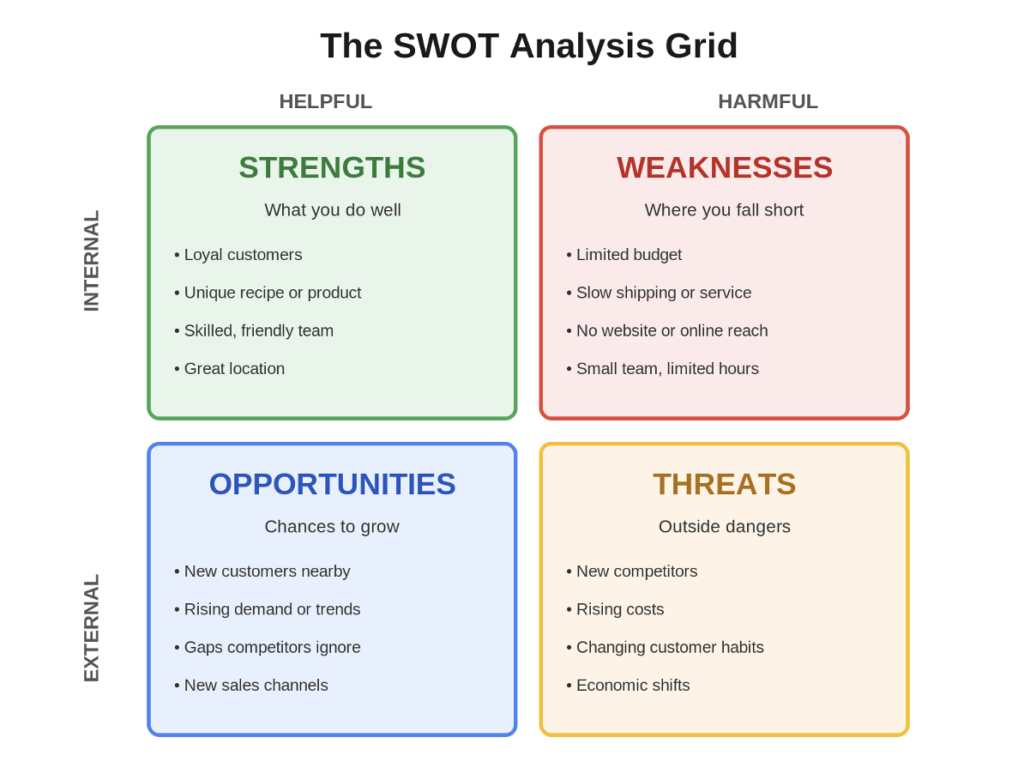
This visual layout matters because it helps you spot connections. You might use a strength to grab an opportunity, or you might need to fix a weakness before a threat catches up with you. For Rosa, that means using her strength, the beloved secret recipe, to attract the new office workers nearby, which is her opportunity. At the same time, she needs to fix her weakness, the lack of a website and card payments, so she can compete with the supermarket down the street, which is her threat.
This is where SWOT analysis becomes more than just a list. It becomes a bridge between understanding a business and actually planning what to do next.
Rosa’s Full SWOT Analysis in Action
Let’s bring everything together and see how Rosa turns her SWOT analysis into a real plan. Her strengths are a unique, beloved recipe and a loyal, personal relationship with her regular customers. Her weaknesses are a cash-only till and no website, both of which quietly turn away newer, younger customers.
Her opportunities are the new office building bringing in hungry workers every morning, and the rising local demand for gluten-free bread that nobody else nearby is serving. Her threats are the supermarket chain’s new bakery counter and the steadily rising cost of flour.
Once Rosa sees all four boxes laid out clearly, she can make smarter decisions instead of guessing. She adds card payment machines and builds a simple one-page website, closing the gap in her weaknesses. She creates a small gluten-free menu and prints flyers to hand out at the new office building, seizing both opportunities at once. She keeps highlighting her secret recipe in every conversation and every flyer, leaning on her strength to stand apart from the supermarket’s threat. This is exactly what SWOT analysis makes possible for Rosa, and for any business owner: turning scattered observations into a clear plan of action.
Why Every Business Should Try This, No Matter the Size
You might think SWOT analysis is only for big corporations with fancy consultants. That couldn’t be further from the truth. If a small neighbourhood bakery like Rosa’s can benefit from this simple exercise, so can a teenager running a lemonade stand, a freelancer building their first client base, or a massive company managing thousands of employees, just on a bigger scale.
The reason this tool works so well is that it forces an owner to slow down and think clearly instead of running the business on autopilot. It’s easy to get caught up in daily tasks and forget to look at the bigger picture. SWOT analysis gives Rosa, and anyone else who tries it, a reason to pause and reflect on the business every few months, whether things are going well or not.
Common Mistakes to Avoid
Even a simple tool like SWOT analysis can go wrong if you rush through it. Here are a few pitfalls worth watching out for.
Many people list too many points in each category without prioritising them. Instead, focus on the three or four most important items in each box rather than trying to list everything. Others confuse weaknesses with threats, or strengths with opportunities. Remember, strengths and weaknesses live inside a business, while opportunities and threats live outside it.
Some people also complete this exercise once and never revisit it. A business changes, its market changes, and its competitors change too. Rosa, for instance, plans to redo her SWOT analysis every six months, since a new competitor or a new trend can appear at any time. Treat SWOT analysis as a living document you revisit regularly, not a one-time assignment you file away and forget.
Bringing It All Home
SWOT analysis isn’t complicated, and it isn’t reserved for people with fancy business degrees. As we saw through Rosa’s story, it’s simply a way of asking honest questions about your strengths, your weaknesses, the opportunities around you, and the threats you face. When you answer these questions clearly, you turn confusion into clarity and guesswork into a real plan.
So grab a piece of paper today. Draw four boxes. Write down what you’re good at, where you struggle, what chances you can seize, and what dangers you should watch for. Whether you run a bakery like Rosa, a freelance business, or you’re simply mapping out your career, this simple exercise might just be the clearest thinking you do all year.
References
Morrison, M. (no date) https://rapidbi.com/history-of-the-swot-analysis/. History of the SWOT Analysis (brief) [Originally SOFT Analysis]. RapidBI. (Accessed: 16 August 2026).
Puyt, R., Lie, F.B. and Wilderom, C.P.M. (2023) ‘The origins of SWOT analysis’, Long Range Planning, 56(3), Article 102304. Available at: https://www.sciencedirect.com/science/article/pii/S0024630123000110 (Accessed: 16 August 2026).
Weihrich, H. (1982) ‘The TOWS matrix — a tool for situational analysis’, Long Range Planning, 15(2), pp. 54–66.
Read More: The Fundamentals by The Venture Journal


[…] piece is part of the same series as our guides to SWOT analysis, PESTLE analysis, Porter’s Five Forces, and the BCG Matrix. We will use Zara’s juice […]
[…] piece is part of the same series as our guides to SWOT analysis, PESTLE analysis, Porter’s Five Forces, the BCG Matrix, and the Ansoff Matrix. We will follow […]