

Zara opened a small juice bar three years ago, and business has been good. Steady, even. But steady was starting to feel like a ceiling. She wanted to grow, and that is where she got stuck. She could think of four different ways forward. She could try to get her current customers to buy more often. She could open a second stand in a part of town she had never sold in. She could add new items to her menu, like protein shakes or breakfast bowls. Or she could start something new altogether, maybe a small meal-prep delivery service that had nothing to do with juice at all. Each idea sounded fine on its own. Picking just one felt harder than running the shop itself.
That is where the Ansoff Matrix comes in. It takes every growth idea a business owner has and places it into one of four boxes, based on two simple questions: are you selling something you already sell, or something new, and are you selling to people you already know, or to people you have not reached yet. On its own, that sounds simple enough to skip. In practice, most business owners never sit down and ask these two questions clearly, which is exactly why so many growth plans end up chasing three or four ideas at once instead of picking the one that actually fits the business’s appetite for risk.
This piece is part of the same series as our guides to SWOT analysis, PESTLE analysis, Porter’s Five Forces, and the BCG Matrix. We will use Zara’s juice bar throughout, so you can see how the Ansoff Matrix works on a business you can picture, rather than one built from theory alone.
Where the Ansoff Matrix Came From
The Ansoff Matrix is named after Igor Ansoff, a mathematician who moved into business strategy after years of working on planning problems for large organisations. Ansoff was born in Vladivostok, Russia, in 1918, and his family later moved to the United States, where he studied engineering before earning a doctorate from Brown University. That background shows up clearly in how he approached the subject of business growth. Where some of the other strategy tools we have covered on this site grew out of loose team brainstorming among consultants, Ansoff came at growth the way a mathematician would, by breaking it down into a small number of clear, countable choices rather than a long list of loose ideas.
Ansoff’s holistic approach to strategic planning first took shape in the corporate development planning department at Lockheed, the aircraft company, during the 1950s, where he worked before moving into academic life. In September 1957, he published an article called Strategies for Diversification in the Harvard Business Review. In it, he laid out a chart showing the different paths a company could take to grow, based on whether it was selling an existing product or a new one, and whether it was selling to an existing market or a new one (Ansoff, 1957). He called this chart a product-market strategy, and it later became known simply as the Ansoff Matrix, the name most people use today.
Ansoff did not stop there. In 1965, he expanded on these ideas in a full book called Corporate Strategy, which is still considered one of the founding texts of the entire field of strategic management (Ansoff, 1965). In that book, he introduced the idea of synergy, the notion that a company’s different parts should work together and reinforce one another rather than simply sitting side by side, and he argued that a business moving into unfamiliar territory needed to weigh that synergy carefully before committing. Ansoff went on to advise major companies including IBM, General Electric, and Philips, and by the time of his death in 2002, he was widely known as the father of strategic management, a title not many business thinkers earn (Thinkers50, no date).
Ansoff’s bigger point in his original 1957 article still holds up well nearly seventy years later. He argued that growth does not happen by accident, and a business that grows without a clear reason for choosing one path over another is taking on more risk than it realises. Business schools still teach the Ansoff Matrix almost exactly as he first drew it, which is a rare thing for any idea from the 1950s to survive largely unchanged, and it says something about how well the Ansoff Matrix matches the way people actually make decisions under uncertainty.
What the Ansoff Matrix Actually Does
At its core, the Ansoff Matrix is a way to sort growth ideas by how risky they are. It uses two questions. Is the product new or is it something you already sell? And is the market new or is it made up of people who already buy from you?
The reason these two questions matter so much comes down to something fairly obvious once it is pointed out: familiarity lowers risk. A business that already knows its product and already knows its customers is standing on solid ground. Change either one of those things, the product or the customer, and the ground gets a little less solid, since you are now guessing about something you have not tested before. Change both at once, and you are relying almost entirely on guesswork, since neither the product nor the audience has been proven to work together. This simple idea, that risk grows as familiarity shrinks, is the whole logic the Ansoff Matrix is built around.
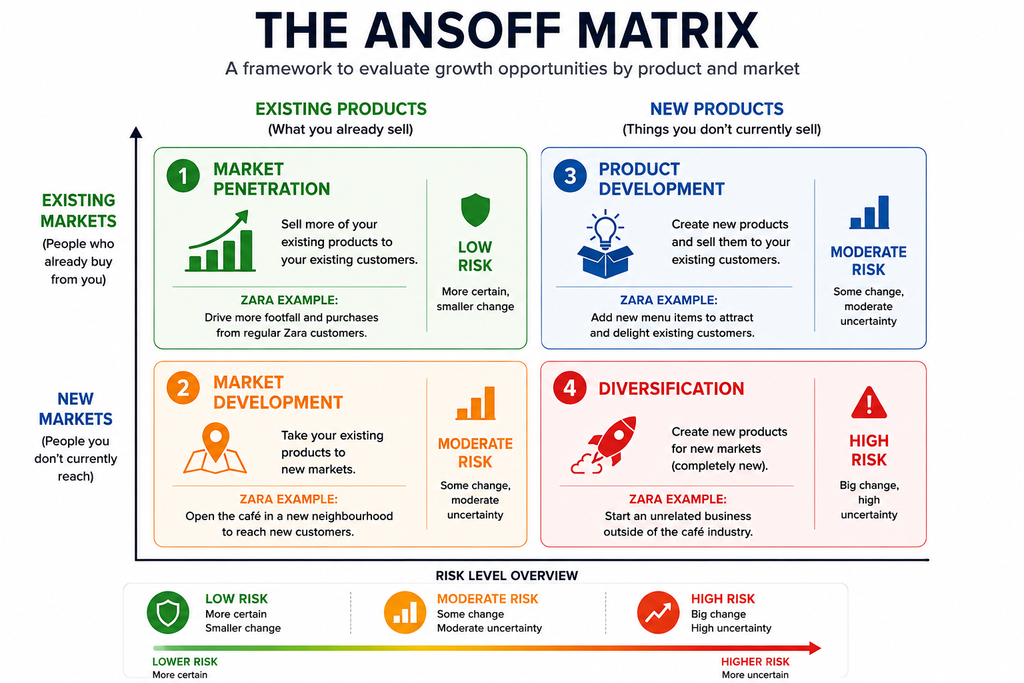
Those two questions create the four boxes of the Ansoff Matrix: Market Penetration, Market Development, Product Development, and Diversification. Each box carries a different level of risk, and Zara’s four growth ideas, selling more to regulars, opening in a new neighbourhood, adding new menu items, and starting an unrelated business, happen to land neatly into each one. What makes the Ansoff Matrix genuinely useful, rather than just a tidy way of labelling ideas, is that it forces a business owner to notice which parts of an idea are familiar and which parts are a leap of faith.
Market Penetration: Sell More to the Same People
Market Penetration means selling more of what you already sell to the people who already buy from you. For Zara, this is her loyalty programme. She started offering a free juice after every ninth purchase, and she began texting regulars about new flavours before they went on the menu.
This is the safest box on the Ansoff Matrix, since nothing about the product or the customer is unfamiliar. Zara already knows what her regulars like, and she already knows how to reach them. The only real question is how to get them buying a little more often, which is usually the cheapest and fastest way for a small business to grow. Common tactics here go beyond loyalty cards. Lowering prices slightly to win business away from a competitor, running seasonal promotions, improving customer service so people come back sooner, or simply making sure the shop is open at the times people actually want to buy, all count as Market Penetration in the Ansoff Matrix, because none of them ask the business to sell something new or find someone new to sell it to.
The trade-off is that Market Penetration has a ceiling. There are only so many juices one regular customer can drink in a week, no matter how good the loyalty programme is. Once a business has captured most of the easy wins in its existing market, this corner of the Ansoff Matrix tends to produce smaller and smaller gains, which is usually the signal that it is time to look at one of the other three boxes.
Market Development: Take What Works to New People
Market Development means taking a product that already works and offering it to a new group of customers, often in a new location. Zara’s version of this is a second juice stand she is considering near the university campus across town, a part of the city where she has never sold before.
The product itself does not change. Her recipes stay exactly the same. What changes is who gets to buy them. In the Ansoff Matrix, this box carries more risk than Market Penetration, since Zara does not yet know if students near the campus will want what she sells, but it is still lower risk than trying to sell something entirely new. Market Development can take several forms besides a new physical location. It might mean selling online for the first time, reaching a new age group through a different style of marketing, or even exporting a product to another country. What ties all of these together, and what keeps them in this box of the Ansoff Matrix rather than another, is that the product does not change, only the audience does.
The risk in this box of the Ansoff Matrix usually comes down to one question: does the new audience actually want what has worked so well with the old one? A recipe that regulars in one neighbourhood love is not guaranteed to land the same way with a different crowd, which is why Market Development, despite reusing a proven product, still counts as a real step into the unknown rather than a safe extension of what already works.
Product Development: Give Old Customers Something New
Product Development flips that logic around. Instead of a new market, you offer a new product to the market you already have. Zara’s idea here is to add protein shakes and breakfast bowls to her menu, aimed squarely at the same regulars who already walk through her door every morning.
She already understands what these customers want and how they behave, which lowers some of the risk. What she does not yet know is whether they will actually want these new items enough to pay for them. This box of the Ansoff Matrix often depends on trust built up over time, and Zara has spent three years earning exactly that kind of trust with her regulars. Businesses that succeed in this quadrant of the Ansoff Matrix usually do so because they are extending something customers already associate them with, rather than launching a product that feels completely unrelated to what made customers loyal in the first place.
The main risk in this quadrant of the Ansoff Matrix is development cost rather than audience risk. Zara does not need to convince anyone that she understands juice and healthy food, since her regulars already believe that. What she does need to figure out is whether a breakfast bowl fits the kitchen space she has, whether it slows down her existing service, and whether the ingredients are worth stocking if only a portion of her regulars order them.
Diversification: A New Product for a New Market
Diversification means selling a new product to a new market at the same time, and it is the riskiest box in the Ansoff Matrix by a wide margin. Zara’s meal-prep delivery idea fits here. It has nothing to do with juice, and it would reach an entirely different set of customers who may never have set foot in her shop.
Nothing about this path is familiar. Not the product, not the customer, not even the way the business would operate day to day. Ansoff himself was cautious about this corner of the Ansoff Matrix in his original writing, since it offers none of the built-in advantages that come from an existing product or an existing customer base. Some companies do succeed this way, but it usually demands more money, more research, and more patience than the other three boxes combined. Diversification tends to work best when a business already has some transferable skill or resource it can lean on, a strong brand name, a loyal following willing to try something new, or operational know-how that carries over even when the product itself does not.
For a business the size of Zara’s, this corner of the Ansoff Matrix is worth naming and understanding, even if it is not the first one to act on. Knowing that an idea sits in the riskiest corner of the Ansoff Matrix does not mean the idea is bad. It means the idea deserves more testing, more caution, and probably more money set aside before committing, than an idea sitting in one of the other three boxes.
Seeing All Four Paths at Once
Looking at one growth idea at a time can make each option feel equally reasonable. Placing all four on the Ansoff Matrix at the same time makes the differences between them much easier to see.
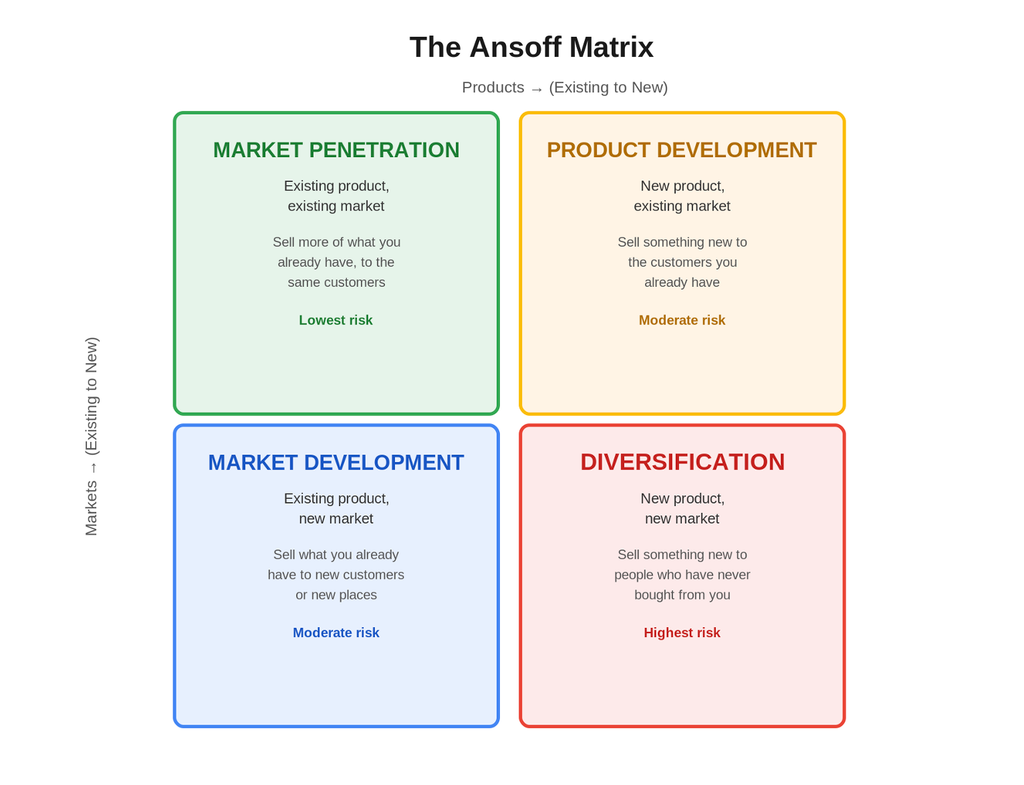
Once Zara laid her four ideas out this way, the choice in front of her looked different. Her loyalty programme sat quietly in the safest corner, something she could start almost immediately with very little money. Her meal-prep idea sat in the opposite corner, exciting but expensive and unproven. The two ideas in between, the new stand and the new menu items, offered real growth without asking her to bet the whole business on a guess.
Weighing Risk Against Reward
Seeing the four boxes side by side naturally raises a follow-up question: does lower risk always mean lower reward on the Ansoff Matrix? Not necessarily, and this is where a lot of business owners misread it. Market Penetration is the safest box, but it is rarely the box with the biggest ceiling, since it depends on customers who already exist and a market that is not growing simply because a business decided to try harder within it. Diversification carries the most risk, but it also carries the most room for a business to grow into something genuinely bigger than what it started as, assuming the idea works.
A useful way to think about this is to ask how much of the business’s future you are willing to put behind an unproven idea. Zara could afford to test her loyalty programme with almost no downside, since the worst case was simply that regulars did not respond and she was back where she started. The meal-prep idea carried a very different kind of risk, since a failed attempt could drain the cash she needed to keep her main shop running. Matching the size of the bet to how much the business can afford to lose is really what the Ansoff Matrix is helping a business owner do, more than simply sorting ideas into boxes for the sake of tidiness. This is also why revisiting the Ansoff Matrix regularly matters, since how much a business can afford to lose tends to change as it grows.
What Zara Chose to Do
An Ansoff Matrix only matters if it changes what happens next, so here is what Zara actually did once she had worked through her own version of it. She launched the loyalty programme first, since it cost almost nothing and she could start that same week. Within two months, regulars were visiting noticeably more often, and the extra revenue gave her a small cushion to work with.
She used part of that cushion to test two breakfast bowls on her existing menu rather than a full new lineup, keeping this step on the Ansoff Matrix small and manageable. She tracked how many regulars actually ordered them over six weeks before deciding whether to expand the menu further, rather than assuming the idea would work simply because it sounded reasonable. The university stand stayed on her list for the following year, once she had more cash saved and more confidence in her numbers, and she planned to visit the area herself on a few mornings first, just to watch how many students were already buying coffee or juice from somewhere else nearby.
The meal-prep idea, the Diversification option, she set aside entirely for now. Not because it was a bad idea, but because it made more sense to attempt once the safer three had already paid off and she had more money set aside to absorb a slow start. She did not rule it out permanently. She simply moved it to the bottom of the list, in the order her own Ansoff Matrix suggested made sense for a business her size.
Does This Work for a Small Business?
Ansoff wrote this framework with large companies in mind, the kind that had whole departments dedicated to deciding where to invest next. It is easy to assume a shop the size of Zara’s does not need something this formal, but the four questions behind the Ansoff Matrix apply just as well to a business with one location as they do to one with a hundred.
What changes at a smaller scale is not whether the Ansoff Matrix applies, but how much room there is for error. A large company can afford a failed diversification attempt far more easily than a small juice bar can, which is exactly why ordering these choices by risk matters even more for a business like Zara’s than for a large one. A single bad bet can end a small business. The same bad bet barely shows up on a large company’s balance sheet.
Where People Get the Ansoff Matrix Wrong
The most common mistake people make with the Ansoff Matrix is jumping straight to Diversification because it feels like the most exciting option, without first testing the safer three boxes. Ambition is not the problem here. Skipping the groundwork is.
A second mistake with the Ansoff Matrix is assuming every business needs to fill all four boxes eventually. Some businesses grow perfectly well by staying almost entirely in Market Penetration for years, and there is nothing wrong with that. A third mistake is treating the Ansoff Matrix as a one-time decision rather than something worth revisiting, in much the same way the SWOT and PESTLE habits covered elsewhere on this site are meant to be revisited. A market that looked new and risky last year might feel familiar and safe by now.
A fourth mistake, and one that catches out even careful planners, is underestimating how much a seemingly small step into a new box of the Ansoff Matrix actually costs. Zara’s breakfast bowls looked like a minor menu addition on paper, but they meant new suppliers, new kitchen equipment, and new training for her staff. Product Development and Market Development often look easier on a whiteboard than they turn out to be once a business actually starts building them.
How the Ansoff Matrix Fits Alongside Other Strategy Tools
None of the frameworks covered on this site are meant to be used entirely on their own, and the Ansoff Matrix works best when it follows, rather than replaces, some of the other tools we have written about. A SWOT analysis would have told Zara what she is already good at and where she is weak, which shapes which box of the Ansoff Matrix actually makes sense for her. Her strong relationships with regulars, for instance, is exactly the kind of strength that makes Product Development a realistic option rather than a hopeful guess.
A PESTLE analysis would tell her whether outside conditions favour any of the four paths on the Ansoff Matrix right now, such as whether local rules make it easy or hard to open a second stand, or whether rising food costs make a new menu item riskier than it would have been a year ago. Porter’s Five Forces would tell her how much competition she is likely to face if she tries Market Development near the university, where other cafes and juice sellers may already be well established. And the BCG Matrix, once her business has more than one location or product line to manage, would help her decide which existing part of the business should fund the next move on the Ansoff Matrix in the first place.
Used together, these tools answer different parts of the same underlying question. What am I good at, what is happening around me, how crowded is my market, which of my current products deserve more investment, and finally, given all of that, which direction should I actually grow in. The Ansoff Matrix is usually the last step in that chain, the point where analysis turns into an actual decision about what to do next, which is also why it tends to be the framework business owners reach for once the earlier groundwork is already done.
Closing Thoughts
The Ansoff Matrix will not tell Zara, or anyone else, exactly which growth idea to chase first. What the Ansoff Matrix does is separate the safe bets from the risky ones, so that a decision which once felt like a guess starts to feel like a choice made with open eyes.
It is worth drawing these four boxes for your own business and being honest about where each of your growth ideas actually sits. Read alongside the SWOT, PESTLE, Five Forces, and BCG Matrix guides on this site, the Ansoff Matrix answers a question none of the others quite ask: not what you are good at, or what is happening around you, but which direction is worth growing toward next, and how much risk that direction is likely to bring with it. Zara’s juice bar is a small example, but the same four boxes of the Ansoff Matrix apply whether the business behind them is a single stand on a street corner or a company with locations across the country.
References
Ansoff, H.I. (1957) ‘Strategies for diversification’, Harvard Business Review, 35(5), pp. 113–124. Available at: https://hbr.org/1957/09/strategies-for-diversification (Accessed: 17 August 2026).
Ansoff, H.I. (1965) Corporate Strategy: An Analytic Approach to Business Policy for Growth and Expansion. New York: McGraw-Hill.
Thinkers50 (no date) H. Igor Ansoff 1918–2002. Available at: https://thinkers50.com/biographies/h-igor-ansoff/ (Accessed: 17 August 2026).