
A few summers ago, a heatwave settled over Leo’s neighbourhood for the better part of three weeks, and by the time it passed, his electricity bill had climbed by nearly forty percent. Not long after that, a change to data protection law landed on his desk with barely any notice, and he found himself scrambling to bring his gym’s old spreadsheet of member records up to a standard he hadn’t known existed a month earlier. Neither of these things had much to do with how well Leo ran his business. His equipment was well maintained, his trainers were good at their jobs, and his members seemed genuinely happy. Even so, the world outside his gym kept nudging his plans off course.
Most business owners eventually learn this the hard way, usually after being caught off guard once or twice. You can get everything inside your four walls right and still find yourself reacting to a law, a price shift, or a change in what people want, simply because nobody was watching for it. There’s a fairly old tool built for exactly this problem, and it goes by the name PESTLE analysis.
We’ve written before about SWOT analysis, which looks at a business’s own strengths and weaknesses (you can read that guide here). This piece takes the opposite view, turning outward to look at the wider world a business has to operate inside of, and it follows one story throughout, Leo and the small neighbourhood gym he’s spent the better part of a decade building.
Table of Contents
Where PESTLE Analysis Began
The framework has a clearer starting point than most business tools of its age, which tend to accumulate myths the way old buildings accumulate ivy. Its roots trace back to Francis J. Aguilar, who joined the faculty at Harvard Business School in 1964. Three years later, in a book called Scanning the Business Environment, Aguilar made the case that companies needed a deliberate, repeatable way of studying the world beyond their own operations rather than assuming that good internal management was enough on its own. He grouped that outside world into four areas, using the shorthand ETPS for Economic, Technical, Political and Social factors (Aguilar, 1967).
The idea didn’t stay in that exact shape for long. Arnold Brown, who worked at the Institute of Life Insurance in the United States, rearranged Aguilar’s categories not long afterwards and gave the tool a new name, STEP, standing for Strategic Trend Evaluation Process (Morrison, no date). Over the two decades that followed, a number of researchers and consultants, including Fahey, Narayanan, Renfro and Porter among others, kept adjusting the framework, adding Legal and Environmental factors and reordering the letters in different combinations depending on who was teaching it (Morrison, no date). Nobody appears to have kept a precise record of who introduced each addition or exactly when, which is largely why you’ll still come across PEST, STEPLE and PESTLE used almost interchangeably depending on the textbook in front of you.
The version that eventually became standard, particularly across business, marketing and HR courses in the UK, is PESTLE: Political, Economic, Social, Technological, Legal and Environmental (Morrison, no date). What matters more than the exact letters, though, is the instinct Aguilar wrote down close to sixty years ago, that a business studying only itself is working with half the information it needs.
What a PESTLE Analysis Actually Involves
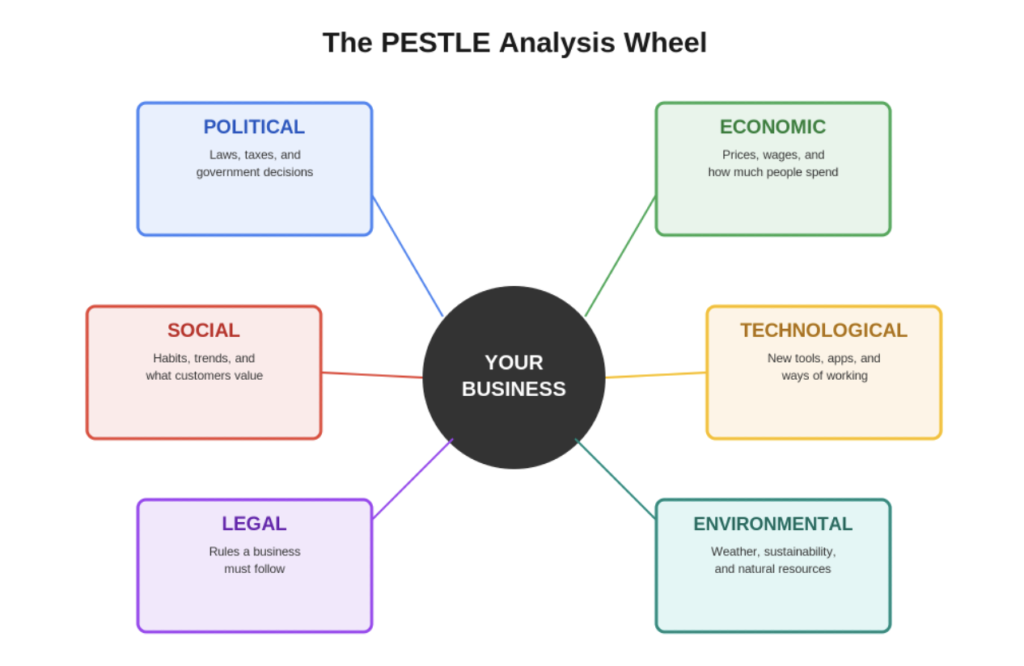
Once you strip away the terminology, a PESTLE analysis is simply a structured way of asking what is changing out in the world that a business owner cannot control but genuinely ought to know about. It divides that outside world into six categories, largely so that nothing important quietly slips past unnoticed while attention is focused elsewhere.
| Letter | Stands for | In practical terms |
| P | Political | Decisions made by governments and councils |
| E | Economic | The movement of prices, wages and spending |
| S | Social | Shifting habits, values and expectations |
| T | Technological | New tools that change how work gets done |
| L | Legal | Rules a business is required to follow |
| E | Environmental | The natural world’s effect on the business |
What stands out immediately is that none of these six categories describe the business itself, its products, or its people. That marks the clearest difference between this framework and the SWOT analysis we covered previously, since SWOT spends half its attention looking inward at a business’s own strengths and weaknesses before it ever turns outward. A PESTLE analysis, by contrast, is concerned entirely with the conditions surrounding a business rather than the business itself. With that distinction in mind, it helps to walk through each factor as Leo experienced it over the past year at his gym.
Political Factors
Somewhere in a council building or a government office, a decision gets made about grants, taxes or new regulations, and months later it lands on a business owner’s desk as either a welcome opportunity or an unwelcome cost. Leo currently has two of these moving through the pipeline at once. His local council recently launched a public health grant scheme that rewards fitness businesses willing to run free community classes, which struck him as a fairly easy opportunity to chase given how much he already enjoys running group sessions. At the same time, a proposed increase to the national minimum wage has been working its way through parliament, and if it passes, his staffing costs will rise regardless of how prepared he feels.
Keeping track of political factors rarely requires anything more sophisticated than reading a local council newsletter now and again and paying loose attention to national policy debates that touch your particular industry. Nobody needs to become a political analyst to benefit from this habit. The goal is simply to avoid being surprised by something that, in hindsight, had been signposted for months.
Economic Factors
Money tends to move in moods, and Leo’s members have clearly grown more cautious lately. Rising interest rates have made people think twice before committing to an annual membership, and he’s watched a fairly steady drift toward cheaper, more flexible month-to-month plans over the past year. His own costs haven’t stood still either. Electricity prices have crept upward throughout the year, quietly eating into margins that were never especially generous to begin with, so he’s effectively being squeezed from both directions at once.
There isn’t much mystery to tracking economic factors in principle, since it mostly involves watching inflation, keeping an eye on local employment figures, and noticing when customers begin hesitating at the till. Acting on what you notice before the numbers force a decision is usually the harder part.
Social Factors
Trends tend to move more slowly than headlines suggest, but they do move, and Leo has watched two of them build quietly inside his own gym over roughly the last year. More members have started asking about mental wellness and recovery-focused classes rather than sticking purely to weights and cardio, and a growing number of people over fifty have begun walking through his doors, a group his original early-morning and evening class schedule was never really designed around. Neither shift arrived as a single dramatic moment worth noting on a calendar. They built up gradually, through comment cards and passing conversations at the front desk, which tends to be exactly how social change shows up in a small business.
Owners who notice these shifts early generally get to adapt on their own schedule, while those who miss them end up reacting under pressure once the gap between what they offer and what customers want has already widened.
Technological Factors
A gym two streets over from Leo’s recently introduced app-based class booking along with equipment that tracks a member’s reps automatically, while Leo has continued relying on a paper sign-in sheet and a whiteboard that gets wiped clean every Sunday evening. Neither approach is inherently wrong, and plenty of members still appreciate the personal, low-tech feel of Leo’s front desk. What tends to shift, though, is member expectation, and once a nearby competitor raises the bar, a whiteboard that once felt personal can start to feel simply outdated by comparison.
The more useful question here usually isn’t whether your current technology is broken, since it may well still work perfectly well, but whether the baseline expectation around you has moved without your noticing.
Legal Factors
Some outside pressures are reasonably safe to postpone thinking about. Legal ones generally are not. Leo’s gym has always needed to meet fire safety standards and keep its equipment maintenance records up to date, but a recent change to data protection law now requires him to store his members’ personal details far more securely than his old spreadsheet was ever built to handle. This is the one category on the list where putting things off can escalate quickly, from a minor oversight into fines, legal disputes, or in a worst case, a forced closure.
It helps to think of legal compliance less as one factor among six to weigh against the others, and more as a baseline requirement that has to be met regardless of how the rest of the analysis turns out.
Environmental Factors
The heatwave mentioned at the start of this article is a fairly clean example of environmental risk arriving uninvited. Leo’s air conditioning ran continuously for weeks, and the electricity bill that followed reflected exactly that. A second, quieter environmental thread has also emerged over the past year, as more members have begun asking whether the gym recycles its old equipment or uses environmentally friendly cleaning products. It’s a modest question on the surface, but ignoring it carries a real cost, since environmentally conscious members tend to drift toward competitors who took the time to answer it properly.
Bringing the Six Threads Together “PESTLE Analysis”
Studying six categories in isolation only accomplishes half of what this framework is capable of. The more useful insight tends to appear once you lay all six side by side and start noticing where they overlap.
Consider Leo’s rising electricity costs. On paper, that observation sits comfortably under Economic, since it concerns the price of running the business day to day. Yet it’s also tangled up with Environmental factors, given that the heatwave caused the spike in the first place, and with Technological factors too, since better insulation or a more efficient cooling system could resolve both problems through a single investment. The growing demand for app-based booking tells a similar story. It looks Technological on the surface, but the underlying pressure is really Social, driven by members quietly comparing Leo’s gym against the flashier one down the road.
This overlapping quality is where a PESTLE analysis earns its keep. Rather than producing six separate homework assignments to work through independently, it tends to produce one connected picture, and once the connections become visible, a single change can often address more than one pressure at a time.
What Leo Actually Changed by using PESTLE Analysis
None of this is worth much without some action attached to it, so it’s worth being specific about what changed at Leo’s gym once the picture came into focus. He applied for the council’s health grant and used the funding to launch two wellness classes aimed at his growing over-fifty membership. He subscribed to a modest booking app, closing the gap that had started to make his whiteboard feel a little behind the times. He upgraded his insulation and switched to a more efficient cooling system, which trimmed both his electricity bill and his environmental footprint through the same investment. He also brought on a part-time administrator specifically to bring his data storage up to the required legal standard, well before an inspector ever had reason to come asking.
Taken individually, none of these changes would make for a particularly dramatic headline. Taken together, they represent six deliberate responses to six outside pressures Leo could finally see coming, rather than six separate problems arriving one after another with no warning at all.
A Tool for Businesses of Any Size
It’s easy to assume that a framework like this belongs mainly in large companies with dedicated strategy teams, but that assumption doesn’t really hold up under scrutiny. If a single neighbourhood gym has six outside forces genuinely worth tracking, the same is almost certainly true of a solo hairdresser, a family-run restaurant, or a freelancer working out of a spare bedroom. What changes with company size is the scale of the response, not the underlying habit of paying attention to the world outside.
The value of this tool has less to do with complexity and more to do with the discipline it encourages. It gives a busy owner a reason to pause occasionally and ask what might be shifting beyond their own front door, ideally before that shift turns into an emergency that can no longer be ignored.
Where This Tends to Go Wrong
The most common failure isn’t choosing the wrong categories. It’s completing the exercise once, filing it away somewhere, and never returning to it again. The world outside a business doesn’t hold still simply because an analysis has been finished, which is why Leo now revisits his every few months, much as he does with his SWOT analysis.
A second common issue is listing observations without deciding what to actually do with them. A page of notes titled “things that might matter eventually” isn’t really a plan so much as a collection of worries with tidier formatting. A third issue involves misplacing a factor entirely, for instance treating a rising interest rate as political when it more accurately belongs under economic. None of these mistakes tend to be fatal on their own, but left unchecked, they can quietly turn a genuinely useful tool into little more than a box-ticking exercise.
Closing Thoughts
A PESTLE analysis won’t hold off a heatwave, rewrite a piece of legislation, or keep interest rates from rising. What it offers instead is a way of sorting the world’s ongoing chaos into six categories a business owner can actually think through, one at a time, well before any of it lands unannounced on their desk.
It’s worth setting aside a page for this, whether that means drawing six boxes or sketching a wheel like the one shown earlier, and writing down what seems to be shifting in the politics, economy, culture, technology, law and environment surrounding your own business. Anyone who has already worked through a SWOT analysis for the same business will likely find this a natural next step, since the two frameworks complement each other rather than compete. Whether you’re running a gym like Leo, a small shop, or something you haven’t started yet, this is the sort of habit that tends to turn nasty surprises into problems you can see coming from a reasonable distance.
References
Aguilar, F.J. (1967) Scanning the Business Environment. New York: Macmillan.
Morrison, M. (no date) https://rapidbi.com/history-of-pest-analysis/. History of PEST Analysis. RapidBI. (Accessed: 17 August 2026).



[…] piece is part of the same series as our guides to SWOT analysis, PESTLE analysis, Porter’s Five Forces, the BCG Matrix, and the Ansoff Matrix. We will follow Mateo’s […]