
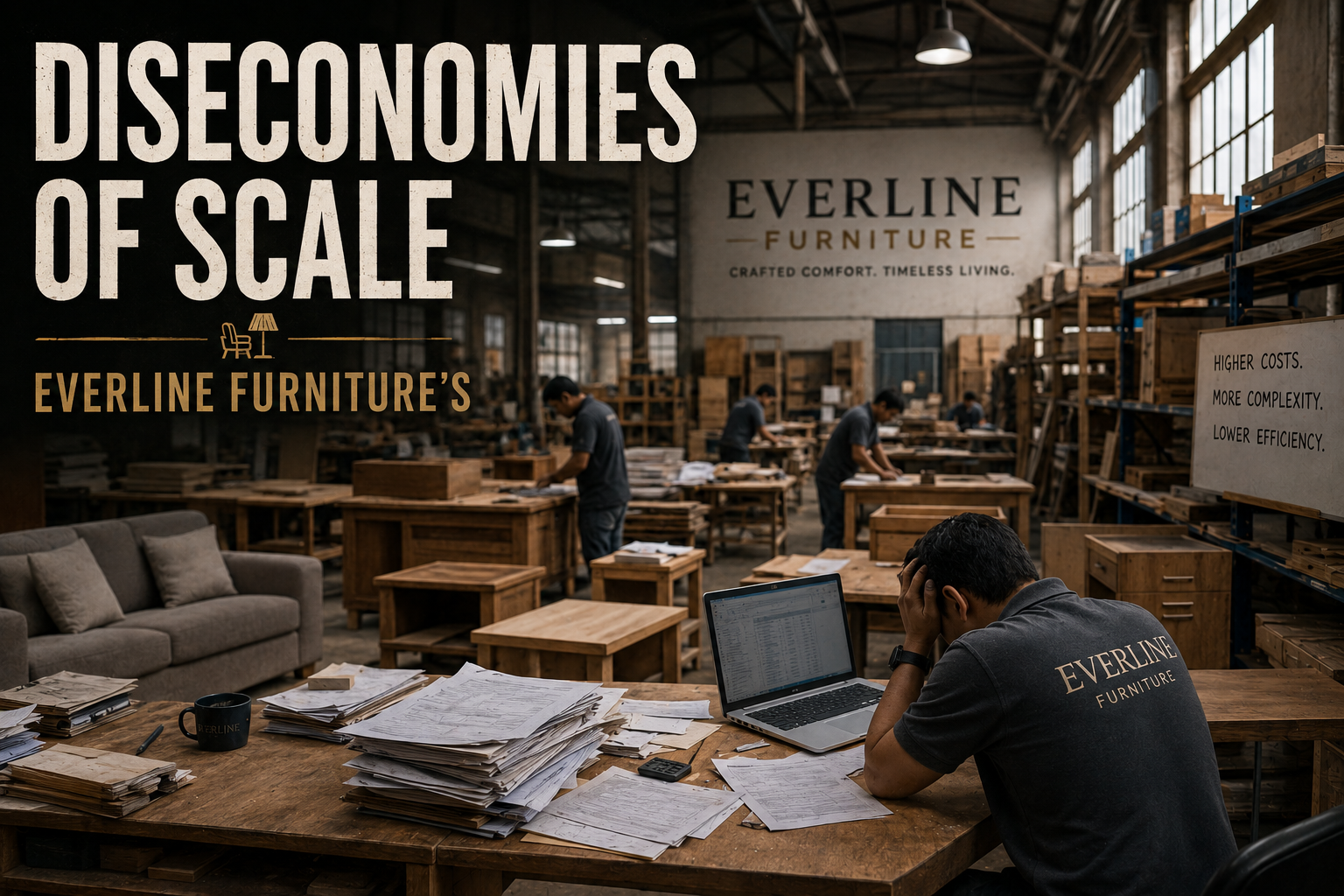
Why does a large company sometimes produce each unit of its product more expensively than it did when it was smaller? The answer lies in an economic idea called diseconomies of scale. To show exactly how and why this happens, this article follows a single example, a furniture maker named Everline Furniture, through the stage where its growth stopped paying off.
Diseconomies of scale means that as a business grows past a certain size, the cost of producing each unit starts to rise instead of fall. This is the opposite of economies of scale, where growth lowers the cost per unit. Every business eventually reaches a point where further growth stops helping and starts hurting, and this article explains why.
Table of Contents
Where Diseconomies Begin
Everline Furniture started as a single factory making wooden chairs. As it grew, it enjoyed the usual benefits of economies of scale: bulk discounts on timber, efficient machinery, and specialist managers who each did one job well. Cost per chair fell steadily for several years. Growth did not keep paying off forever, though.
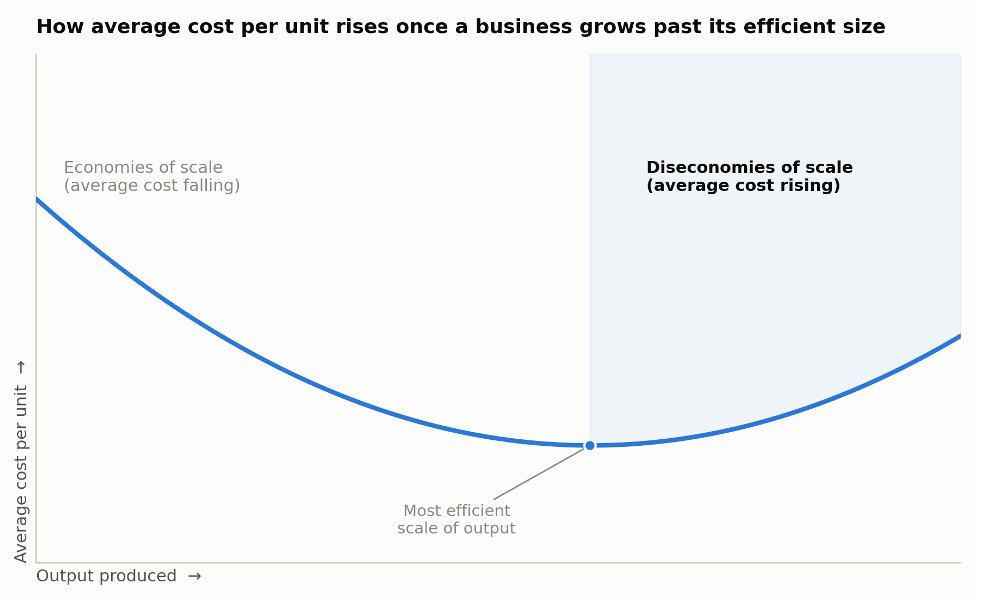
The chart above shows this pattern in general terms. As a business grows toward its most efficient size, its average cost per unit falls. Past that point, diseconomies of scale take over, and the average cost per unit begins to climb again. The rest of this article explains what causes that climb, using Everline Furniture as the example throughout.
What Diseconomies of Scale Really Mean
At its efficient size, Everline Furniture ran a single well-organised factory producing two thousand chairs a week. To see exactly why its cost per chair later rose, it helps to assume real numbers for both stages and add them up, rather than simply saying costs went up.
The table below lists Everline Furniture’s assumed weekly costs at its efficient size.
| Materials (2,000 chairs × $20) | $40,000 |
| Labour (2,000 chairs × $25) | $50,000 |
| Management and coordination | $10,000 |
| Rework and quality corrections | $2,000 |
| Total weekly cost | $102,000 |
| Chairs produced | 2,000 |
| Cost per chair | $51.00 |
Some years later, Everline expanded quickly into several new factories to chase higher sales, reaching six thousand chairs a week. The table below lists its assumed weekly costs at this larger, overexpanded size.
| Materials (6,000 chairs × $18) | $108,000 |
| Labour (6,000 chairs × $27) | $162,000 |
| Management and coordination | $54,000 |
| Rework and quality corrections | $36,000 |
| Total weekly cost | $360,000 |
| Chairs produced | 6,000 |
| Cost per chair | $60.00 |
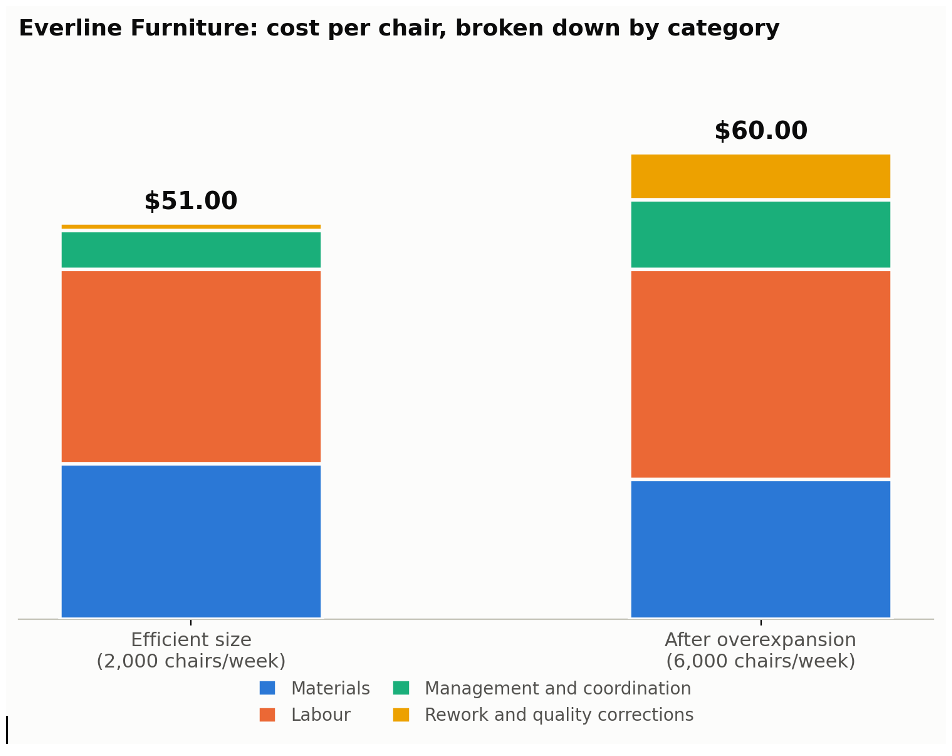
Not every cost rose per chair. Materials actually became slightly cheaper per chair, from $20 to $18, because Everline could still negotiate bulk discounts on timber at a larger order size. If materials were the only cost that mattered, growth would have kept paying off. It was not the only cost that mattered.
Labour cost per chair rose slightly, from $25 to $27, even though Everline was paying for many more workers overall. Spread across several new factories with unclear instructions between them, each worker on average produced a little less than before. Management and coordination cost per chair rose sharply, from $5 to $9, because running several factories required many more supervisors, regional managers, and approval layers than one factory ever needed. Rework and quality corrections rose the most of all, from $1 to $6 per chair, as workers had to fix mistakes caused by poor communication between sites after the fact.
Add these four costs per chair together, and the total rises from $51.00 at the efficient size to $60.00 after overexpansion, a clear example of diseconomies of scale at work, as the chart below shows. The chairs themselves did not change. What changed was the business becoming too large to run as smoothly as it once did, and that alone was enough to push the cost up.
The Two Main Types of Diseconomies of Scale
Economists usually divide diseconomies of scale into two groups: internal and external. Internal diseconomies of scale come from problems inside the business itself. External diseconomies of scale come from problems in the wider industry and location in which the business operates. The following sections explain both, using Everline Furniture as the example throughout.
Internal Diseconomies of Scale
Communication. When Everline was a single factory, instructions from managers reached the workers on the floor directly and clearly. After it expanded to several factories connected through layers of regional supervisors, the same instructions passed through many hands before reaching the workers, and each handoff dropped or altered a detail along the way. Workers at some factories assembled batches of chairs to outdated specifications because a correction never reached every site in time.
Coordination. In the single factory, one production planner scheduled all the work and could see the whole operation at a glance. Once Everline operated across several factories, each site began scheduling its own work with little visibility into what the others were doing, and two factories sometimes produced the same order at once while a different order sat delayed. This duplicated effort raised costs without producing any chairs Everline could actually sell.
Motivation. In the small factory, each worker knew the owner and could see their own part in a shipment leaving that week. In the much larger operation, workers on the assembly line rarely saw the finished product or met anyone above their immediate supervisor, and many felt like an anonymous part of a large machine. This drop in motivation showed up directly in the rework figures, since distracted or disengaged workers made more assembly mistakes than before.
Bureaucracy and decision-making. A simple decision, such as approving a new fabric supplier, once took the owner a single afternoon. After Everline added several layers of regional and department managers, the same decision had to pass through approval from multiple people before it could proceed, and what once took an afternoon began taking several weeks. The extra managers hired to handle this approval chain added directly to the management and coordination cost shown earlier.
Technical. The original factory’s machinery ran comfortably within its designed capacity, and maintenance was predictable. To meet the higher output target, some newer factories ran their machines for more hours than the design allowed, which led to more frequent breakdowns and higher repair bills. These unplanned stoppages slowed production further and raised the cost of every chair made during the downtime.
External Diseconomies of Scale
A reasonable question is worth asking here too. If many furniture factories operate in the same industrial town, should this not still lower costs for everyone, through shared training, shared suppliers, and shared infrastructure, exactly as it once did? For a while, it did. A cluster of firms can also grow too large for its own good.
When the town where Everline operates had a modest number of furniture factories, shared infrastructure kept costs low for every firm there: trained carpenters were easy to find, timber suppliers competed for business, and the roads and power supply comfortably handled the traffic. As hundreds more factories set up in the same town, competition for the same carpenters, warehouse space, and electricity became intense, and wages, rent, and power costs rose sharply for every firm in the town, not only Everline. Roads built for a modest industrial town became congested with delivery trucks, slowing supply lines for every factory operating there.
Shared infrastructure no longer offsets these rising costs, because congestion now overwhelms the infrastructure itself. This is external diseconomies of scale: when the whole industry around a location grows so large that congestion and competition for resources raise costs for every firm operating there, regardless of what any single firm chooses to do on its own.
Why This Concept Matters
Diseconomies of scale shape decisions far beyond a single furniture maker. Investors consider it when they judge whether a company expanding quickly can keep its costs under control at a much larger size. Executives consider it when they decide whether to grow a business as one large operation or split it into smaller, more independent units. Large real-world companies have run into this problem directly: retailers and manufacturers that expanded too quickly have had to close factories or restructure management layers after growth stopped paying off.
Students of business and economics encounter diseconomies of scale often, because it explains why very large organisations sometimes lose out to smaller, more focused competitors. It explains why some companies deliberately choose to stay a certain size rather than grow further. It also explains why many large firms split themselves into smaller, semi-independent divisions, an attempt to keep the benefits of scale while avoiding the coordination problems that come with being too large.
Final Thoughts
Diseconomies of scale is not a complicated idea once you break it down into its parts. As Everline Furniture’s example shows, growth that once lowered the cost per unit can eventually raise it instead, once a business becomes too large to communicate, coordinate, and manage efficiently. Recognising the warning signs, rising overhead, more errors, and slower decisions, allows a business to address them before costs climb too far. Understanding both economies and diseconomies of scale together gives a much clearer view of how real businesses actually grow.
References
Sloman, J., Garratt, D. and Guest, J. (2024) Economics. 11th edn. Harlow: Pearson.
Corporate Finance Institute (2019) Diseconomies of Scale: Guide and Examples of Rising Marginal Costs. Available at: https://corporatefinanceinstitute.com/resources/economics/diseconomies-of-scale/ (Accessed: 30 August 2026).
For more such content explore: Business Concepts & Terms by The Venture Journal