
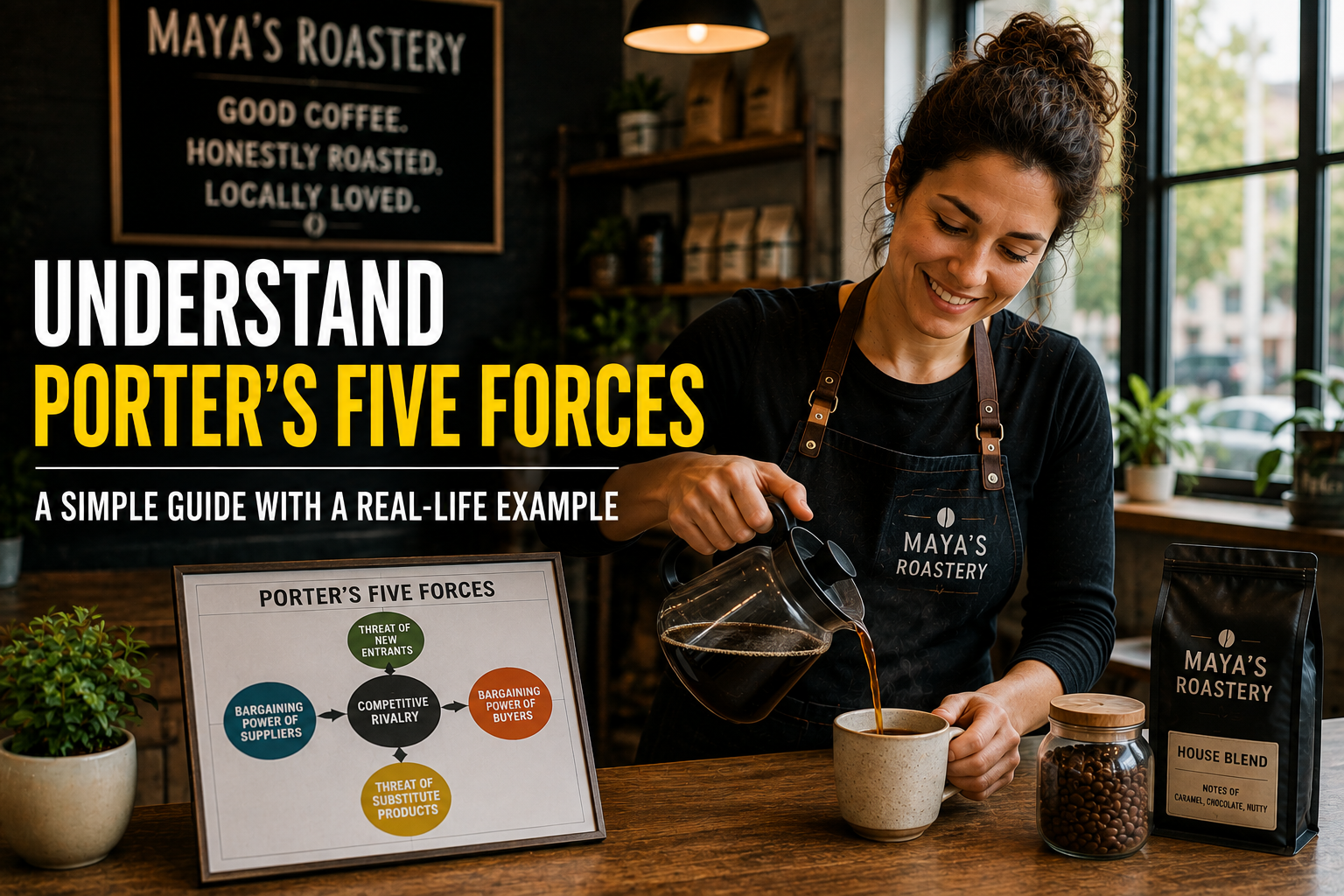
Maya spent two years perfecting her coffee before she opened her small roastery on the edge of town, and by most measures, she got it right. Her beans were sourced well, her roasting was consistent, and the regulars who found her in that first year kept coming back. Yet eighteen months in, her margins were thinner than she had expected, a national chain had opened three streets away offering a nearly identical flat white for less, and two of her longtime suppliers had quietly raised their prices within the same quarter. None of this was really about the coffee itself. It was about the industry Maya had stepped into, and the forces pressing on it from every direction, mostly invisible until they weren’t.
This is the gap that Porter’s Five Forces was built to close. Where a SWOT analysis looks at a business from the inside out, and a PESTLE analysis studies the sweeping political and economic weather around it, Porter’s framework zooms in on something narrower and, for many owners, more immediately useful: the specific competitive pressures inside the industry a business actually competes in.
If you’ve already read our earlier pieces on SWOT analysis and how a business can scan its wider environment with PESTLE analysis, this framework fits neatly alongside both, and this guide follows Maya’s roastery throughout to show exactly how it works in practice.
Table of Contents
Where Porter’s Five Forces Came From
Unlike SWOT and PESTLE, both of which drifted into their final shape through decades of quiet edits by different hands, Porter’s Five Forces has an origin story that is refreshingly easy to pin down. Michael E. Porter, then a young professor at Harvard Business School, published an article titled ‘How Competitive Forces Shape Strategy’ in the March–April 1979 issue of Harvard Business Review, volume 57, pages 137 to 145 (Porter, 1979). It was his first piece for the publication, and it would go on to become one of the most cited pieces of business writing of the twentieth century.
Porter’s central argument broke from how most people thought about competition at the time. Business owners tended to assume that rivalry meant watching the competitor across the street, the other firm selling roughly the same thing. Porter, drawing heavily on ideas from industrial organisation economics rather than case study folklore, made the case that a company’s profitability was shaped by five distinct pressures acting on its industry as a whole, only one of which was direct rivalry between existing competitors. A business could be doing everything right and still struggle, simply because it operated in an industry where suppliers held all the leverage or where new competitors could enter with almost no friction.
A year later, Porter expanded the article into a full book, Competitive Strategy: Techniques for Analyzing Industries and Competitors, published in 1980 by the Free Press in New York (Porter, 1980). The framework has barely changed since. Porter revisited it himself nearly three decades later in a follow-up Harvard Business Review piece, reaffirming that the five forces still explained industry profitability even as markets had grown more global and more digital (Porter, 2008). Few strategy tools from the same era have aged this well without needing a rebrand.
What Porter’s Five Forces Actually Measures
At its core, the framework asks a fairly blunt question: how much of the value your business creates will you actually get to keep, once every other player in your industry has taken their share? Porter identified five groups capable of pulling that value away from a business, or alternatively, making it easier to hold onto.
Four of these forces sit around the edges of an industry, pressing inward: the threat of new entrants, the bargaining power of suppliers, the bargaining power of buyers, and the threat of substitute products. The fifth, competitive rivalry, sits at the centre, shaped by how the other four are behaving at any given moment. None of the five forces work in isolation, which is really the whole point of the model, and Maya’s coffee roastery turns out to be a fairly clean example of how they interact.
Threat of New Entrants
This force asks how easily someone new could walk into your industry and start competing with you tomorrow. In Maya’s case, the answer stung a little: not very difficult at all. Opening a small coffee shop requires modest capital compared with, say, launching an airline or a semiconductor plant, and the skills involved, while real, aren’t especially rare. That national chain that opened three streets away didn’t face much in the way of obstacles.
Industries with low barriers to entry tend to see profits get squeezed over time, since anyone attracted by early success can simply join in. High barriers, whether they come from expensive equipment, strict regulation, or brand loyalty built over decades, tend to protect the businesses already inside. Maya’s roastery sits on the vulnerable end of that spectrum, which meant she needed to build defences that didn’t rely on scarcity alone.
Bargaining Power of Suppliers
Suppliers hold power when there are few of them, when switching between them is costly or slow, or when the product they provide has no easy substitute. Maya sources her beans from a small number of specialty importers, and when two of them raised prices within the same quarter, she had little room to push back. Finding an equally reliable supplier of the specific bean varieties her customers had come to expect wasn’t something she could do overnight.
This is where the framework earns its keep as a planning tool rather than just a description of the obvious. Recognising supplier power early gives a business owner room to diversify sourcing, negotiate longer contracts, or build relationships with backup suppliers before a price increase forces the issue.
Bargaining Power of Buyers
Customers hold power under fairly similar conditions: when they have plenty of alternatives, when switching costs them little, and when they’re price sensitive rather than loyal. Coffee drinkers, as a rule, are not famous for their brand loyalty. A customer who finds Maya’s flat white a dollar cheaper down the street will often just go there instead, with no real cost to switching beyond a short walk.
Maya’s response wasn’t to compete purely on price, which would have been a losing game against a national chain with far deeper pockets. Instead, she leaned into the things that made switching feel like a genuine loss rather than a minor inconvenience: a loyalty programme, a roasting process she was transparent about, and a physical space regulars had grown attached to. None of these fully eliminate buyer power, but they soften it considerably.
Threat of Substitute Products
A substitute isn’t a direct competitor selling the same thing. It’s a different product entirely that satisfies the same underlying need. For Maya, the obvious substitutes aren’t other coffee shops at all, but energy drinks, bottled iced tea, and increasingly capable home espresso machines that let customers make something close to a café-quality drink without leaving their kitchen.
This force is easy to overlook precisely because substitutes rarely look like competitors on the surface. Nobody thinks of a home espresso machine as a rival business, yet every cup made at home is a cup not bought from Maya. Industries facing strong substitute pressure usually need to compete on something substitutes can’t easily replicate, in Maya’s case, the atmosphere, the social ritual of sitting down, and the quality control that a five-hundred-dollar home machine still struggles to match.
Competitive Rivalry
This is the force most people picture when they hear the word competition, and it sits at the centre of the model because it’s shaped by everything happening in the other four. Maya’s direct rivalry looks fierce partly because entry barriers are low, meaning new cafés keep appearing, and partly because buyers switch easily, meaning existing cafés have to fight hard for loyalty rather than assuming it.
Rivalry tends to intensify when competitors are numerous and similarly sized, when the industry is growing slowly rather than quickly, and when the product itself is hard to tell apart from one seller to the next. Specialty coffee ticks most of these boxes in Maya’s town, which is part of why she felt the squeeze so quickly after opening.
Reading the Five Forces Together
Studying each force on its own tells only part of the story. The real value of the framework shows up once you see how the five interact and reinforce each other.
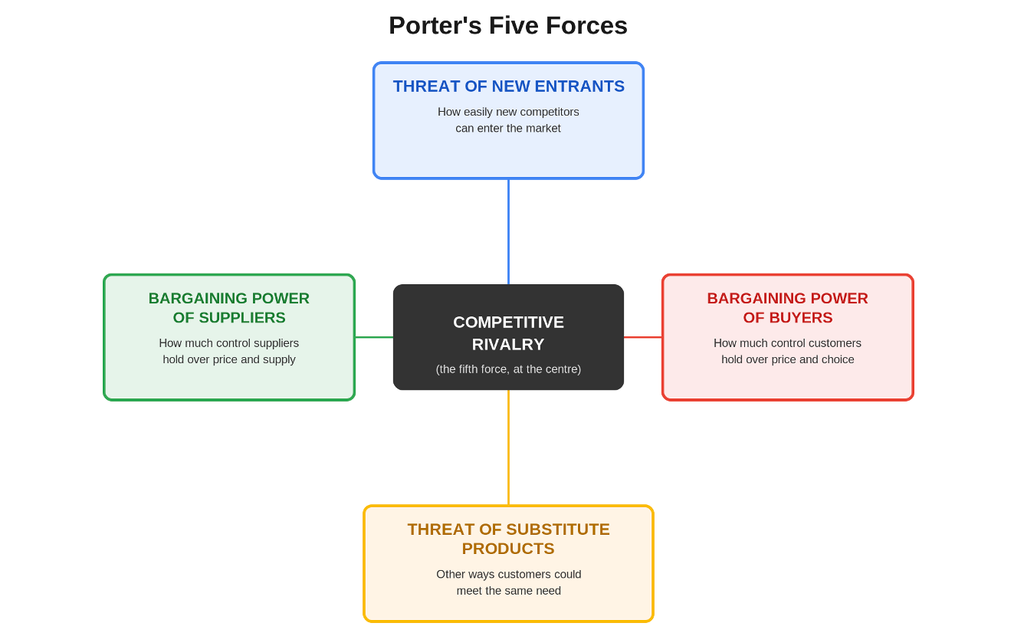
Low barriers to entry feed directly into intense rivalry, since new competitors keep arriving. Strong buyer power feeds into rivalry too, since customers who switch easily force existing businesses to compete harder just to keep them. Supplier power squeezes margins from the other side, leaving less room to absorb the pressure created by rivalry and buyer power at once. Seen together, Maya’s situation wasn’t really about one bad force. It was about several moderate pressures compounding on top of each other, which is a far more common pattern than a single dramatic threat.
What Maya Did With the Picture
Understanding the five forces only matters if it changes what a business actually does, so it’s worth being specific about Maya’s response. To soften buyer power, she introduced a loyalty card and started hosting monthly cupping sessions that turned casual customers into people who felt genuinely invested in her roastery. To manage supplier power, she signed a longer contract with her most reliable importer and began sourcing a secondary bean variety from a different region, reducing how exposed she was to any single price increase.
Against the threat of substitutes, she leaned harder into the parts of the experience a home machine or a canned drink couldn’t offer, extending her seating area and running weekend tasting events. And rather than trying to out-discount the national chain on rivalry, she picked a lane the chain wasn’t built to compete in, positioning her roastery as the place serious coffee drinkers went for beans they couldn’t get anywhere else in town.
Does This Apply to Small Businesses Too?
Porter originally wrote this framework with large industries in mind, oil, airlines, pharmaceuticals, the kind of sectors Harvard Business Review’s readers ran in 1979. It’s tempting to assume it doesn’t translate to a business the size of Maya’s roastery, but the underlying logic scales down just fine. Every business, regardless of size, sits inside an industry shaped by these same five pressures. What changes at a smaller scale isn’t whether the forces apply, but how directly an individual owner can respond to them without a boardroom or a strategy department standing in the way.
If anything, small businesses often feel these forces more sharply than large ones, since they carry less cushion to absorb a price increase from a supplier or a sudden new competitor down the street.
Common Ways This Analysis Falls Apart
The most frequent misstep is defining the industry too narrowly, the way Maya might have if she’d only considered other coffee shops as competition and ignored energy drinks and home brewing altogether. A framework built around five forces is only as useful as the boundaries drawn around the industry itself.
A second common problem is treating the analysis as a one-time exercise rather than something worth revisiting as conditions shift, much like the SWOT and PESTLE habits we’ve covered elsewhere. Supplier power that felt manageable last year can tighten considerably within a few quarters, as Maya discovered firsthand. A third issue is confusing strong rivalry with an unwinnable position. Intense competition doesn’t mean a business can’t succeed, it just means the strategy needs to account for pressure from multiple directions rather than assuming a good product will be enough on its own.
Closing Thoughts
Porter’s Five Forces won’t tell a business owner exactly what to do next, and it was never really designed to. What it offers instead is a sharper set of questions to ask about the industry surrounding a business, questions most owners never think to ask until a competitor undercuts them or a supplier tightens the screws unexpectedly.
It’s worth sitting down with a page divided into five sections, or sketching the wheel shown earlier, and working through each force honestly for your own business. Anyone who has already mapped out a SWOT analysis or a PESTLE analysis for the same business will find this framework fills in a piece the other two don’t quite reach, the specific structure of the industry itself, rather than the business alone or the world at large. Whether you’re running a coffee roastery like Maya, a small agency, or something you’re still only sketching out, understanding these five pressures is what separates a business that reacts to its industry from one that reads it in advance.
References
Porter, M.E. (1979) ‘How competitive forces shape strategy’, Harvard Business Review, 57(2), pp. 137–145.
Porter, M.E. (1980) Competitive Strategy: Techniques for Analyzing Industries and Competitors. New York: Free Press.
Porter, M.E. (2008) ‘The five competitive forces that shape strategy’, Harvard Business Review, 86(1), pp. 78–93. Available at: https://hbr.org/2008/01/the-five-competitive-forces-that-shape-strategy (Accessed: 17 August 2026).



[…] piece is part of the same series as our guides to SWOT analysis, PESTLE analysis, Porter’s Five Forces, and the BCG Matrix. We will use Zara’s juice bar throughout, so you can see how the Ansoff […]
[…] piece is part of the same series as our guides to SWOT analysis, PESTLE analysis, Porter’s Five Forces, the BCG Matrix, and the Ansoff Matrix. We will follow Mateo’s restaurants throughout, so you […]