

Nadia runs a small bicycle shop, and over the years it has quietly turned into four different businesses under one roof. She sells road bikes, she repairs bikes of every kind, she recently started selling e-bikes, and she keeps a small shelf of kids’ training wheels and accessories near the back door. For a long time she treated all four as one single shop and gave each one roughly the same amount of care and money. Then, on a slow February afternoon, she sat down with her sales numbers spread across the counter and noticed something she had never really seen before. She was not running one business. She was running four, and they were not doing equally well.
This is the situation the BCG Matrix helps with. It is a simple way to look at everything a business sells, one part at a time, and ask a clear question about each one: is this part worth the time and money going into it, and if so, what should happen to it next?
This guide is part of a small series on The Venture Journal, alongside our earlier guides to SWOT analysis, PESTLE analysis, and Porter’s Five Forces. We will follow Nadia’s bike shop through the whole piece, since watching the BCG Matrix work on a real shop is much easier to follow than reading about it in the abstract.
Table of Contents
Where the BCG Matrix Came From
The BCG Matrix takes its name from the Boston Consulting Group, and the story starts with the firm’s founder, Bruce Henderson. In 1970, Henderson wrote a short essay called The Product Portfolio, published by the firm. In it, he argued that a company should stop looking at everything it sells as one big pile. Instead, he said, each product or business line should be judged on its own, the way an investor looks at each stock in a portfolio rather than treating the whole portfolio as a single thing (Henderson, 1970).
One detail rarely makes it into the popular version of this story. The BCG Matrix is often described as Henderson’s own idea. But according to the firm’s own account of its history, a colleague named Alan Zakon, who later became the firm’s chief executive, actually drew the first two-by-two grid on paper. Henderson and the rest of the team then shaped the idea further before it was published under his name (BCG, 2014). Strategy tools often work this way. One name ends up attached to work that really came from a small group of people thinking it through together.
The timing helped the idea spread fast. By the late 1970s and early 1980s, close to half of all Fortune 500 companies were using the BCG Matrix, often called the growth-share matrix in more formal writing, to decide where to spend money and where to pull back (BCG, 2014). Harvard Business Review later named it one of the frameworks that changed how companies think about strategy, which is a strong claim for a tool built from just two lines and four boxes.
What the BCG Matrix Actually Does
In plain terms, the BCG Matrix takes everything a business sells, whether that means separate products, services, or even entire divisions, and places each one on a simple chart. One side of the chart shows how fast the market for that product is growing. The other side shows how big a share of that market the business holds compared to its strongest rival.
Those two questions create four boxes, and the BCG Matrix gives each box a name and a rough piece of advice: Stars, Cash Cows, Question Marks, and Dogs. Nadia’s four product lines, road bikes, repairs, e-bikes, and kids’ accessories, happen to land almost perfectly into these four boxes, which makes her shop a good way to see the BCG Matrix at work.
Stars: The Part of the Shop Worth Backing
A Star sits in a market that is growing fast, and the business already holds a strong place in it. For Nadia, that is her road bike line. More people in her city have taken up cycling over the past few years, helped along by new bike lanes and a general push toward outdoor exercise, and her shop has built a strong name for road bikes specifically. Customers now drive in from other parts of the city just for her advice and her selection. That combination of a growing market and a strong position is exactly what turns a product into a Star on the BCG Matrix.
In the BCG Matrix, a Star usually deserves more investment, not less, since the goal is to keep up with a market that is still growing. Pulling back on a Star just because it is doing well is often the wrong move. Nadia has kept putting money from her road bike sales back into better stock and better-trained staff, which is close to what the framework would suggest here.
Cash Cows: The Steady Earner
A Cash Cow sits in a market that has stopped growing much, but the business still holds a strong place in it, and it brings in steady money without asking for much fresh investment. Nadia’s repair and servicing counter fits this box well. The BCG Matrix expects a business like this to behave in a fairly predictable way, and Nadia’s repair counter does exactly that, month after month. Demand for bike repairs in her city is not growing fast, since most people who own a bike already know where they take it, but her shop has earned enough trust over the years that customers keep coming back rather than trying somewhere new.
The usual advice for a Cash Cow is to keep it running smoothly without pouring extra money into it, and to let the steady income fund the parts of the business that need more help. In Nadia’s shop, the repair counter pays most of the monthly bills, which frees her up to take bigger risks elsewhere. It is the steady box the BCG Matrix expects a Cash Cow like this to fill.
Question Marks: The Hard Call
A Question Mark sits in a market that is growing fast, but the business has not yet built much of a place in it. Nadia’s e-bike line fits here closely. E-bikes are one of the fastest-growing parts of her local market right now, but she only started selling them eighteen months ago, and a few well-known e-bike shops already lead the way. Her share of that growing market is still small.
This is the hardest box in the BCG Matrix to make a decision about, and it is meant to be hard. A Question Mark can grow into a Star with the right investment, or it can quietly lose money for years without ever really taking off. Nadia’s choice here is not obvious, and that is exactly why the framework treats this box differently from the other three instead of offering an easy answer.
Dogs: The Shelf Nobody Talks About
A Dog, in the language of the BCG Matrix, sits in a market that is not growing much, and the business has not built a strong place in it either. Nadia’s shelf of kids’ training wheels and accessories lands here. Demand for these items has stayed flat for years, and a few large stores and online sellers dominate this part of the market with prices Nadia cannot match.
The usual advice for a Dog is to fix it, sell it, or drop it, since it tends to take up space and time without giving much back. That said, the label can be harsher than it deserves. Some Dogs still serve a small purpose, such as bringing parents into the shop who then look at road bikes for themselves, which is worth thinking about before clearing the shelf completely.
Looking at the Whole Shop Together
Looking at each product on its own is helpful, but the BCG Matrix becomes far more useful once all four sit on the same chart at the same time.
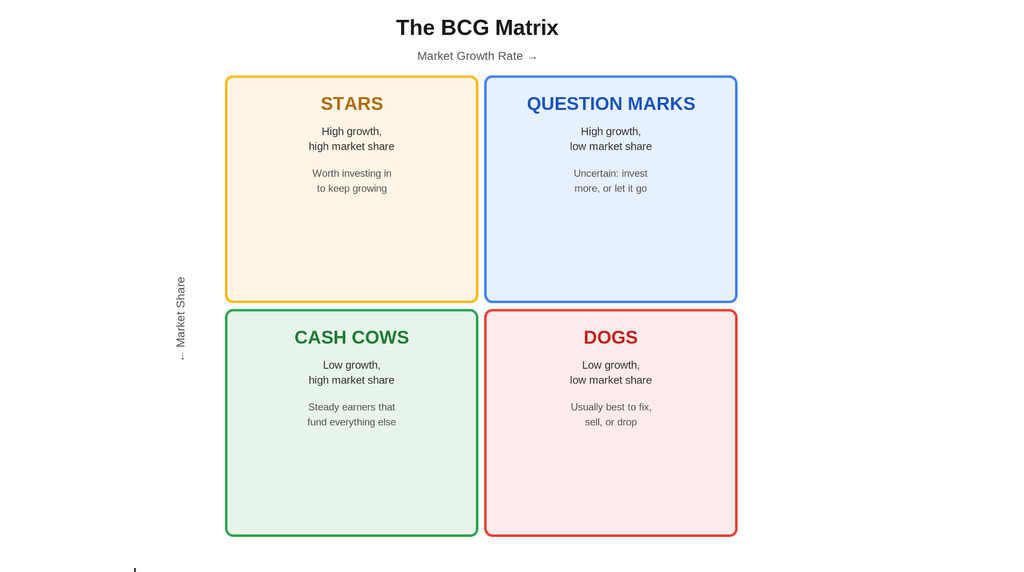
This is where the BCG Matrix really earns its place on the counter, since four boxes side by side can say more than a stack of spreadsheets ever could. Seen together, the chart told Nadia something she had never quite put into words before. Her Cash Cow, the repair counter, was quietly paying for a Question Mark, the e-bikes, that had not yet proven itself, while a Dog, the kids’ accessories, sat there taking up shelf space that might do more good elsewhere. None of these facts were new to Nadia on their own. What changed was seeing all four parts of her shop side by side on one page, instead of thinking about each one alone.
What Nadia Did Next
A chart on paper only matters if it leads to a decision, so here is what Nadia actually did after working through the BCG Matrix for her own shop. She kept investing in road bikes, ordering more stock ahead of spring while the market was still clearly on her side. She left the repair counter mostly alone, since it was already working well, and simply made sure it stayed fully staffed rather than trying to grow it further.
The harder calls were the other two. For e-bikes, she chose to push forward rather than pull back, using some of the repair counter’s steady income to fund a proper e-bike display and train a staff member on the technology, betting that a focused push now could still win her a real place in that market. For the kids’ accessories shelf, she cut it down but did not remove it, keeping a small selection mainly because parents buying training wheels often stayed to look at road bikes too, which made the shelf worth a little space even though it barely turns a profit on its own. That kind of trade-off, weighing a small loss in one box against a gain in another, is exactly the sort of decision the BCG Matrix is meant to make easier to see.
Does a Small Business Even Need the BCG Matrix?
Bruce Henderson built this framework with large companies in mind, the kind of firms BCG worked with in 1970. It is easy to assume the BCG Matrix does not apply to a shop the size of Nadia’s, but four product lines is really all it takes to make the exercise worthwhile. Even a business with only two things to sell can gain from asking which one is doing the heavy lifting and which one is still just an experiment.
What matters is not how big the business is, but whether it sells more than one thing. The moment a business has more than one product or service, some part of it is quietly working harder than the rest, and the BCG Matrix simply gives that gap a name and a place to sit.
Where People Get the BCG Matrix Wrong
The most common complaint about the BCG Matrix, and a fair one, is that market share and market growth are not the only things that decide whether a product is worth keeping. A Dog might still matter for reasons the chart does not capture, the way Nadia’s kids’ shelf brings parents into the shop, and a Star in a booming market can still fail if it is run poorly.
A second mistake is treating the four boxes as fixed forever, rather than as a picture of one moment in time. Markets change, and a Question Mark that looks weak today can look very different in two years, just as Nadia’s e-bikes could become tomorrow’s Star or tomorrow’s Dog depending on the choices made now. Going back to the BCG Matrix every so often, in the same spirit as the SWOT and PESTLE habits covered elsewhere on this site, keeps it useful instead of letting it turn into an old snapshot mistaken for a permanent truth.
Closing Thoughts
The BCG Matrix will not tell Nadia, or anyone else, exactly what to do with a shop full of different products. What it does is make her be honest about where her time and money are actually going, compared with where they are paying off best, a gap that is easy to miss when you are running a business day to day instead of stepping back to look at the whole picture.
It is worth drawing the four boxes for your own business, no matter how many products or services you sell, and being honest about where each one sits right now. Read alongside the SWOT, PESTLE, and Five Forces guides on this site, the BCG Matrix fills in a piece the others do not quite cover. It is not about what is happening inside the business, or in the wider industry, but about which parts of what you already sell deserve more of your time, and which parts might quietly be costing you some.
References
Henderson, B.D. (1970) The Product Portfolio. Boston: The Boston Consulting Group. Available at: https://www.bcg.com/publications/1970/strategy-the-product-portfolio (Accessed: 17 August 2026).
BCG (2014) BCG Classics Revisited: The Growth Share Matrix. Available at: https://www.bcg.com/publications/2014/growth-share-matrix-bcg-classics-revisited (Accessed: 17 August 2026).