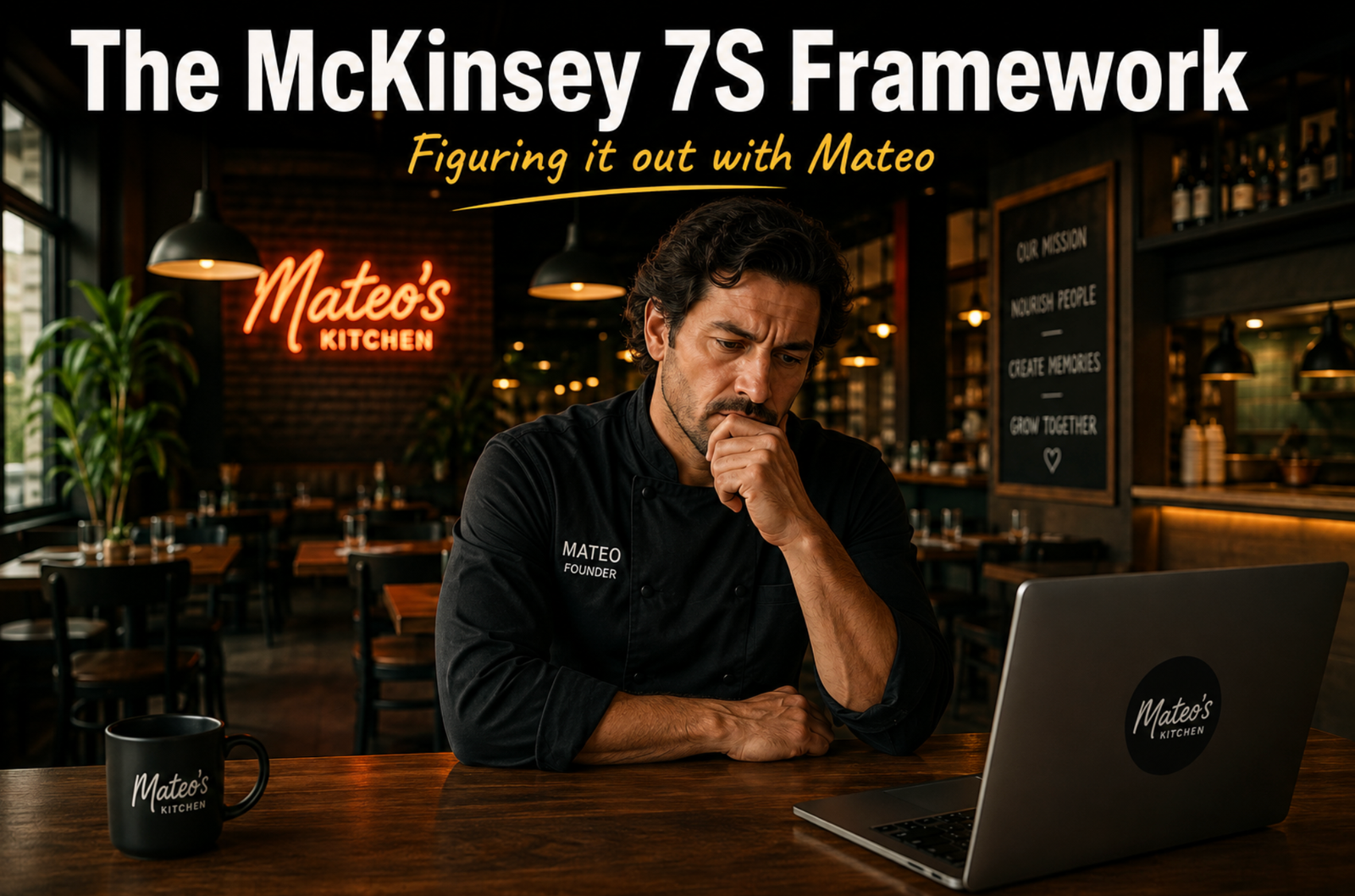
Mateo opened his first restaurant eight years ago, a small family place built around his grandmother’s recipes. It worked, and it worked well, mostly because Mateo was everywhere at once. He greeted regulars by name, corrected a dish himself if it left the kitchen wrong, and trained every new hire personally. Three years ago, riding that success, he opened a second location. Last year, a third. On paper, growth looked like a win. In practice, something felt off. The food at the new locations was good but not quite right. Staff turnover crept up. Regulars from the original restaurant started mentioning, gently at first, that the newer branches did not feel like Mateo’s.
Mateo had not changed his recipes. He had not changed his prices. He still believed in the same things he always had. Yet somehow, the business had come apart at the seams a little, in ways that were hard to pin on any single decision. This is precisely the kind of problem the McKinsey 7S Framework was built to diagnose, not a failure of strategy or recipes, but a quiet misalignment between the different parts of a business that are supposed to move together.
This piece is part of the same series as our guides to SWOT analysis, PESTLE analysis, Porter’s Five Forces, the BCG Matrix, and the Ansoff Matrix. We will follow Mateo’s restaurants throughout, so you can see how the McKinsey 7S Framework works on a business you can picture, rather than one built from theory alone.
Table of Contents
Where the McKinsey 7S Framework Came From
The story behind the McKinsey 7S Framework starts with a rival, which is a detail most summaries of the model leave out of most McKinsey 7S Framework explanations entirely. In the late 1970s, McKinsey & Company, the consulting firm, felt pressure from a younger competitor, Bruce Henderson’s Boston Consulting Group, the same firm behind the BCG Matrix covered elsewhere on this site. McKinsey’s newly appointed managing director, Ron Daniel, wanted to sharpen the firm’s thinking in response, and in 1977 he handed a consultant named Tom Peters an unglamorous assignment out of the firm’s San Francisco office: look into why clever strategies so often failed to actually get implemented (Peters, 2011).
Peters had recently finished a doctorate in organisational behaviour at Stanford, and he brought an unusual set of influences to the project, researchers who studied how decisions actually get made inside organisations, messily and imperfectly, rather than how they were supposed to happen on paper. He was soon joined by fellow McKinsey consultant Robert Waterman, and together they pulled in two outside academics, Richard Pascale and Anthony Athos of Harvard Business School, along with McKinsey’s Julien Phillips. At a two-day working session in San Francisco, the four of them sketched out what became the McKinsey 7S Framework, built around seven factors they believed every organisation needed to keep in balance (Peters, 2011).
One detail from that session says a lot about why the McKinsey 7S Framework caught on. Athos insisted that every factor’s name begin with the letter S, purely so the framework would be memorable. Peters later admitted he initially found the idea a little gimmicky, but came to credit the alliteration as a major reason the McKinsey 7S Framework outlived most of the consulting frameworks from the same era (Peters, 2011). The seven factors, Strategy, Structure, Systems, Shared Values, Skills, Style, and Staff, were split into what the team called Hard Ss, the formal, easily written-down parts of a business, and Soft Ss, the harder to measure parts involving people and culture.
The McKinsey 7S Framework first appeared in print in June 1980, in an article titled Structure Is Not Organization, written by Waterman, Peters, and Phillips for the journal Business Horizons (Waterman, Peters and Phillips, 1980). Pascale and Athos used it the following year in their own book, The Art of Japanese Management (Pascale and Athos, 1981), and it reached a much wider audience in 1982, when Peters and Waterman built their bestselling book In Search of Excellence around it, studying dozens of admired American companies through its lens (Peters and Waterman, 1982). More than four decades later, the McKinsey 7S Framework is still taught in business schools, a rare achievement for a model that began life as a secondary project in an unfashionable regional office.
What the McKinsey 7S Framework Actually Does
At its core, the McKinsey 7S Framework argues that a business is not one thing but seven interconnected things, and that a business struggles not necessarily because any one of those seven is broken, but because they have drifted out of alignment with each other. The seven elements the McKinsey 7S Framework tracks are Strategy, Structure, Systems, Shared Values, Skills, Style, and Staff.
Peters and his colleagues split these seven into two groups. Strategy, Structure, and Systems are the Hard Ss, the parts of a business that show up on paper: a written plan, an organisation chart, a documented process. Shared Values, Skills, Style, and Staff are the Soft Ss, the parts that are harder to pin down in a document because they live in how people actually think and behave day to day. A common mistake, one Peters himself pushed back against for most of his career, is assuming the Hard Ss matter more simply because they are easier to measure. In practice, the Soft Ss are often what determines whether the Hard Ss ever actually happen the way they were planned, which is the central tension the McKinsey 7S Framework was designed to expose.
Shared Values sits at the centre of the McKinsey 7S Framework’s diagram for a reason. All six other elements connect back to it, since a business’s underlying beliefs tend to shape everything else, whether people realise it or not. Mateo’s restaurants make a fairly clean illustration of this, since every one of the seven elements was present at all three locations, yet only at the original restaurant did all seven still point in the same direction.
Strategy: The Plan Behind the Growth
Strategy is the business’s plan for winning, the answer to the question of how it intends to succeed against its alternatives. For Mateo, the strategy was never complicated: serve genuinely authentic family recipes, made with care, in a warm and personal setting, and let word of mouth do the rest. That strategy had worked beautifully at one location for five years before he expanded, which is exactly the starting point the McKinsey 7S Framework asks a business to examine first.
The trouble was not that the strategy stopped making sense. It was that Mateo kept repeating the same strategic goal, authentic and personal food, at two new locations without asking what that strategy actually required once he was no longer the one cooking every dish and greeting every table. A strategy that depends entirely on one person’s personal presence is not really a strategy that scales, even if nobody wrote that limitation down anywhere. Strategy in the McKinsey 7S Framework is not just the goal on the page. It includes an honest account of what the goal demands from the rest of the business, which is exactly where Mateo’s plan started to strain.
Structure: Who Decides What, and Where
Structure covers who reports to whom, how decisions get made, and how authority is actually distributed across a business, regardless of what the org chart says. At Mateo’s original restaurant, structure barely existed as a formal concept, because Mateo made every meaningful decision himself, and the restaurant was small enough that this worked fine, long before the McKinsey 7S Framework ever entered the picture.
Once he had three locations, that same structure, everything running through Mateo personally, became a genuine bottleneck. Managers at the newer restaurants could not get quick answers on menu substitutions, staffing decisions, or vendor problems, because Mateo was often at a different location entirely. Nobody had formally been given the authority to make those calls in his absence, so decisions either stalled or got made inconsistently by whichever staff member happened to be present. Structure is easy to overlook precisely because it feels like an administrative detail rather than a strategic one, but a structure built for a one-location business rarely survives a three-location one without deliberate redesign, which is exactly the kind of gap the McKinsey 7S Framework is built to surface.
Systems: The Daily Routines Nobody Notices
Systems are the repeated processes and routines that keep a business running: how inventory gets ordered, how new staff get trained, how a shift gets scheduled, how a customer complaint gets handled. At the original restaurant, most of these systems lived entirely in Mateo’s head. He knew which supplier delivered the best tomatoes, he trained new cooks by working the line beside them, and he handled complaints personally, table by table, exactly the kind of undocumented Systems the McKinsey 7S Framework asks a business to notice before it becomes a problem.
None of that knowledge had ever been written down, which was not a problem when there was only one kitchen for it to live in. Once there were three kitchens, the absence of documented systems became one of the clearest sources of the inconsistency regulars were starting to notice. A new hire at the third location learned the recipes secondhand, from a manager who had learned them thirdhand, and small details drifted with each retelling. Systems are the least glamorous of the seven elements in the McKinsey 7S Framework, but they are often the most direct explanation for why a proven idea stops producing consistent results once it grows beyond the person who originally carried it.
Shared Values: What the Business Actually Believes
Shared Values are the underlying beliefs that guide decisions across a business, whether or not anyone has ever written them down as a formal mission statement. At Mateo’s first restaurant, the shared value was obvious to everyone who worked there: food this good and this personal is worth the extra effort, every single time, no shortcuts. Staff absorbed that belief simply by working alongside Mateo for months or years, the kind of quiet transfer the McKinsey 7S Framework treats as a Shared Values strength rather than an accident.
At the newer locations, staff had not had that same exposure. They had been told the value, in a handbook or a training session, but they had not lived inside it the way the original team had. Shared Values are the hardest of the seven elements to transfer deliberately, since they usually spread through example and repeated experience rather than instruction. This is also why Shared Values sits at the centre of the McKinsey 7S Framework’s diagram. When it drifts, everything connected to it, staff behaviour, service style, even how strictly systems get followed, tends to drift along with it, often before anyone notices the root cause.
Skills: What the Business Is Genuinely Good At
Skills are the capabilities a business actually possesses, as opposed to the ones it assumes it has. Mateo’s original restaurant was genuinely excellent at two things: cooking a specific style of food very well, and making customers feel personally looked after. Both skills were concentrated heavily in Mateo himself and in the small original team who had trained directly under him, which the McKinsey 7S Framework would flag immediately as a risk the moment the business tried to grow.
When he opened the second and third locations, he assumed those same skills would simply transfer along with the recipes and the branding. Some did. Cooking technique, being teachable through direct instruction, transferred reasonably well. The second skill, the personal warmth that made regulars feel like family, transferred far less reliably, because it was never taught as a skill in the first place. It had simply been Mateo, being himself, at a scale where he could still do it personally. Recognising which skills are genuinely embedded in a business, and which ones are really just one person’s individual talent wearing the business’s name, is one of the more uncomfortable but valuable exercises the McKinsey 7S Framework forces into the open.
Style: How Leadership Actually Behaves
Style, the sixth element of the McKinsey 7S Framework, refers to how leadership actually behaves day to day, not how a leader describes their own management approach, but the pattern staff genuinely observe and respond to. At the original restaurant, Mateo’s style was hands-on, warm, and highly visible. He was in the kitchen, on the floor, and available, and staff took their cues directly from watching him work, precisely the observable pattern the McKinsey 7S Framework labels as Style.
Spread across three locations, that same style became something closer to its opposite. Mateo was stretched thin, visibly stressed, and often absent from any one location for long stretches while he tried to be everywhere at once. Staff at the newer restaurants experienced a leader who seemed distracted and hard to reach, which is a strikingly different style from the one that had built the brand’s original reputation, even though Mateo’s underlying values had not changed at all. Style is one of the Soft Ss precisely because it cannot be fixed with a memo. It shows up in behaviour, under pressure, in real time, which makes it one of the harder elements to deliberately correct once it has drifted.
Staff: The People Who Carry It All Out
Staff, the final element of the McKinsey 7S Framework, covers who the business actually employs, how they are hired, developed, and retained, and whether the people in place are capable of carrying out the strategy the business has chosen. Mateo’s original team had mostly been hired slowly, trained personally by him over months, and had stayed for years, the kind of Staff foundation the McKinsey 7S Framework treats as a genuine asset rather than a coincidence.
Opening two new locations quickly meant hiring quickly too, and quick hiring left little room for the kind of gradual, hands-on training that had shaped the original staff. Turnover at the newer restaurants ran noticeably higher, which meant Mateo was frequently training brand-new staff rather than reinforcing standards with an experienced team, a cycle that made consistency even harder to achieve. Staff problems are often blamed on individual hires, this person was not a good fit, when the more accurate explanation is usually structural: a hiring and training system built for slow, personal onboarding was being asked to support rapid growth it was never designed for.
Seeing All Seven Elements Together
Looking at each of the seven elements on its own can make Mateo’s situation look like a string of unrelated problems: a training gap here, a staffing issue there, a leader spread too thin. The McKinsey 7S Framework’s real contribution is showing that these are not separate problems at all.
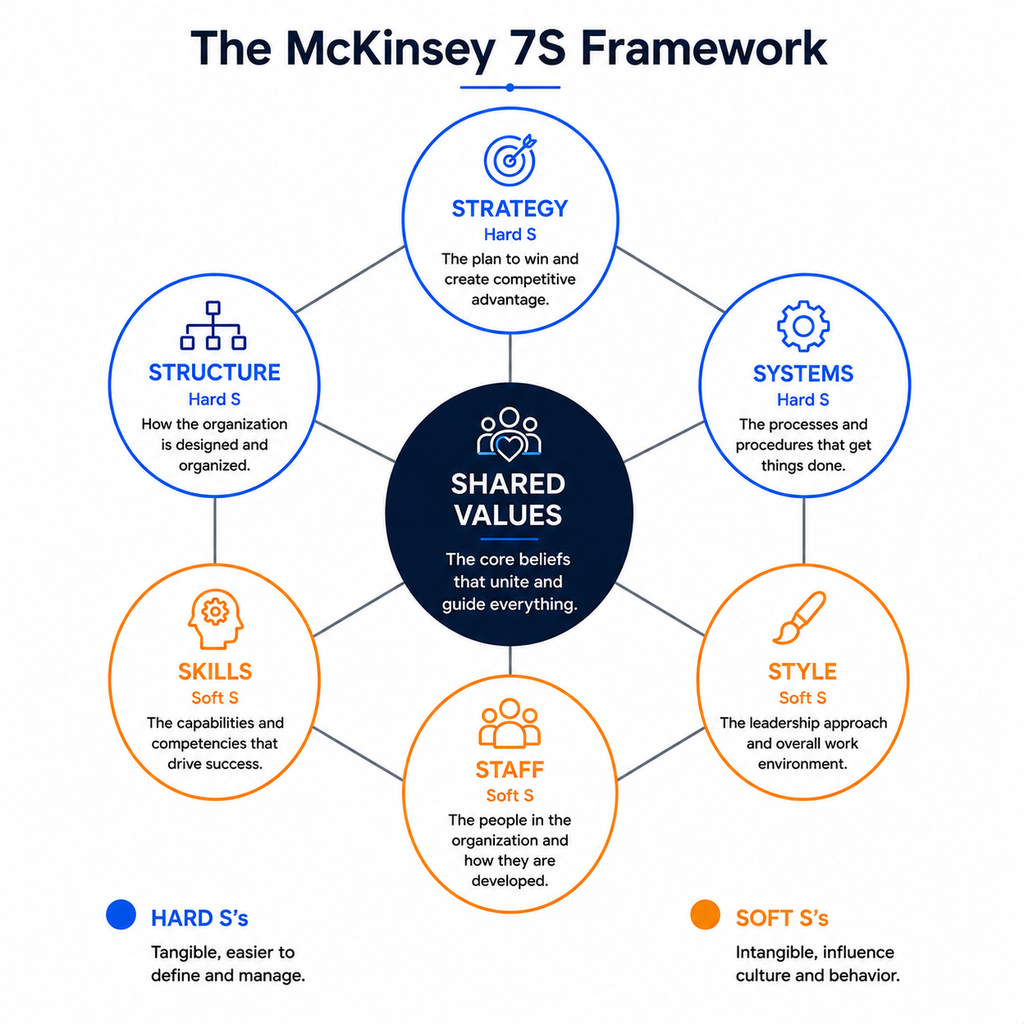
Laid out this way, the pattern in Mateo’s restaurants becomes clear. His Strategy never changed, but his Structure did not evolve to support it at scale, which strained his Systems, which weakened how well Shared Values transferred to new Staff, which affected which Skills actually made it into the newer kitchens, which shaped a Style that felt unrecognisable compared with the original restaurant. Every element on the McKinsey 7S Framework diagram connects to the centre, and to each other, precisely because a change in one rarely stays contained to that one box.
Why Alignment Matters More Than Any Single Element
It would be easy to read Mateo’s story and conclude that Structure, or Systems, was simply the broken piece that needed fixing. The McKinsey 7S Framework pushes back on that instinct deliberately. Peters and Waterman’s original argument was that no single element, however well designed, can compensate for the other six drifting out of step with it. A brilliant Structure paired with the wrong Staff still fails. Excellent Systems paired with Shared Values nobody actually believes in still produce inconsistent results.
This is really the model’s central insight, and it is easy to underestimate because it sounds almost too simple to be useful: alignment is not a nice-to-have layered on top of a good business. It is closer to being the business itself. Mateo did not have seven separate problems. He had one problem, alignment, that happened to show up in the seven different places the McKinsey 7S Framework asks a business to check.
What Mateo Did Next
A framework only matters if it changes what happens next, so it is worth being specific about what Mateo actually did once he had mapped his restaurants against the McKinsey 7S Framework. Working through the McKinsey 7S Framework in order of urgency, he started with Systems, since it was the most concrete place to begin. He spent six weeks documenting his core recipes precisely, down to specific measurements and techniques that had previously lived only in his head, and built a short, structured training programme new hires could go through consistently, regardless of which location they joined.
Next he addressed Structure, formally naming a head chef and a floor manager at each of the two newer locations, with clear authority to make day-to-day decisions without waiting for Mateo. This was uncomfortable for him at first, since it meant trusting decisions he could not personally oversee, but it also freed him to actually visit each location regularly instead of being perpetually stretched between all three, a Structure fix the McKinsey 7S Framework would call overdue.
Staff and Skills followed naturally from there. With clearer systems and real decision-making authority in place, he slowed his hiring pace and invested more in training the people he already had, rather than constantly replacing turnover with rushed new hires. Shared Values took the longest, since belief is not something a memo can install. He started holding a short weekly gathering across all three locations, in person when possible, simply to talk through what had gone well and what had not, the same kind of informal exposure that had built the original team’s values in the first place, just deliberately recreated at a larger scale, the last of the seven pieces the McKinsey 7S Framework had helped him identify.
Does This Work for a Small Business?
Peters and Waterman built the McKinsey 7S Framework while studying large, well-known corporations, and it is tempting to assume it only applies at that scale. Mateo’s business, three restaurants and a few dozen staff, is a fraction of the size of the companies in In Search of Excellence, yet every one of the seven elements the McKinsey 7S Framework tracks was already present and already causing him real, measurable problems.
What changes at a smaller scale is mostly the amount of formal documentation needed. A three-location restaurant does not need a corporate strategy department to think through its Structure or Systems, but it still benefits enormously from working through the McKinsey 7S Framework deliberately rather than letting each element evolve on its own, which is exactly what had quietly happened to Mateo’s business over three years of growth.
Where People Get the McKinsey 7S Framework Wrong
The most common mistake is treating the McKinsey 7S Framework as a checklist to work through once, ticking off each of the seven elements and moving on. The model was built to be revisited, since growth, new hires, and changing markets constantly push the seven elements out of alignment again, in much the same way the SWOT and PESTLE habits covered elsewhere on this site are meant to be revisited rather than filed away.
A second mistake people make with the McKinsey 7S Framework is over-focusing on the Hard Ss, Strategy, Structure, and Systems, because they are easier to write down and measure, while treating the Soft Ss as vague or secondary. Peters spent much of his later career arguing the opposite case, that Shared Values, Skills, Style, and Staff are usually what determines whether the Hard Ss ever get properly implemented at all. A third mistake, one Mateo very nearly made when he first sat down with the McKinsey 7S Framework, is trying to fix every element simultaneously rather than starting with the one or two that are creating the most immediate strain and letting the others follow.
How the McKinsey 7S Framework Fits Alongside Other Strategy Tools
The McKinsey 7S Framework tends to enter the picture after several of the other tools covered on this site, since it assumes a business already has a direction and is now trying to execute it well. A SWOT analysis would have told Mateo where his original restaurant was strong, largely in Skills and Shared Values, long before expansion diluted them. A PESTLE analysis might have flagged rising labour costs or shifting expectations around staff training that made rapid hiring riskier than it first appeared.
The Ansoff Matrix would have framed his three-location expansion as Market Development, taking an existing product to new customers in new locations, and flagged it correctly as carrying more risk than simply serving more regulars at his original restaurant, risk that eventually showed up as the very misalignment the McKinsey 7S Framework later helped him untangle. What none of those tools do, and what the McKinsey 7S Framework is specifically built for, is diagnose why an already-chosen growth path is struggling in execution. Strategy tools help a business decide where to go. The McKinsey 7S Framework helps explain why getting there is not going as smoothly as planned.
Closing Thoughts
The McKinsey 7S Framework will not tell Mateo, or anyone else, exactly how to run three restaurants instead of one. What it does is give a business owner seven specific places to look when something feels off in a way that is hard to describe precisely, and a reminder that the fix rarely lives in just one of those seven places alone.
It is worth mapping your own business against these seven elements, especially if something about it feels harder to run than it should, given that nothing on paper appears to have gone wrong. Read alongside the SWOT, PESTLE, Five Forces, BCG Matrix, and Ansoff Matrix guides on this site, the McKinsey 7S Framework answers a question none of the others quite reach: not what you are good at, or where you should grow next, but whether the different parts of the business you already have are still pulling in the same direction.
References
Waterman, R.H., Peters, T.J. and Phillips, J.R. (1980) ‘Structure is not organization’, Business Horizons, 23(3), pp. 14–26. Available at: https://tompeters.com/docs/Structure_Is_Not_Organization.pdf (Accessed: 17 August 2026).
Pascale, R.T. and Athos, A.G. (1981) The Art of Japanese Management. New York: Simon & Schuster.
Peters, T. and Waterman, R.H. (1982) In Search of Excellence: Lessons from America’s Best-Run Companies. New York: Harper & Row.
Peters, T. (2011) A Brief History of the 7-S (“McKinsey 7-S”) Model. Available at: https://tompeters.com/a-brief-history-of-the-7-s-mckinsey-7-s-model/ (Accessed: 17 August 2026).